Search This Blog

Monday, October 4, 2010

SITA SINGS THE BLUES (2009)

You know how sometimes there comes a project that so overwhelms you with its quality and singular charm that you wish the artistic hand and mind behind it nothing but further success and accolades? That's exactly how I feel with regard to cartoonist Nina Paley and the Herculean effort she put into SITA SINGS THE BLUES, a very personal and compelling take on the great ancient Indian epic RAMAYANA, a work that serves as one of the cornerstones of Hindu literature and culture. I was totally blown away by its cornucopia of seemingly incongruous music, mythic culture and imagery, and the film came from out of nowhere to find itself on the short list of my favorite animated films. (It's a great movie in general, but as animation it's a unique work.) Those of you who read this blog with any kind of regularity know that I'm a very tough audience, so take this review at face value.

Told in a number of contrasting visual styles, the film looks at the RAMAYANA as recounted by a trio of contemporary Indians discussing it amongst themselves, providing the Western newcomer with a greatly abbreviated version that retains all of the important bits of the narrative while infusing the piece with healthy doses of modern irreverence. The meat of the tale relates the disintegration of the relationship between Rama — the ideal of the "perfect" man and seventh avatar of Vishnu, the supreme Hindu god — and his wife, Sita — perhaps the example of the "perfect" Indian woman and spouse, also an avatar of the goddess Laxmi, consort to Vishnu — but unlike most interpretations of its source material, Paley's film has the audacity (and sanity) to call into serious question Rama's treatment of Sita, especially when all she does is be selfless to a fault. You see, due to the political machinations of one of his father's wives, Rama is sent away from his father's kingdom for fourteen years just as he's about to take the reigns of rule from his dad; the scheming wife seeks to elevate one of her sons to the throne by way of cashing in a carte blanche wish promised by Rama's father, so she figures that sending the rightful heir away for fourteen years will amount to a case of "out of sight, out of mind." The dutiful Sita accompanies her hubby into the wilderness and while there she catches the eye of the rakshasa Ravana (a rakshasa is a kind of evil spirit, best known in the West for being a "monster of the week" on KOLCHACK: THE NIGHT STALKER back in 1974), the king of the land of Lanka, who abducts her with the intention of making her his bride.

Ravana puts on the moves, much to Sita's displeasure.

That opens a major can of whupass in the form of a righteous and quite understandably offended Rama, who is aided by the monkey warrior Hanuman and his army of loyal monkey badassess, leading to all-out war between the forces of good an evil.

Rama leads the monkey army into battle against Ravana.

Upon Sita's rescue, Rama promptly rejects his wife, believing her to have submitted to her demonic captor's advances. We, the viewers, know that isn't the case thanks to us having witnessed the details of Sita's captivity and her steadfast belief in her man coming to save her, plus her unwavering loyalty to him, yet despite her declarations of her innocence, Rama nonetheless demands that she undergo a very literal trial by fire via which her "purity" will be proven. If she lives and is unharmed by the flames, innocent. If not...

Rama, Hanuman and Sita.

Sita comes through it all without so much as an inch's worth of sooty sari, so Rama takes her back (which one would damned well hope he would since several of the major gods show up in testament to Sita's complete and utter innocence). But things once more go off the rails when Sita finds herself pregnant with Rama's twin sons, which, for no adequately explained reason, Rama believes the result of Sita's non-existent infidelity (again, her innocence was vouched for by the gods themselves), so he banishes his pregnant wife from his kingdom in order to maintain the respect of the citizenry. More happens after that, but the point is that Sita keeps receiving the doo-doo end of the lollipop, all while clinging to her love and respect for her husband, a state of being that was meant to be an inspiration to all women back in the days (or all Indian women, anyway).

Sita's narrative is interesting enough and obviously ripe for much discussion from a feminist point of view, but the piece is lent an interesting parallel by Nina Paley's injection of her own marital situation into the mix, rendered with a "squigglevision" visual style whose simple mundanity underscores the RAMAYANA's epic grandeur. When Nina's husband accepts a job that takes him away from his wife (and their cat) for a six-month contract job in India, the man undergoes some changes during his time over there, changes that really become apparent when Paley arrives in India to join him and discovers he has grown distant and indifferent to her.

A contemporary parallel narrative: Nina arrives in India to discover her man has gone through some unexpected and unfortunate changes.

Upon returning to the States for a short gig in New York, Paley finds herself dumped by her husband, via email, no less (his reasons are never actually explained, but they are not necessarily germane to the point and they're not the viewer's business anyway), which leads her to find a degree of solace in the ancient words of the RAMAYANA. Thus, as embodied by Paley as a modern avatar (in my interpretation, anyway), Sita's struggle becomes a universal trial shared by a 21st-century sister, a deeply moving example of how the arts so often reflect life and how even a work as seemingly hoary as the RAMAYANA can remain relevant so long after its composition and so utterly removed from the time, place and native culture of its intended audience.

The kind of animated visuals that make me regret giving up recreational hallucinogens. (Gotta love that strutting moon!)

The fascinating stylistic elements found in SITA SINGS THE BLUES are many and never are they exploited solely for their sheer visual gimmickry. Paley's design style is both crisp and lush, lending the RAMAYANA's subjects a visually-pleasing and colorful aspect, which is wholly appropriate when dealing with Indian mythic figures, several of whom have been depicted since Day One as possessing pigments of assorted non-human hues. Everything within the RAMAYANA's mythic landscape is alive with color and interest, so even if that were the only thing the film had going for it, the audience would still have something solid and legitimate to absorb. In fact, I would say this film has the most fully-realized animated world/universe in any film since YELLOW SUBMARINE (1968) and that is a compliment I do not hand out lightly.

The well-versed and often irreverent "Greek chorus" of shadow puppets, seen here discussing Sita and Rama. I found these guys both informative and occasionally funny as hell.

Offering a running commentary on the story's events are a trio of modern day Indians who are represented in ornate silhouette by shadow puppet figures. Serving as the film's "Greek chorus," the trio of two guys and a woman recount the story in a manner suggesting it's something they've experienced since perhaps as far back as childhood, and their conversational manner suggests a level of comfortable, intimate familiarity with the material, an aspect that will certainly make the piece much more accessible to the Western newbie. That comfort and familiarity also affords an unexpected and refreshing level of discourse involving inconsistencies in the venerable narrative that more hidebound and reverent adherents would overlook or accept due to the work's place as a literary landmark, but the film's narrators' approach the material like a bunch of fans discussing a beloved work over drinks during happy hour, having fun with the object of their shared interest and making a number of very valid points about its content when looked at from a modern post-feminist context. Rama's behavior is deservedly called into question — Dude, the gods exonerated your wife...Hell-loooooo!!! — but Sita also gets called on the carpet for her moon-eyed and doting acceptance of her husband's cruelties, a pattern described by one of the male narrators as "her big mistake." Definitely not an attitude that would have been so matter-of-factly expressed in the more patriarchal time and culture from which the RAMAYANA sprang.

Jazz Age vocalist Annette Hanshaw (1901-1985): the voice of SITA SINGS THE BLUES.

Accenting all of this, and to great effect, is the music of vocalist Annette Hanshaw, a singer whose understated-but-heartfelt tones lend appropriate voice to Sita's point of view. Displaying that haunting and haunted sound that only pre-1940's jazz and blues recordings have, Hanshaw's songs are so dead-on in synch with what's going on in the story, you'd swear they were recent recordings crafted especially for Paley's film, only slightly aurally tweaked to simulate the aforementioned period sound. Jazz and blues are not exactly my thing, but I do love the very old school stuff, so the tunes found in the film's soundtrack were right up my alley, so much so that I bought the album immediately after seeing the film for the first time.

Speaking of which, I first sat through SITA SINGS THE BLUES a week ago, and as of me sitting here writing this piece — it's nearing 1AM on this Monday morning — I just sat through it for the fourth time about three hours ago. I intended to write about it last Monday or Tuesday, but I didn't have the time to sit down and give it the attention it deserves. I have now rectified that situation and I strongly urge you to buy your own copy of the DVD. A decent cut of the sales goes to Paley, who busted her ass making this film almost totally by herself, a feat that is nothing short of mind-blowing when one considers that there are many animated features from the past decade or so that cost many times more and had dozens of animators on staff and yet aren't one tenth as good as this.

Here endeth the review/love letter.

Tuesday, September 21, 2010

MACHETE (2010)

"Exploding houses? Bodies falling from the sky? Jesus Christ, Machete! You're a walking shit magnet!"
-Santana Rivera (Jessica Alba)


Sometimes you just have to check your brain at the door and enjoy an out of control roller coaster ride of a movie, and that's certainly the case with Robert Rodriguez's balls-to-the-walls non-stop actioner, MACHETE. And the true beauty of it is that it doesn't take itself seriously for even two seconds.

MACHETE sprang from a fake trailer that preceded the PLANET TERROR half of 2007's GRINDHOUSE (the most fun I had at a movie that year), a coming attraction that really made the viewer want to see the flick in question. Judge for yourself:


Audience reaction was strong and favorable, so Rodriguez actually rendered it into feature length, utilizing some of the footage from the trailer and spinning a wild, gore-drenched "Mexploitation" flick that's a delight for old school aficionados of 42nd Street-style fare and the uninitiated alike. (I took my girlfriend to see it, a woman who had somehow managed never to see an exploitation film before, and she loved it.)

Our hero.

MACHETE stars my man Danny Trejo as the title character, a completely badassed Mexican federale who dishes out evisceration and dismemberment like Halloween candy. Following a bloody encounter with vicious drug lord Torrez (Steven Seagal), who's pissed at Machete not allowing himself to be paid off to look the other way, Machete's wife and daughter are killed and a seriously injured Machete is left to die, presumed burned alive when the bad guys torch the house. Skip ahead by three years and we find the grizzled badass eking out a living as a low-paid day laborer near the Texas border, blending in as just another illegal immigrant.

Don Johnson at his most villainous.

It's a bleak existence marked by hatred for illegals, an animosity personified by the likes of vigilante sheriff Von Jackson (Don Johnson) and his pack of redneck scum who patrol the border and kill wetbacks, an activity they lovingly capture on video.

A scenery-chewing Bobby D as the loathsome Senator John McLaughlin.

Also along for the murderous ride with those assholes is Senator John McLaughlin (Robert DeNiro in a scenery-chewing turn), a politician who's up for re-election and riding a campaign platform based on stringent anti-immigration policies while secretly being funded by drug lord Torrez. From out of nowhere, Machete is approached by Michael Booth (Jeff Fahey), a businessman who claims to feel that the Senator's point of view fails to realize that the country, and more immediately the state, runs on illegal labor and cutting that off would fuck things up bigtime.

Machete takes aim, only to find himself royally screwed.

Booth offers Machete $150, 000 to assassinate McLaughlin during an outdoor political rally and Machete accepts, unaware that he's being set up himself; Booth has one of his own men shoot Machete as Machete wings McLaughlin in the leg, intending for the whole thing to be witnessed by the media and made to look like a conspiracy to stop the senator, thus garnering sympathy votes. Unfortunately for Booth's plans, Machete does not die easily, and once he susses out what's up, a hardcore odyssey of gory vengeance begins. That bloody trail also brings Machete into contact with two beautiful sides of the immigration issue: Immigration and Customs Enforcement agent Santana Rivera (Jessica Alba) and work site taco truck proprietress Luz (Michelle Rodriguez), who is actually the head of a network that smuggles illegals into the country. With all the pieces in place on the chessboard of hate and retribution, all hell breaks loose and it soon becomes hard to distinguish between splattering sanguinary spew and salsa picante.

MACHETE is packed to the rafters with crazy, ultra-violent set pieces, some amusingly heavy-handed political commentary, and a cornucopia of tongue-in-cheek exploitation movie fun. In fact, if it were up to me I would classify this film as a completely straight-faced action comedy, and a very funny one at that.

Assorted notes and observations:
  • At age 66, the leathery Danny Trejo makes for a grizzled and Charles Bronson-like protagonist, a man of few words and positively lethal badassery, and I hope to see more from him as Machete (which may happen if Rodriguez is serious about making two sequels).
  • We get the welcome return of the toothsome Avellan sisters, Elise and Elektra, aka "the crazy babysitter Twins" from PLANET TERROR (who also happen to be the director's nieces).
Robert, give these gals a movie of their own while they're still hot, for fuck's sake!
  • Lindsay Lohan appears in the role she was born to play, namely a drug-addicted, spoiled rich kid who gets into a lurid threesome with her mother and Machete before having a change of heart and becoming a vengeful, gun-toting badass in a nun's habit.
Lilo's best role next to MEAN GIRLS.
  • Steven Seagal's sadistic and assholish Torrez is a fun bad guy with plastic hair like something out of the Devo merchandise catalog, circa 1981, and he's a scary antagonist in many ways. It's a hoot to see Seagal ditch his good guy badass image to essay a bad guy badass, one who used to be a fellow federale with Machete, so you just know the guy's beyond deadly.
Torrez (Steven Seagal), living the pimp life.
  • Also on hand is the the always welcome Cheech Marin as Machete's brother, a priest whose line "God has mercy...I don't" pretty much defines his role.
Cheech: a long way from his days with Tommy Chong.

To sum up, MACHETE is the kind of film whose enjoyment factor is contingent upon the kinds of films the viewer digs. If you love old school exploitation excess, ultra-violence, gratuitous nudity and general mayhem, this film is right up your alley. If your taste runs toward Merchant Ivory films of genteel ruminations on the human condition, this ain't for you. Ya pussy.

Machete and his army of kickass day laborers!

TERMINAL ISLAND (1973)

I first heard of this flick during high school when my friend Kenny told me about the trailer, which was included in the theatrically-released coming attractions collection THE BEST OF SEX AND VIOLENCE and when I saw that collection for myself years later, I was greatly intrigued. Then came my college days and the exchange of sleazy films with fellow connoisseurs, and TERMINAL ISLAND fell into my hands thanks to a freshman who would later gain deserved renown as writer/critic Selwyn Harris (at least I think I got it from him). I remember watching the film (admittedly through a thick fog of bonghit smoke), but if truth be told it happened during the first of what I now refer to as my "lost years," a period where I was perpetually drunk and/or stoned, so my memories of it remained spotty at best until a few days ago, when I got my hands on the film now that it's out on DVD. So was it worth revisiting after over twenty years?

A knife fight over one of the few available females. Just another day on Terminal Island.

TERMINAL ISLAND takes place in what was then the near-future (an element that adds nothing whatsoever to the plot) and brings viewers to its titular location, the San Bruno maximum security penal island, where the most vicious of convicted murderers are sent for life, there to eke out a meager existence or perish, or as the film's trailer so matter-of-factly states, it's "where we throw our human garbage." We watch as Carmen (Ena Hartman) is sentenced to the island, where, to her horror, she discovers she is only one of four females in the place, and is thus doomed to slavery — sexual and otherwise — under the iron hand of the psychotic Bobby (Sean Kenney) and Monk (Roger Moseley), his huge black enforcer. From the moment she arrives in the camp, Carmen is brutalized by Monk while the other female prisoners look on with mute resignation, each having no choice but to accept their status and service a minimum of four men per night on a semi-regular basis (the men outnumber the women roughly ten to to one).

Carmen's arrival: "Welcome to Terminal Island, baby."

After what appears to be a few days of such degradation, Carmen and the rest of the women are stolen from the bad guy murderers by a small group of nomadic good guy murderers who live on the other side of the island. Once among the new group of men, the women are (mostly) treated as equals and no longer forced to give it up on demand. Meanwhile, Bobby and Monk send out men to track down and retrieve the women and kill the dissident good guy murderers in the process. It all builds to a head and the good guy murderers pool their skills to organize themselves into a smart guerrilla army.

The "good guy" murderers.

With casualties on both sides, when the smoke clears it's a brand new day on Terminal Island as the good guy murderers take control and embark on a more pleasant, equality/cooperation-based way of existence.

In answer to my earlier question, TERMINAL ISLAND was not really worth coming back to after twenty-some-odd years and was very much a disappointment after its classic bombastic trailer. For a story with such sleazy potential, surprisingly little is made of it and its gore, nudity and violence are tepid at best. All of the sexual slavery takes place off-camera — which suits me fine, but the audience that came expecting it was certain to be disappointed and pissed off — the characters are pretty much all murderers, so it's kinda hard to root for any of them, and the thrills are quite tepid, especially when measured against the across the board excesses of the film's contemporaries in the exploitation field.

The only thing that's really notable here is the cast, several of whom came from or went on to careers in TV. For most viewers, TERMINAL ISLAND is of interest for early appearances of Roger Moseley and Tom Selleck (as the sole innocent on the island), who would go on to co-star on MAGNUM, P.I. some seven years later.

A pre-MAGNUM, P.I. Tom Selleck (with Barbara Leigh).

For a geek like me, this film is a must-see thanks to the presence of two childhood favorites and veterans of Irwin Allen kids' sci-fi TV shows from the 1960's appearing in a potentially-sleazy R-rated flick. Both Don Marshall, who played Dan Erickson on LAND OF THE GIANTS (1968-1970), and the lovely Marta Kristen, who launched many young lads into puberty as Judy Robinson on LOST IN SPACE (1965-1968), are on hand and of the two it's Kristen who has the more interesting character, specifically that of a radical bomber whose political rampage resulted in the accidental deaths of innocent civilians. During the climactic coup, her character's skills at creating homemade munitions come in very handy and she proves to be the polar opposite of the stereotypical dumb blonde. She's really cool here and displays a presence that was never allowed to flower during her days among the Jupiter 2 gang, and it's a shame that she's only been seen sporadically ever since.

Irwin Allen refugees in da house: Don (LAND OF THE GIANTS) Marshall and Marta (LOST IN SPACE) Kristen.

And just so we're clear on this and to spare you any disappointment upon rental, at no point does Marta Kristen get nekkid or fuck Don Marshall. Pfooey.

So the bottom line on TERMINAL ISLAND is that I don't really recommend it unless you're curious about what the aforementioned TV actors bring to the table. It's only 89 minutes long, so if you choose to see it at least you won't be wasting too much time. Oh, and some critics have made much of the film being directed by a woman, Stephanie Rothman, and how the film apparently has some sort of political message, but neither aspect helps make TERMINAL ISLAND anything other than a footnote in the annals of '70's exploitation cinema.

Thursday, September 16, 2010

DEADLIER THAN THE MALE (1967)

Back in the 1960’s when the world went positively apeshit over the exploits of cool superspy James Bond, filmmakers all over the globe flew into action and released a slew of imitators in hope of cashing in on the secret agent zeitgeist. There were seemingly hundreds of Bond imitators unleashed upon an innocent moviegoing public and the majority of them sucked out loud, being cloyingly and unfunnily campy at best or downright boring at their worst — the Derek Flint movies, OUR MAN FLINT (1966) and IN LIKE FLINT (1967) being among the best of the lot — so finding a gem amongst that misbegotten subgenre, the so-called “spy spoofs,” is a rare occurrence. DEADLIER THAN THE MALE isn’t just a rare gem, it’s a downright treasure of the genre and it came from out of nowhere to make my list of all-time favorite espionage thrillers.

Top oil company executives have been dropping like flies, horribly and creatively done in by a pair of mouth-watering assassins: cold, Teutonic Imma (Elke Sommer) and sunny-but-sadistic nympho/kleptomaniac Penelope (Sylva Koscina).

The luscious and lethal Imma (Elke Sommer) and Penelope (Sylva Koscina).

As the body count rises, British secret agent Bulldog Drummond (Richard Johnson, a good ringer for Sean Connery) is called in to investigate and must figure out who the murderesses are and, more importantly, why they’re on a killing spree, resulting in Drummond’s efforts placing him and his randy nephew, Robert (Steve Carlson), square in the killers’ sights. To say any more would give away much of this thoroughly entertaining adventure, so I’ll shut up right here and now. Just take my word for it that if you’re a fan of Bondish thrills, an enthusiast for “chicks who kick ass” movies, or even a casual observer, you won’t go wrong by seeking this one out.

DEADLIER THAN THE MALE shamelessly set out to ape what made the earlier Bond films so much fun and possesses all of the elements that we’ve come to expect from the 007 series, so much so that one could have easily taken an unproduced Bond script, crossed out the words “James Bond,” replaced them with “Bulldog Drummond,” and no one would have been any the wiser save for noticing Richard Johnson (heh, "Dick Johnson") filling in for Sean Connery. No bullshit, it's got everything you need to make a decent James Bond flick:
  • An interesting plot that takes the hero on a globe-trotting adventure.
  • Hot chicks, this time being much more clever than just about any Bond Girl you can name.
  • A cool car; Drummond drives a Rolls and puts it to brutal offensive use.
  • A memorable title song, sung here by the Walker Brothers, the guys who performed the 1966 #1 chart-topper "The Sun Ain't Gonna Shine Anymore."
  • The hard-to-achieve spot-on balance of thrills and humor; the laughs here are genuine and played totally straight, with Sylva Koscina's kooky and homicidal Penelope stealing the film.
  • A cool/weird lair for the chief baddie.
  • Kickass fights; the ass-whuppin' found here is better than anything found in the entire 007 series, with the exceptions of FROM RUSSIA WITH LOVE (1963), ON HER MAJESTY'S SECRET SERVICE (1969), AND CASINO ROYALE (2006).
  • No over-the-top gadgets that allow the hero to win without really trying, in other words technological superpowers.
  • Kinky torture.
Penelope convinces Robert (Steve Carlson) that smoking is very bad for his health.

In short, it's all good and I had a big, satisfied smile on my face when the film ended.

Other than stumbling across it and reading many reviews touting how good it was, DEADLIER THAN THE MALE further piqued my interest with the presence of Elke Sommer, one of the rare Aryan types who gets me going.

Elke Sommer, a mainstay of trashy sixties cinema, seen here in THE WRECKING CREW (1969).

Her beauty was compounded by a genuine sense of humor and great comedic chops as proven in A SHOT IN THE DARK (1963), and she turned up frequently in sixties flicks that required a hot piece of Eurotrash who could actually act, perhaps most notoriously in the howlingly-bad must-see all-star disaster THE OSCAR (1966). And as if Elke wasn't enough to get my attention, she's aided by Sylva Koscina, a Croatian cutie probably best known to film goons as Iole in the Steve Reeves peplum classics HERCULES (1958) and HERCULES UNCHAINED (1960), a character I've carried a torch for since I was but a wee Bunche.

Sylva Koscina as Iole, the demigod's squeeze in the first two Italian Hercules flicks.

Koscina's turn as Penelope was bound to appeal to me since she's not only cute and sweet as can be, but is also a professional killer who genuinely enjoys her job as much as she likes chasing guys. Hot + crazy = a typical Bunche girl, and I have no explanation for this phenomenon. It just is. But I digress...

Unlike most of the legion of Bond clones, this one delivers in spades, even when the actual series began to suffer under its perceived need to outdo itself, becoming an excessive self-parody by virtue of sacrificing the plot in favor of spectacle and gadgets while the scripts became more ludicrously fantastic and convoluted. I’d even go so far as to say that DEADLIER THAN THE MALE is actually a hell of a lot better than the two Connery Bond films that came out right before and after its release, namely THUNDERBALL (1965), a slow-moving bloatfest worth seeing mostly for a great villain, and YOU ONLY LIVE TWICE (1967), the first of the insanely over-the-top Bonds that blends spaceships, assault helicopter fights, offensively stereotypical western male fantasies about Japanese women, and — I shit you not — ninjas to form what amounts to a listless travelogue with would-be clever dialogue. In every way, DEADLIER THAN THE MALE is the Bond film that should have been a part of the series rather than those two lackluster entries, both of which used to hold a fond place in my younger Bond fan's heart, but now stand revealed in my eyes as nothing more than examples of a franchise operating on autopilot and following the theory of "if it ain't broke, don't fix it." Why sit through either of those for the umpteenth time when you can add this overlooked classic to your Netflix queue? TRUST YER BUNCHE and give this a look at once!

Wednesday, September 1, 2010

TENEMENT: GAME OF SURVIVAL (1985)

WARNING: HERE THERE BE SPOILERS!

Is there any better lure for an exploitation movie junkie than the promise of a film that was allegedly deemed too ultra-violent to be rated? That was certainly the case with TENEMENT: GAME OF SURVIVAL — aka SLAUGHTER IN THE SOUTH BRONX, which, if you ask me, is a better title — , a very, very nasty 1985 grindhouse classic that was legitimately awarded an X rating by the MPAA for its foul language and generous lashings of sadism, gore, and humanity-degrading brutality. I'd never heard of it until it popped up a while ago as one of three films included in a "Grindhouse Psychos" boxed set, and my interest was piqued as I read a description of its plot. I love revenge movies and films about people trapped in a location where they're pitted against psychos or monsters and there's no way out other than to become as savage as their assailants, and that's exactly what we get with this low budget, balls-out visceral mamma-jamma. (I don't know how the fuck I missed this during its theatrical run, but I'm guessing it came out during the period in my third year of college where the only movie I saw in the theater was RE-ANIMATOR.)

The Gang: these guys make the droogs in A CLOCKWORK ORANGE look like choir boys by comparison. And is it just me, or does the guy with the red sash have a kind of Shabadoo Quinones thing going on?

The plot of TENEMENT is a study in exploitation movie simplicity: a bunch of totally '80's multi-racial thugs/gang members of the type common to films like VIGILANTE, SAVAGE STREETS and the sublime DEATH WISH 3 are hanging around in the basement of some South Bronx shithole tenement building — located in an area so desolate that it's nearly as surreal as the myth-ready wasteland in THE ROAD WARRIOR — snorting Angel Dust off of switchblades (no, really) and apparently eating rats (no, really) while making feeble attempts at break dancing, but otherwise not bothering anybody. The building's drunken Hispanic busybody of a superintendent calls the cops and has the gang busted, but the gang hears the approaching cops and has time to rid themselves of their stash and hide their weapons before their trip to the local precinct. The super mocks them to their faces as they're led away and the building's residents immediately throw a party to celebrate, secure in the knowledge that the gang is gone for good. Seeing as we're only about eight minutes into the movie at that point, it's no surprise to viewers when the gang is released a few hours later due to lack of evidence. Once freed, the gang scores some primo Angel Dust, gets staggeringly high (their leader has crazed, blood-filled visions), and embarks on a vicious mission of payback that sees them make their way up the tenement floor by floor, raping, killing and mercilessly torturing as they go.

That's pretty much it as far as the basic plot goes, so the bulk of the film is taken up with the building's residents being horribly slaughtered and finally banding together once they've had enough. As is par for the course with the urban terror genre, the tenement's residents are a corny collection of ethnic/religious stereotypes straight from Central Casting:
  • an unwed, very pregnant Hispanic girl
  • her "Ay-yi-yi"-accented mother
  • the bitter black handyman who becomes the de facto leader of the residents.
  • a tough-as-nails Jewish old lady from "the old country"
  • a loving middle-aged black couple, of which the wife is a broad-beamed complainer who would be right at home in a Baptist revival meeting
  • the savvy black single mother who fantasizes about moving to a Park Avenue apartment where she can raise her daughter in safety while drinking champagne all day
  • a blind Hispanic man and his companion dog
  • a number of cute kids for instant audience sympathy
  • the once-well-off white girl who's become a whore in order to pay for her boyfriend's raging heroin habit
There's little attempt at characterization, but that's beside the point since we're given all we need to know in brief bits of character shorthand since the real point of the movie is the carnage and the fighting back in response to it. And what carnage it is! I haven't seen so much red paint used in lieu of stage blood since the LONE WOLF AND CUB movies or one of Chang Cheh's Shaw Brothers flicks, and every now and then random bits of ripped out (and hard to identify) internal organs are on display. We're even treated to a bit where the head creep, Chaco (Enrique Sandino), and the gang's sole female member get it on beside the corpse of one of their fallen comrades (who was ingeniously killed when he shot up what he thought was heroin but was instead rat poison) and his gut-stabbed victim, engaging in some blood-smeared foreplay that made me laugh out loud at how fucking sick it was.

The only way this bit could have been more repulsive is if Chaco had wanked off between her blood-anointed tits.

The film is certainly not shy in the violence department and its "X" was earned due to that and relentless uses of "motherfucker" in the dialogue. According to director Roberta Findlay's commentary, there was actually a point when multiple uses of the F-bomb, especially when used in a maternally incestuous context, would ensure an X-rating, which would explain why RICHARD PRYOR LIVE IN CONCERT (1979) went out unrated. Then again, John Waters' A DIRTY SHAME (2004) reportedly earned its NC-17 for dialogue involving frank sexuality and concepts related to various kinky acts, so I guess things haven't really changed at all...

But the one sequence that really gained TENEMENT its X is one of the nastiest rape scenes ever committed to celluloid, and it's even more amazing/horrifying because it has such hideous impact without showing one bit of nudity. It's often been said that what the viewer can come up with in his or her imagination is far worse than anything a director can show directly onscreen, and that's proven true by this scene. The rapee is hauled into her bedroom by about four gang members and has her wrists tied as the assault begins, but a pair of sewing shears is within reach on her nightstand and she swiftly grabs them and plunges them through the eye and into the brain of her rapist, killing him stone dead. That was shocking enough, but then the remaining gang scum proceed to pummel her senseless before hitting upon the unsavory idea of killing her by unceremoniously shoving a broom handle into a place where such household items were in no way intended to go... This landmark in cinematic good taste occurs while the woman's five-year-old daughter hides in the closet, eventually coming out once the gang has taken their leave, there to discover her mother's horribly violated corpse.

Do I need to tell you I don't recommend this one as a date movie?

Following that bit of business and several other heinous atrocities, the tenants take the fight to the gang in earnest, resorting to blunt instruments, scalding water, a swiftly MacGyvered electrified fence, and other defenses before the day is eventually won by a handful of survivors.

Lesson learned: an old Jewish broad with a grip-taped baseball bat is a dangerous thing.

TENEMENT is a down-and-dirty, relentlessly vicious story that appeals to those who can handle it because it's simply impossible not to put yourself in the place of the besieged tenants. Made in the years before cell phones and during the days when a cut phone line meant no way of contacting help, this is an urban horror story that brings one back to the bygone time when New York City could still (almost) believably be depicted as an earthly manifestation of Hell itself. It's kind of a campfire horror story transplanted from the deep woods into the concrete jungle and as such it's very effective, provided one can stomach its excesses. I know I could, and stories about people resorting to savagery when backed against a wall have for some reason always spoken to some dark place deep within me, so if you also understand the appeal of that primal, on-the-defensive animal urge, by all means give TENEMENT: GAME OF SURVIVAL a look. It ain't great cinema by any means, but you can certainly do worse with a Netflix choice.

Tuesday, August 31, 2010

THE DIRTY HARRY SERIES: A STUDY IN "SEQUELITIS"

If you're a fan of violent mainstream action films, it's a good bet you enjoy yourself a Dirty Harry movie or two and no doubt know the following quote by heart:

I know what you're thinking. "Did he fire six shots or only five?" Well, to tell you the truth, in all this excitement I kind of lost track myself. But being as this is a .44 Magnum, the most powerful handgun in the world, and would blow your head clean off, you've got to ask yourself one question: Do I feel lucky? Well, do ya, punk?

Clint Eastwood's always been cool as fuck, but none of the badasses he's played in his impressive career have attained the downright iconic status held by Inspector Harry Callahan of the San Francisco Police Department (although there's a case to be made in favor of the Man with No Name in those Sergio Leone spaghetti westerns). Spanning a series of five feature films, the series kicked off in 1971 with the eponymous DIRTY HARRY and its box office success guaranteed a sequel would appear not long after. But like most film series it soon fell victim to the dread disease of "sequelitis," in other words the subsequent films just couldn't hold a candle to the root entry. That said, let's examine the five films one by one.

DIRTY HARRY (1971)

Director Don Siegel — who helmed the excellent 1956 version of INVASION OF THE BODY SNATCHERS — crafted a tense thriller with this first film, and the results are justly considered one of the classics of the genre. We meet "Dirty" Harry Callahan (so called because he gets "stuck with every dirty job that comes along") as he hunts Scorpio (the superb and completely underrated Andrew Robinson, later former Cardassian spy Elim Garak on STAR TREK: DEEP SPACE NINE), a serial-killing sniper who has no agenda other than to cause terror and murder innocent people.

Andy Robinson as the chilling serial killer Scorpio.

Over the course of the film we see Harry's rather cynical and nihilistic worldview through the eyes of his new partner, Chico Gonzalez (Reni Santoni), the latest in a line of partners who never last long, and in no time we realise Harry's pretty much the old school, tough as nails western sheriff transplanted into the modern day of the Vietnam era, and as such he's the walking antithesis to the "peace and love" generation. Harry's psychologically agonizing battle with Scorpio is a nerve-wracking back-and-forth conflict of equally clever and tough opponents, with Scorpio having a slight advantage by virtue of his sociopathic insanity, and as it plays out we see that Harry's outright savagery in his handling of matters is the only thing that can possibly bring down the psycho in question. Waging an endless war against the "creeps" and "punks" that infest his city, Harry simply does not give a fuck about such piddling considerations as due process or even basic human rights when it comes to criminals, and the audience is right there with him because the judgment he passes down upon those he blasts into oblivion with his expertly-wielded Smith & Wesson revolver is never wrong. And let's face it, people understandably hate vicious criminals who prey upon society, and the figure of the righteous Harry Callahan "taking out the trash" is bound to strike a chord within the viewer, no matter how seemingly fascistic such a character may come off as. I'm not in any way down with vigilante cops in real life, but when it comes to fantasies writ large across the big screen, I'm glad to know Harry's there to do what the legal system can't — or won't — due to its own bureaucracy and respect for its own sometimes self-restricting legal statutes. An extremely odd film to have come out when it did, DIRTY HARRY pretty much invented and defined the "cop on the edge" archetype that has since been beaten to death (even within the series itself) and is one hell of an engrossing cinematic effort. If you only see one film in this series, the initial DIRTY HARRY is the absolute "must see" of the lot.

MAGNUM FORCE (1973)

Following the events of the first film Harry is no longer working homicide and is instead stuck doing stakeout duty (with new partner Felton Perry, who would later turn up in ROBOCOP), but Harry's a veritable trouble-magnet, so when assorted "untouchable" criminals and assorted other human vermin keep turning up very dead, Harry comes to realize the victims were dispatched by a motorcycle cop, someone the victims would not have anticipated as a potential murderer. At first the spotlight of suspicion falls on one of Harry's old cop pals, but it soon becomes obvious that a quartet of motorcycle cops with extraordinary marksmanship skills have taken it upon themselves to mete out vigilante justice as they see fit and, seeing Harry's way of thinking and acting as being in line with their own, the psycho cycle fuzz ask Harry to join their cause (oh, and by this point Harry's been brought back into homicide). What they definitely don't count on is Harry not being down with their murderous plan, and once he refuses their offer it's only a matter of time until he becomes number one on their hit list... There's more going on behind the scenes with the "magnum force," as Harry discovers to his horror, and this entry is hands-down the most visceral and violent of the bunch. It's also sadly pedestrian in its direction, especially when considering how intriguing the premise is and how it tests Callahan's own code of ultra-violent justice with a story by John (CONAN THE BARBARIAN and RED DAWN) Milius and screenplay by Milius and Michael (THE DEER HUNTER) Cimino. While not brilliant, the film's moral ambiguities and shattering, exploitation movie-style ultra-violence make it my favorite of the sequels.

THE ENFORCER (1976)

Here's where the sequels' precipitous nosedive in quality commenced, or rather the sequelitis began its insidious infection in earnest. THE ENFORCER feels like the pilot for a Dirty Harry mismatched "buddy cop" TV series, thanks largely to a by-the-numbers threat — a motley terrorist organization called the People's Revolutionary Strike Force — and Harry's latest partner, Inspector Kate Morse (played by Tyne Daly of THE ROOKIES and later CAGNEY & LACEY renown), a nine-year veteran of the Personnel department with no prior homicide experience who is included to provide Harry with endless opportunities to display a sexist attitude that predictably mellows as he warms to his sidekick's pluckiness.

Tyne Daly as Inspector Kate Morse.

As this was the mid-1970's, Morse is very much in "I am Woman, hear me roar" mode, and in those days I'd guess the character was somewhat revolutionary for a mainstream action movie (but certainly not for the exploitation genre, which had cornered the market of tough females not long previous), but now the earnest stridency and gumption the screenwriters gave her is dated, trite, and kind of embarrassing to endure. Plus, since she's one of Harry's partners, she's the equivalent to a "red shirt" on STAR TREK, so it's much ado over an inevitable casualty; at least her dying words weren't "I love you," because that would have made the average viewer puke and sent the action movie fans in the audience into a litany of booing and Bronx cheers. THE ENFORCER is watchable, but only just, so approach with discretion.

SUDDEN IMPACT (1983)

Prior to the days when the house where I grew up had a VCR, this was the first Dirty Harry movie I ever saw and I was curious to see what the big deal about the character was. Following what I saw here, I'm surprised I was interested enough to delve back to the series' origins. The only film in the series to be directed by Clint Eastwood, this is an ugly throwback to the rape/revenge movies that were popular in the grindhouses during the previous decade and is considered by many to be the most violent film in the franchise (my vote unequivocally goes to MAGNUM FORCE in that department). Looking like a garden variety exploitation actioner from a company like Golan-Globus, SUDDEN IMPACT finds a fifty-something Harry on the trail of a revenge killer (Sondra Locke, who was romantically involved with Clint Eastwood for some fourteen years) who's blowing the genitals off her male victims before murdering them outright in retaliation for a gang-rape that she survived while her sister was so traumatized that she was left catatonic. Once the gang of rapists and their stereotypical dyke cohort figure out that they're targets, it's only a matter of time until a final showdown, with Harry on the fence as to whether he should allow the killer retribution or bust her along with the rapists. This film is routine in every way and is notable only for Harry's new gun, a hand cannon called an AutoMag, and for introducing the catch phrase "Go ahead, make my day" to the lexicon. Wildly popular and deeply unpleasant — not that one would expect a Dirty Harry movie to be pleasant, but you know what I mean — this one is best enjoyed by sadists, those who get off on sordid rape fantasies, and folks who have no better action film to watch at the moment. More like SODDEN IMPACT, if you ask me. Or as the British might say, "SODDING IMPACT."

THE DEAD POOL (1988)

The final film in the Dirty Harry cycle sees the series fizzle out utterly as our hero finds himself on "the dead pool," a list of famous people whom participants in the game predict will die. This film is just more of the same, to ever-diminishing returns, and is worth seeing only to note Liam Neeson in a Dirty Harry movie, and an early appearance of a then-unknown Jim Carrey as a junkie rock star asshole who lip-synchs Guns 'N' Roses' "Welcome to the Jungle."

A young Jim Carrey (credited as "James") as junkie rock star asshole Johnny Squares, two years before his breakout work on IN LIVING COLOR.

But when all is said and done, this series really should not have continued past the initial entry because once it had invented the archetype where else was there for the series to go? MAGNUM FORCE made a valiant attempt at doing something interesting, scriptwise anyway, but from there on the patient succumbed to a virulent case of sequelitis and could not be saved. Or at least that's my take on it. What sez you?

"Keep reading CINE-MISCREANT, asshole, or I'll blow your head clean off!"

Thursday, August 26, 2010

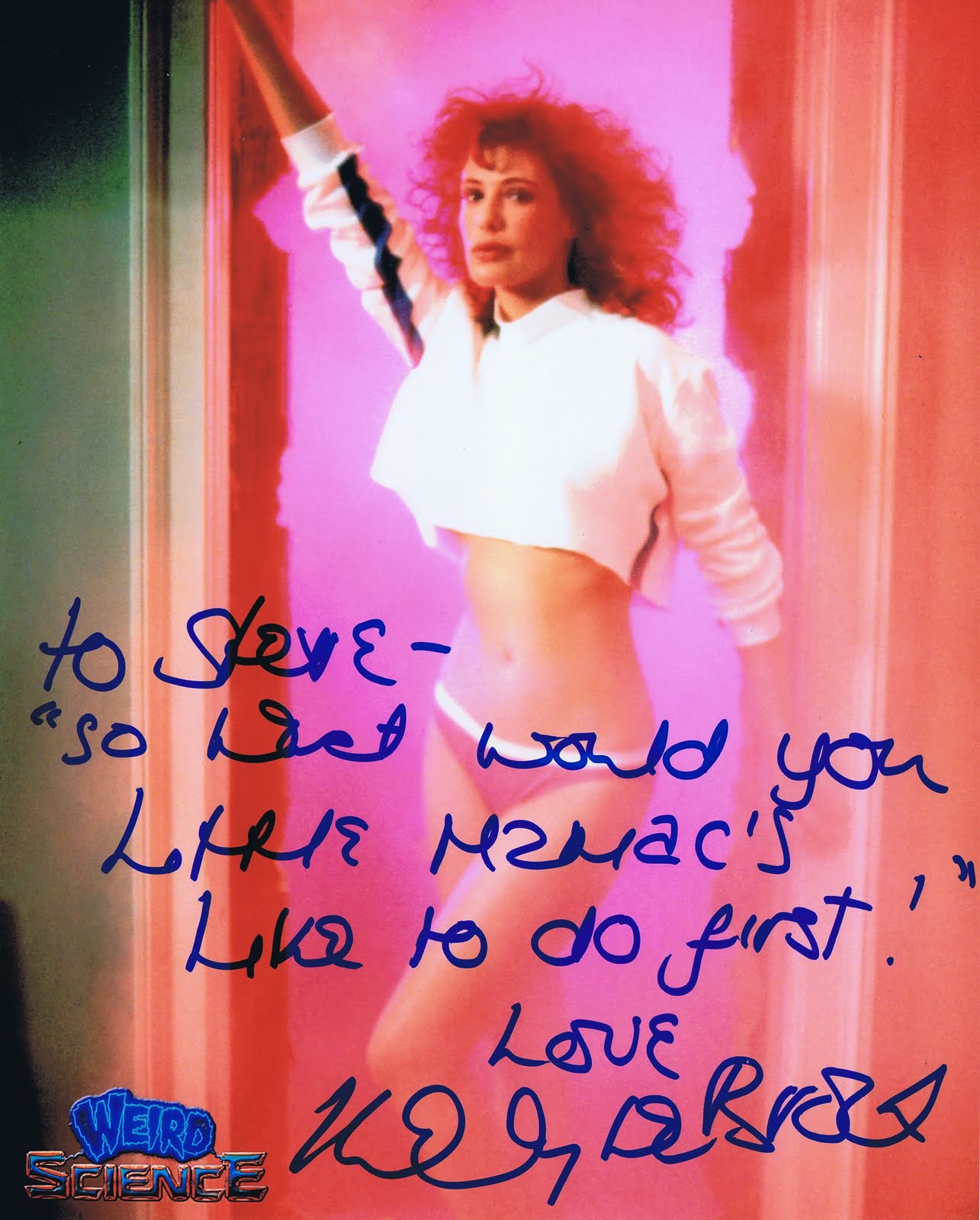
WEIRD SCIENCE (1985)

The spectre of the late John Hughes looms large over American cinema of the 1980's, with the writer/director often cited as "the voice of a generation." Personally, I never bought into that assessment of the guy's work because his films about the teenage condition were really no different than similar fare that came in previous generations, with the sole difference being that Hughes' films were fortunate enough to happen at a time when Hollywood movies could be more honest about youthful sexual longings, insecurities and the distinctly post-1970's suburban partying excess that defined much of the MTV decade (or at least that defined the goings-on when and where I grew up). I'll also grant that Hughes' strong suit was that not one of his protagonists was what would usually pass for the idealized "glamorous" teenager (with the possible exception of Molly Ringwald in THE BREAKFAST CLUB), instead populating several of his stories with dorks and losers of both genders, something that insecure kids could easily identify with. While the majority of Hughes' teen flicks were, I believe, aimed at girls, WEIRD SCIENCE was a straight-up adolescent male fantasy writ large, and as such it's my favorite Hughes movie and one of my favorite films from its era.

In case you somehow missed it, WEIRD SCIENCE follows Wyatt Donnelly (Ilan Mitchell-Smith) and Gary Wallace (Anthony Michael Hall), two nerdy high school losers who are the butt of constant abuse from bullies (including a young and embarrassingly new wave-looking Robert Downey, Jr.), Gary's meathead asshole of an older brother, Chet (Bill Paxton, in perhaps his most definitive role this side of Hudson in ALIENS), and can't get the time of day from any living female. When Wyatt's parents leave for the weekend, Gary offhandedly suggests that the pair use Wyatt's computer to simulate the ideal woman, feeding the computer with every bit of data that could facilitate the fantasy. What they did not expect was the program and a half-assed voodoo ritual actually working and coming up with Lisa (former fashion model Kelly LeBrock), a total knockout redhead with amazing, godlike superpowers.

The arrival of Lisa (Kelly LeBrock): the '80's answer to Botticelli's "The Birth of Venus."

Sweet, British-accented, funny, genius-level smart, smokin'-hot and completely willing to acquiesce to her creators' sexual whims, Lisa is a literal genie let out of the bottle, and the rest of the movie chronicles her successful efforts to make confident men out of a pair of pathetic losers who hadn't seen a trace of pussy since they slid out of their mothers'. It's a noble and utterly selfless quest that's fueled by the movie throwing all logic and realism out the window and embracing the sensibility of what is essentially a live-action cartoon, an aspect cited by many viewers as what makes this their least favorite of Hughes' "big three" (the other two being THE BREAKFAST CLUB and the achingly funny SIXTEEN CANDLES).

In my humble opinion, it's that very cartoonishness that makes WEIRD SCIENCE a gem, and some of its elements would be right at home in a comic book or a particularly good issue of MAD. It's also a strong contender for the title of "Best Male Fantasy Movie Ever Made" and some of its qualifying characteristics include the following:
  • Kelly LeBrock's Lisa is not at all what one might expect from a film like this. Sure, she's fine enough to make the corpse of Liberace claw its fetid way from the grave and loudly proclaim a newfound heterosexuality, but though she plainly states that Wyatt and Gary made her and can therefore do with her whatever they chose — meaning exactly what you think it does — she is in no way a mindless sex-puppet. She's smart — positively brilliant, actually — fun, adventurous, and supportive of the boys. In fact, her commitment to seeing them "man up" is quite single-minded, even realizing that her sex-goddess-made-flesh factor intimidates the boys and then adjusting her plan to make them of interest to the rather bland girls they are attracted to (girls who tellingly lack virtually all of the desired elements that they made sure to imbue Lisa with). As previously mentioned, Lisa also possesses superpowers, and they are indeed formidable. In fact, Lisa's ability to bend the fabric of reality to her will with zero effort would have been horrifying in the hands of most other characters, and her creators should be commended for having some of their own goodness manifest in her personality. Instead of a world-destroyer, she's a benevolent and fun-loving Aphrodite for the then-nascent digital age.
  • The lunacy that transpires over the weekend of Wyatt's parents' absence is epic and much of it has become the stuff of fond reminiscence for those of us who saw it when it first came out, but the one sequence that still reduces me to near-incontinence is when Lisa takes the obviously underage boys to a waaaaay ethnic blues bar and encourages them to get their drink on. At first quite uncomfortable and terrified by the place, the boys allow alcohol to work its magic and in no time they find themselves genuinely befriended by a pack of hard, old school Greek, Hispanic and black dudes, all of whom are amazed that they appear to be sexually involved with Lisa (who does nothing to correct their assumption and actually bolsters it). The whole sequence is funny, but it becomes hilarious when the scene skips forward by several rounds and finds Gary completely shitfaced, now sporting a pair of shades and a pimp hat, and channeling an old school black dude's conversational style to incredibly un-PC effect.

Gary (Anthony Michael Hall) inexplicably becomes the blackest man in the known universe.

That sequence fucking kills me and is so over-the-top offensive that it does a complete one-eighty, becoming a satire of its own outrageousness. It's a classic moment and reads just like the twisted John Hughes I first encountered years earlier during his days as a writer for NATIONAL LAMPOON, a Hughes whose incredibly filthy and mean-spirited bent was considerably sanitized for Hollywood deployment.
  • Bill Paxton's turn as Chet is a study in the comedic asshole and he is nothing less than fantastic.
Behold the testosterone-fueled majesty that is Chet (Bill Paxton).

Infinitely worse than the pussified new wave bullies Max (Robert Rusler) and Ian (Robert Downey, Jr.), Chet is a shotgun-toting, jarheaded douchebag of the highest order and he's that rare bad guy that you just love to hate.
  • The aforementioned new wave bullies serve to point out just what a couple of pussies Wyatt and Gary are. Rather than being in any way physically threatening, Max and Ian are more of an annoyance than a physical threat, and even the biggest milquetoast could most likely kick the living shit out of both of them with little effort.
Max (Robert Rusler) and Ian (Robert Downey, Jr.), two bullies who are un-threatening but assholes nonetheless.

But the real point of these limp bullies is to illustrate what Wyatt and Gary would be like if they were themselves assholes. Max and Ian are the dark reflection of our dorky heroes, only a tad more posh and romantically connected to the girls Wyatt and Gary like, girls the bullies would ditch in a heartbeat for a shot at Lisa. Perhaps my only complaint about this film is that Wyatt and Gary did not get in at least one shot to the kisser on these pricks. Chet would kick their asses if they attempted it with him, but these escapees from A Flock of Seagulls? I'd call it a fair slap-fight.

And on top of all that, the boys get to drive fast and fancy cars, throw a kickass house party, rout a gaggle of post-apocalyptic biker mutants — including Michael Berryman, the black punker chick from REPO MAN and Vernon Wells, pretty much reprising his role as Wez from THE ROAD WARRIOR — get the girls of their dreams (dull though they may be) and, last but definitely not least, get to see Lisa naked (which we don't, unfortunately).

Re-examining WEIRD SCIENCE after so long was like a welcome trip back to some of the favorite parts of my very much misspent youth with an old friend I had not seen in a very long time, and I gotta tell ya that it felt quite good. Do yourself the favor and check it out, either for the first time, or for the hundredth.

Yes, this is real.