Search This Blog

Showing posts with label KINDA SLEAZY. Show all posts

Sunday, July 3, 2011

MANDINGO (1975)

The sensual. The Shocking. The Sad. The Powerful. The Shameful. Expect all that the motion picture screen has never dared to show before. Expect the truth. Now you are ready for "Mandingo."
-original tag line from the original theatrical release of MANDINGO

I have no idea why I'm so fascinated by the film adaptation of Kyle Onstott's 1957 bestselling epic of the slavery era, but if I had to provide a concrete answer I'd probably say it's because it's arguably the single most offensive film ever released by a major Hollywood studio that also involved a name director — Richard Fleischer, helmer of such classics as 20,000 LEAGUES UNDER THE SEA (1954), THE VIKINGS (1958), and FANTASTIC VOYAGE (1966) — as well as a great thespian spouting some of the most insanely racist and ridiculous dialog in cinematic history, in this case James (A STAR IS BORN) Mason. And this magnificent monstrosity is finally available for the first time in a legitimate DVD release, so there's no need to rely on dodgy "gray market" or foreign copies.

The plot revolves around the pre-Civil War goings-on at Falconhurst, a plantation that breeds fine slaves, and focuses on the adventures of young Hammond Maxwell (Perry King), wealthy and handsome heir to the plantation. Hammond lives like a prince and gets his hump on with every available slave girl since "it's a master's duty to pleasure a wench first time," so the guy ends up with such a colossal case of Jungle Fever that he finds himself totally unaroused by white women. That's a problem because Falconhurst must eventually pass on to one of Hammond's offspring, but obviously not one of his legion of black bastards, so at the urging of his father (James Mason), Hammond goes in search of a suitable wife and ends up marrying his cousin, Blanche (Susan George). While returning home with Blanche, Hammond also buys a beautiful slave girl named Ellen (Brenda Sykes), who ends up becoming the true love of his life (something that does
not sit well with Blanche), and also purchases Mede (Ken Norton), a huge and ultra-virile slave whom Hammond wants to train as a "fightin' nigger" and use as prime stud material because his Mandingo blood is the most prized of all the African varieties.


James Mason and Susan George: a two-Brit scenery-chewing juggernaut.

Once back at Falconhurst the story shifts into balls-out crazy mode and soars into the stratosphere of bad movie Nirvana, piling on the racism, torture, bloody human cockfights, interracial shenanigans, good ol' Southern-style incest and more seriously sick soap opera shit than you might think possible, all building to one of the most horrifyingly offensive climaxes in screen history. This crazy quilt of antebellum brutality and sleaziness is ripe enough from the get-go, but the contributions of James Mason and Susan George cannot be overlooked; it almost seems like the two British actors were in a competition to see who could turn in a more ludicrous performance, both making with the worst Southern accents ever committed to celluloid and cracking up the viewer with such unintentional howlers as Mason's deathless scolding to one of his slaves,


"Drop that gun, you LOONY BLACK BASTARD!!!"


and George's incredible performance on the morning after her wedding night when Hammond calls her on the fact that she very obviously wasn't a virgin.

"Hammond! Wherever did you get such a zany notion!"

If you didn't know better you'd swear that MANDINGO was an over-the-top satire of steamy plantation sagas, written and directed by John Waters, but while that isn't the case it is one hell of spectacular train wreck. The odd thing is that even though it's sheer trash, MANDINGO is simultaneously perhaps the most in-your-face-honest American film about the inhuman brutality and horror of chattel slavery, and while I may find the film a hoot from start to finish it's impossible to deny the flick's power to revulse when the going gets nasty. When compared on the basis of its depiction of the subject matter, ROOTS, the television mini-series that served as an eye-opener for much of the American public, is a kiddie movie, and that's really saying something, so while I consider MANDINGO one of my all-time favorite movies (for all the wrong reasons) and highly recommend it to the curious, keep in mind that it's pretty rough and definitely not for the squeamish or easily offended.


Oh, and as for any cool extras, forget it. I just received the DVD and it includes no commentaries, no "making of" documentary, no look at the source novel to set the whole thing into perspective, not even the goddamned trailer. Bubkes. Zip. Zero. The big goose egg. That's a damned shame, because the content of MANDINGO makes for fascinating discussion, especially when you take into account that a movie of its like could never be made nowadays without the studio being burned to ground and armed riots breaking out in theaters. Hopefully this error will be rectified when (or if) the even loopier sequel, DRUM (1976), comes out on disc.


And in case any of you are interested in reading more about the 1957 source novel, check out THE MANDINGO PROJECT, an in-depth examination of the unabridged version that I wrote a couple of years ago. It's long, but I recommend reading it before seeing the movie so you see the differences between it and the novel. MANDINGO is one of those rare cases where the movie is a vast improvement over the book, so make of that what you will.


Poster from the original theatrical release.

Sunday, June 5, 2011

BEAT GIRL (1960)

A classic example of early U.K. exploitation filmmaking, 1960's BEAT GIRL, aka WILD FOR KICKS, is a fascinating (if rather caricatured) time capsule of post-war England and its head-on collision with the newly-minted rock'n'roll youth culture.

BEAT GIRL takes place in 1959/1960 and relates the story of a hateful and ultra-cunty high school-aged spoiled rich brat named Jenny (the Brigitte Bardot-esque Gillian Hills) a completely unlikeable, unsympathetic asshole of the highest order.

Gillian Hills as Jenny, a real rotter of girl who could use a good, swift kick in the box with a steel-toed Doc Marten.

It's bad enough that she's rude and generally nasty — in other words the total antithesis of what a nice British girl is supposed to be — but her sizable mean streak is aimed squarely at Nicole (Noelle Adam), the new 24-year-old French bride of her architect dad (David Farrar), a man who's too focused on designing the ultra-modern and sound-proofed "City 2000." When dad brings his newlywed Gallic sweetie home to his posh Soho house after being away from his daughter for five months, Jenny is not at all pleased to meet the woman who is taking the place of her presumably-dead mother (her mom's absence is never explained, but it's obvious that she's history), and from the instant they are introduced, Jenny is at all-out war with her step-mom. When not verbally abusing her step-mom, Jenny whiles away her time at the local "beatnik" club, the Off-Beat (which is located across the street from a seedy strip joint called Les Girls), with her cadre of too-cool-for-school chums, all of whom seem to have escaped from some mis-translated Anglo version of REBEL WITHOUT A CAUSE or a garden variety Elvis time-waster.

As the story (such as it is) progresses, the central point is Jenny's cruelty toward Nicole and her discovery of Nicole's past as a stripper and occasional prostitute in Paris, facts she uses to blackmail her stepmother into staying out of her life and stop trying to make friends with her. As it becomes clear that Nicole is determined to win both her favor and her respect — a losing battle if ever there was one — Jenny's rebellious intentions become further skewed upon investigating her step-mom's past association with a stripper named Greta (Delphi Lawrence), which brings her into direct contact with Kenny (Christopher Lee), the oily owner of Les Girls, who immediately sets his vile sights on the underage and not necessarily disinterested Jenny. All of this is interspersed with looks into Jenny's self-destructive social life, featuring "wild" dancing to "jive" music (in actuality that jazz/early guitar rock fusion common to Britain of the late-1950's), drunken speeding, Jenny and friends playing "chicken" by resting their heads on a train track as a speeding locomotive approaches, unauthorized house parties, stylistically-inaccurate Teddy Boys, wanton destruction of property, strip-teasing, and eventually murder, and it all entertains in that uneasy way found on U.K. sleaze flicks of the period, like HORRORS OF THE BLACK MUSEUM (1959) and the epochal PEEPING TOM (1960).

Much like American-made films that milked juvenile delinquency, hippies, bikers, black people and punks for exploitation fodder, BEAT GIRL does likewise with its late-1950's British "youth gone bad" and the results, though rather tame by today's standards, must have been a solid punch in the guts to its contemporary audience (or those among the audience who took it as an accurate representation of reality). With its ludicrous aping of American beatniks and their "hip" lingo, the film comes off as not unlike REEFER MADNESS for the British rock scene of the pre-Beatles era, especially in the scenes involving Jenny's friends, who are sort of led by the uber-douchey Adam Faith as Dave, the would-be rocker of the crew, and as such he's both tepid and kinda THUNDERBIRDS marionette-looking.

Adam Faith, part of the wave of post-Elvis/pre-Beatles U.K. rockers in the Cliff Richard and Tommy Steele mold. All that this guy's missing is a blue International Rescue flight suit and cap.

The thing that renders him so grating is his exaggerated attempts at laid-back "cool" that only make him come off as a dick who you just want to punch in the face as hard as you can. (It always brings a smile to my face when three Teds take his ever-present acoustic guitar and smash it to pieces as a challenge to fight, which he predictably pussies out of.) And as for Jenny, she's perfectly brought to vicious life by Gillian Hills, who enacts her with all sly looks, haughtiness and verbal abusiveness that makes one wonder how any of her friends can tolerate her at all. To the British of the time, her behavior must have been some pretty shocking stuff, what with a theoretically-"proper" upper class spawn like Jenny aggressively and stupidly chucking her father's wealth and position in favor of hanging out with unsavory types who directly prefigure the punks of the 1970's by a generation. Their look may be more proto-preppy than post-apocalyptic tribal, but the mindset is exactly the same, as is the self-pitying whining, only this time it's coming from a bunch of kids who were born during World War II and feel (incorrectly) that they have nothing to live for other than "kicks."

The thing that got me interested in this film in the first place was the early soundtrack work by John Barry, the guy whose music indelibly set the tone for the Connery-era James Bond films and is one of my very favorite composers, for film or otherwise. I'd heard of the movie ages ago, but what steered me toward Barry's soundtrack for it was discovering the film's theme tune as covered by The Damned on the B-side to their 1986 12" single for their cover of "Eloise." (The Damned loved doing covers.) Upon hearing the tune I said to myself, "Holy fuck, that sounds like a John Barry tune from an early James Bond movie!" so I looked at the songwriting credit on the vinyl's label and, sure enough, there was Barry's name. I filed that bit of info away for future soundtrack hunting and eventually got my hands on the CD in the early-'90's, and the wait proved to be well worth it. I didn't see the film itself until sometime later, and it was then that I discovered that the album versions of the soundtrack's music were slicked-up re-recordings, but I didn't mind because all of it was one short evolutionary step away from the signature sound of '60's 007 music. Just check out the studio version of the title track and you'll see what I mean:


Adam Faith's Dave in action, with a very young Oliver Reed as "Plaid Shirt" (which is how he's listed in the credits).

Now, is that or is that not pretty much a dry run for the whole Bondian musical aesthetic?

So I recommend BEAT GIRL as a curiosity for those interested in U.K. exploitation movies and most especially for those who are only familiar with John Barry's James Bond scores. Either way, it's a win for the viewer. Oh, and while doing a search of her filmography, I just found out where else I've seen Gillian Hills before: she's the blonde in the record store sequence in A CLOCKWORK ORANGE (1971).

Gillian Hills (the blonde), still associating with savory characters in the classic A CLOCKWORK ORANGE (1971).

Poster from the original British theatrical release.

Tuesday, May 31, 2011

PLANET OF THE VAMPIRE WOMEN (2011)

As you've probably gathered after reading enough of my reviews, I'm a tough audience and that critical eye certainly extends to the cheesy stuff I sit through. I love low-budget/B movies, provided they entertain me and provide me with something fun to sit through. In the case of PLANET OF THE VAMPIRE WOMEN, I did not think it was terrible, but I cannot say I enjoyed it or that I would recommend it.

The plot follows a crew of infamous space pirates who rob an orbiting casino/brothel of cash and an antique space cruiser, and what befalls them when they are subsequently pursued by a dogged police officer (Jawara Duncan). After unnecessarily spending a half hour leading up to the heist and providing viewers with a bevy of nekkid titties, the pirates head to a mysterious planetoid where their captain (Paquita Estrada) is possessed by a strange parasitic entity that turns her into a vampire (which is convenient since she already looks like a Goth dominatrix, only she's black). After killing one of her crew (who subsequently rises as a vampire minion), the captain escapes the ship and heads for the mysterious ruins on the planet's surface, where evidence of an advanced but extinct civilization reveals how disembodied vampiric presences wiped out the indigenous populace. More vampirism ensues as the remainder of the crew pursues the captain and eventually discovers the secret of the parasitic entities and realizes that the creatures must not be allowed to venture from the planet lest they spread throughout the universe.

That setup is rife with promise and could have made for quite a memorable little bit of fun, but the key problem here is pacing that redefines the word "lugubrious." The first half-hour was padded out to a merciless degree and considering the setup of the heist and the need for exposition on who the characters are, all of that stuff leading up to and including the crash-landing could have been accomplished in ten minutes rather than thirty. Gratuitous nudity is always fun and chase scenes can be entertaining, but not when they're so clearly being used to cover up the fact that nothing is going on in the narrative for long stretches.

Once the crash has happened, it was yet more drugged-Brontosaurus pacing that went nowhere. That was a shame because even with the minimal exposition and characterizations, we were given enough info about the main characters to get that they could have been much more interesting if they had been served by a tighter script. A movie like this could get by with having its characters engaging in interesting/clever dialogue while running around on that hostile planet, but what there was of the dialogue was too sparse and did nothing to alleviate the drag factor. The only characters who truly generated interest were former-Marine Maldonado (Liesl Hanson, looking very butch-cute), cyborg Automatic Jones (Keith Letl), drug-addicted and officially disgraced Doctor Calaveras (Stephen Vargo) and Astrid Corvair (Stephanie Hyden), a smart and sunny pleasure-clone with the ability to change her appearance with a suggestive flick of her hips (whom I liked rather a lot, despite her being a less-gratuitous and comparatively non-violent Cutey Honey knockoff), and the four of them could have easily carried a whole movie without having to resort to the whole staler-than-stale vampire trope. For example, when questioned about displaying what seems to be an uncharacteristic and considerable amount of knowledge about alien archaeology, the bubbly Astrid, who up to this point seemed to be little more than a dumb blonde stereotype with a gimmick, cheerily replies, "There's a lot of down time between all the fucking and sucking. I read a lot." If only the rest of the script displayed such wit.

Exploring the mysterious planet.

I could go on, but I won't. The effort that went into it was all there on the screen and its low-budget in no way detracts from its potential. In fact its DIY qualities added to its charm, giving it a feel like a gene-splicing of PLANET OF THE VAMPIRES, ALIEN, RED DWARF, JASON OF STAR COMMAND and the third season of LOST IN SPACE, with acres of tits thrown in for good measure. So basically my problems with it all come down to terrible pacing and a script that needed a lot more work. When seeking to overcome budgetary limitations, a script for a story like this needs to either be as serious and taut as a heart attack, or else it needs to be flat-out funny, and this script did not have enough of either to fully work for me. But, as previously stated, I'm a tough room and I am also not clairvoyant, so I can't predict how well PLANET OF THE VAMPIRE WOMEN may work for you.

Sunday, January 9, 2011

MANIAC (1934)

Ed Wood's PLAN 9 FROM OUTER SPACE (1959) is often cited as "the worst film ever made," but I take issue with that assessment because, unlike innumerable very bad movies, it is very, very entertaining from start to finish and it is also (mostly) coherent in its storytelling. A more legitimate contender in this department (though also entertaining to an incredible degree) is 1934's MANIAC, a fifty-minute supposedly serious examination of assorted mental disorders, all embodied within the person of one very, very fucked-up guy and explained in periodic "educational" placards that bring the plot (such as it is) to a grinding halt.

A feeble attempt at granting this film some modicum of socially-relevant respectability.

Or rather that's how the filmmakers got away with its considerable excesses back in the days; it's actually a primitive exploitation film of the highest/lowest order and should be seen by all students of the genre, as well as by those fueled by cheap booze and low-grade ditch weed.

Our protagonist: Don Maxwell (William Woods).

The narrative opens in the lab of Dr. Meirschultz (Horace B. Carpenter), a bushy-haired, German-accented and quite obviously mad scientist whose twisted experiments focus on various aspects of re-animating the dead. Aided by former Vaudeville actor/impressionist and inexplicably-wanted felon (?) Don Maxwell (William Woods), the doctor sneaks into a morgue and successfully re-animates the corpse of a recently dead woman with a serum he discovered, so with that success the doctor declares he needs a corpse with a shattered heart with which to continue his work, this time transplanting a re-animated and undamaged beating heart into said corpse.

What a way to get a Saturday night date: re-animating recently-dead hot chicks.

But Maxwell's corpse-pilfering errand is derailed when he's interrupted and frightened by two cats having a fight (why the cats are hanging around in a dungeonlike basement morgue is anyone's guess), so he returns to the lab empty-handed and crazed-looking, right after being once more frightened off, this time by a fight between a dog and a cat in the street. (??? Are there neighborhoods where animal fights just spontaneously break out all the time?) The mad scientist blows a gasket and hands Maxwell a pistol, with which he is told to shoot himself in the heart so the doctor can still have a corpse to work with. Instead, Maxwell does the only sensible thing and kills the doctor, at which point he goes full-tilt, balls-out-hallucinating insane, without preamble and for no apparent reason.

With no warning, Maxwell goes full-tilt insane and hallucinates footage cribbed from HAXAN (1920) and Fritz Lang's SIEGFRIED (1923).

Ah, sweet hallucinations...Wheeeeee!!!

With the mad scientist now tits-up dead on the laboratory floor, Maxwell puts his impersonation skills to good use and literally becomes the crazy old Kraut, even taking over the quack's practice. (I guess it stands to reason that the scientist might have had a practice outside of his interest in re-animation. I guess...)

Maxwell becomes Dr. Meirschultz. Would you trust this guy as your personal physician?

From there the film veers wildly into sheer incoherence and lunacy that rivals that of its protagonist, all of which is driven by ludicrous dialogue, directing choices that amount to visual non sequiturs, and, above all, some of the most entertaining terrible acting in cinema history. Case in point: this classic sequence in which a patient goes insane after Maxwell/Meirschultz accidentally injects him with the re-animation serum.


Wow. Just...WOW.

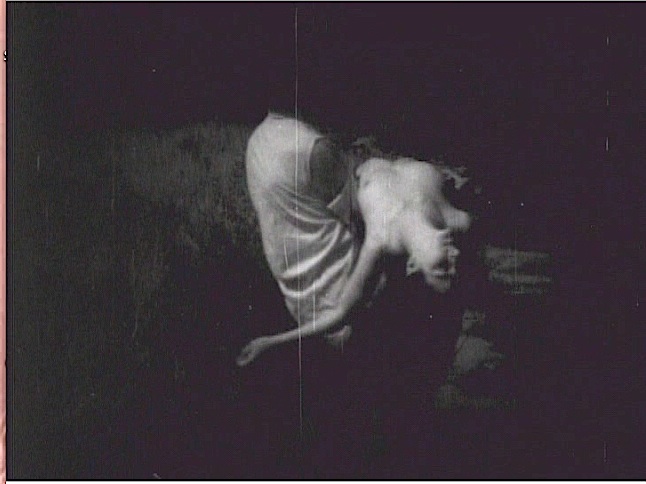
The crazed dude then abducts the re-animated woman and steals her away into the countryside, at which point her gown opens for no reason other than to expose her '30's tits.

GASP! Tits...of the '30's!!!

Sure, it's obviously an early exploitation film, but the nudity element clearly marks this as a pre-Hays Code grindhouse product, and more power to it for going that extra sleazy mile.

More tits of yore. Think about it for a moment: this could be your grandma.

The sex-crazed injectee then goes on to strangle his topless victim, after which that's the last we hear of him. In other words, the sequence existed for no reason other than to provide an eyeful of nekkid titties. A noble artistic intention, to be sure, but I would have liked to have some resolution to this particular plot thread.

Then there's a totally from out of nowhere bit where Maxwell, who by this point has fully become Meirschultz, wrestles one of his neighbor's cats and pops out one of its eyeballs.

Delighted with the results of his efforts, Maxwell scoops the feline peeper from the floor

and promptly eats. it.

Exactly why is anyone's guess, because it is in no way made clear by the script. There's more — a lot more — but I think you get the point that this film is off-the-rails crazy and totally worth seeing. Plus, at a mere fifty minutes in length, it's mercifully short.

Helmed by Dwain Esper — director of such socially important works as MARIHUANA, THE WEED WITH ROOTS IN HELL! (1936), SEX MADNESS (1938) and THE STRANGE LOVE LIFE OF ADOLPH HITLER (1948) — MANIAC (originally SEX MANIAC, but presumably changed to its present title so as not to mislead its sleaze-hungry audience into thinking the film was about the mauler of topless chicks) is a fascinating and hilarious time capsule that conclusively proves exploitation and lurid sleaze are nothing new in the movies, and even by today's standards it's still quite shocking. I can't imagine how I would have reacted to it if I'd had the opportunity to see it during my early youth and the years in which I absorbed tons of old movies of a far more wholesome pedigree, but I bet I would have loved it.

Poster from the film's original release as SEX MANIAC.

Tuesday, September 21, 2010

TERMINAL ISLAND (1973)

I first heard of this flick during high school when my friend Kenny told me about the trailer, which was included in the theatrically-released coming attractions collection THE BEST OF SEX AND VIOLENCE and when I saw that collection for myself years later, I was greatly intrigued. Then came my college days and the exchange of sleazy films with fellow connoisseurs, and TERMINAL ISLAND fell into my hands thanks to a freshman who would later gain deserved renown as writer/critic Selwyn Harris (at least I think I got it from him). I remember watching the film (admittedly through a thick fog of bonghit smoke), but if truth be told it happened during the first of what I now refer to as my "lost years," a period where I was perpetually drunk and/or stoned, so my memories of it remained spotty at best until a few days ago, when I got my hands on the film now that it's out on DVD. So was it worth revisiting after over twenty years?

A knife fight over one of the few available females. Just another day on Terminal Island.

TERMINAL ISLAND takes place in what was then the near-future (an element that adds nothing whatsoever to the plot) and brings viewers to its titular location, the San Bruno maximum security penal island, where the most vicious of convicted murderers are sent for life, there to eke out a meager existence or perish, or as the film's trailer so matter-of-factly states, it's "where we throw our human garbage." We watch as Carmen (Ena Hartman) is sentenced to the island, where, to her horror, she discovers she is only one of four females in the place, and is thus doomed to slavery — sexual and otherwise — under the iron hand of the psychotic Bobby (Sean Kenney) and Monk (Roger Moseley), his huge black enforcer. From the moment she arrives in the camp, Carmen is brutalized by Monk while the other female prisoners look on with mute resignation, each having no choice but to accept their status and service a minimum of four men per night on a semi-regular basis (the men outnumber the women roughly ten to to one).

Carmen's arrival: "Welcome to Terminal Island, baby."

After what appears to be a few days of such degradation, Carmen and the rest of the women are stolen from the bad guy murderers by a small group of nomadic good guy murderers who live on the other side of the island. Once among the new group of men, the women are (mostly) treated as equals and no longer forced to give it up on demand. Meanwhile, Bobby and Monk send out men to track down and retrieve the women and kill the dissident good guy murderers in the process. It all builds to a head and the good guy murderers pool their skills to organize themselves into a smart guerrilla army.

The "good guy" murderers.

With casualties on both sides, when the smoke clears it's a brand new day on Terminal Island as the good guy murderers take control and embark on a more pleasant, equality/cooperation-based way of existence.

In answer to my earlier question, TERMINAL ISLAND was not really worth coming back to after twenty-some-odd years and was very much a disappointment after its classic bombastic trailer. For a story with such sleazy potential, surprisingly little is made of it and its gore, nudity and violence are tepid at best. All of the sexual slavery takes place off-camera — which suits me fine, but the audience that came expecting it was certain to be disappointed and pissed off — the characters are pretty much all murderers, so it's kinda hard to root for any of them, and the thrills are quite tepid, especially when measured against the across the board excesses of the film's contemporaries in the exploitation field.

The only thing that's really notable here is the cast, several of whom came from or went on to careers in TV. For most viewers, TERMINAL ISLAND is of interest for early appearances of Roger Moseley and Tom Selleck (as the sole innocent on the island), who would go on to co-star on MAGNUM, P.I. some seven years later.

A pre-MAGNUM, P.I. Tom Selleck (with Barbara Leigh).

For a geek like me, this film is a must-see thanks to the presence of two childhood favorites and veterans of Irwin Allen kids' sci-fi TV shows from the 1960's appearing in a potentially-sleazy R-rated flick. Both Don Marshall, who played Dan Erickson on LAND OF THE GIANTS (1968-1970), and the lovely Marta Kristen, who launched many young lads into puberty as Judy Robinson on LOST IN SPACE (1965-1968), are on hand and of the two it's Kristen who has the more interesting character, specifically that of a radical bomber whose political rampage resulted in the accidental deaths of innocent civilians. During the climactic coup, her character's skills at creating homemade munitions come in very handy and she proves to be the polar opposite of the stereotypical dumb blonde. She's really cool here and displays a presence that was never allowed to flower during her days among the Jupiter 2 gang, and it's a shame that she's only been seen sporadically ever since.

Irwin Allen refugees in da house: Don (LAND OF THE GIANTS) Marshall and Marta (LOST IN SPACE) Kristen.

And just so we're clear on this and to spare you any disappointment upon rental, at no point does Marta Kristen get nekkid or fuck Don Marshall. Pfooey.

So the bottom line on TERMINAL ISLAND is that I don't really recommend it unless you're curious about what the aforementioned TV actors bring to the table. It's only 89 minutes long, so if you choose to see it at least you won't be wasting too much time. Oh, and some critics have made much of the film being directed by a woman, Stephanie Rothman, and how the film apparently has some sort of political message, but neither aspect helps make TERMINAL ISLAND anything other than a footnote in the annals of '70's exploitation cinema.

Wednesday, September 1, 2010

TENEMENT: GAME OF SURVIVAL (1985)

WARNING: HERE THERE BE SPOILERS!

Is there any better lure for an exploitation movie junkie than the promise of a film that was allegedly deemed too ultra-violent to be rated? That was certainly the case with TENEMENT: GAME OF SURVIVAL — aka SLAUGHTER IN THE SOUTH BRONX, which, if you ask me, is a better title — , a very, very nasty 1985 grindhouse classic that was legitimately awarded an X rating by the MPAA for its foul language and generous lashings of sadism, gore, and humanity-degrading brutality. I'd never heard of it until it popped up a while ago as one of three films included in a "Grindhouse Psychos" boxed set, and my interest was piqued as I read a description of its plot. I love revenge movies and films about people trapped in a location where they're pitted against psychos or monsters and there's no way out other than to become as savage as their assailants, and that's exactly what we get with this low budget, balls-out visceral mamma-jamma. (I don't know how the fuck I missed this during its theatrical run, but I'm guessing it came out during the period in my third year of college where the only movie I saw in the theater was RE-ANIMATOR.)

The Gang: these guys make the droogs in A CLOCKWORK ORANGE look like choir boys by comparison. And is it just me, or does the guy with the red sash have a kind of Shabadoo Quinones thing going on?

The plot of TENEMENT is a study in exploitation movie simplicity: a bunch of totally '80's multi-racial thugs/gang members of the type common to films like VIGILANTE, SAVAGE STREETS and the sublime DEATH WISH 3 are hanging around in the basement of some South Bronx shithole tenement building — located in an area so desolate that it's nearly as surreal as the myth-ready wasteland in THE ROAD WARRIOR — snorting Angel Dust off of switchblades (no, really) and apparently eating rats (no, really) while making feeble attempts at break dancing, but otherwise not bothering anybody. The building's drunken Hispanic busybody of a superintendent calls the cops and has the gang busted, but the gang hears the approaching cops and has time to rid themselves of their stash and hide their weapons before their trip to the local precinct. The super mocks them to their faces as they're led away and the building's residents immediately throw a party to celebrate, secure in the knowledge that the gang is gone for good. Seeing as we're only about eight minutes into the movie at that point, it's no surprise to viewers when the gang is released a few hours later due to lack of evidence. Once freed, the gang scores some primo Angel Dust, gets staggeringly high (their leader has crazed, blood-filled visions), and embarks on a vicious mission of payback that sees them make their way up the tenement floor by floor, raping, killing and mercilessly torturing as they go.

That's pretty much it as far as the basic plot goes, so the bulk of the film is taken up with the building's residents being horribly slaughtered and finally banding together once they've had enough. As is par for the course with the urban terror genre, the tenement's residents are a corny collection of ethnic/religious stereotypes straight from Central Casting:
  • an unwed, very pregnant Hispanic girl
  • her "Ay-yi-yi"-accented mother
  • the bitter black handyman who becomes the de facto leader of the residents.
  • a tough-as-nails Jewish old lady from "the old country"
  • a loving middle-aged black couple, of which the wife is a broad-beamed complainer who would be right at home in a Baptist revival meeting
  • the savvy black single mother who fantasizes about moving to a Park Avenue apartment where she can raise her daughter in safety while drinking champagne all day
  • a blind Hispanic man and his companion dog
  • a number of cute kids for instant audience sympathy
  • the once-well-off white girl who's become a whore in order to pay for her boyfriend's raging heroin habit
There's little attempt at characterization, but that's beside the point since we're given all we need to know in brief bits of character shorthand since the real point of the movie is the carnage and the fighting back in response to it. And what carnage it is! I haven't seen so much red paint used in lieu of stage blood since the LONE WOLF AND CUB movies or one of Chang Cheh's Shaw Brothers flicks, and every now and then random bits of ripped out (and hard to identify) internal organs are on display. We're even treated to a bit where the head creep, Chaco (Enrique Sandino), and the gang's sole female member get it on beside the corpse of one of their fallen comrades (who was ingeniously killed when he shot up what he thought was heroin but was instead rat poison) and his gut-stabbed victim, engaging in some blood-smeared foreplay that made me laugh out loud at how fucking sick it was.

The only way this bit could have been more repulsive is if Chaco had wanked off between her blood-anointed tits.

The film is certainly not shy in the violence department and its "X" was earned due to that and relentless uses of "motherfucker" in the dialogue. According to director Roberta Findlay's commentary, there was actually a point when multiple uses of the F-bomb, especially when used in a maternally incestuous context, would ensure an X-rating, which would explain why RICHARD PRYOR LIVE IN CONCERT (1979) went out unrated. Then again, John Waters' A DIRTY SHAME (2004) reportedly earned its NC-17 for dialogue involving frank sexuality and concepts related to various kinky acts, so I guess things haven't really changed at all...

But the one sequence that really gained TENEMENT its X is one of the nastiest rape scenes ever committed to celluloid, and it's even more amazing/horrifying because it has such hideous impact without showing one bit of nudity. It's often been said that what the viewer can come up with in his or her imagination is far worse than anything a director can show directly onscreen, and that's proven true by this scene. The rapee is hauled into her bedroom by about four gang members and has her wrists tied as the assault begins, but a pair of sewing shears is within reach on her nightstand and she swiftly grabs them and plunges them through the eye and into the brain of her rapist, killing him stone dead. That was shocking enough, but then the remaining gang scum proceed to pummel her senseless before hitting upon the unsavory idea of killing her by unceremoniously shoving a broom handle into a place where such household items were in no way intended to go... This landmark in cinematic good taste occurs while the woman's five-year-old daughter hides in the closet, eventually coming out once the gang has taken their leave, there to discover her mother's horribly violated corpse.

Do I need to tell you I don't recommend this one as a date movie?

Following that bit of business and several other heinous atrocities, the tenants take the fight to the gang in earnest, resorting to blunt instruments, scalding water, a swiftly MacGyvered electrified fence, and other defenses before the day is eventually won by a handful of survivors.

Lesson learned: an old Jewish broad with a grip-taped baseball bat is a dangerous thing.

TENEMENT is a down-and-dirty, relentlessly vicious story that appeals to those who can handle it because it's simply impossible not to put yourself in the place of the besieged tenants. Made in the years before cell phones and during the days when a cut phone line meant no way of contacting help, this is an urban horror story that brings one back to the bygone time when New York City could still (almost) believably be depicted as an earthly manifestation of Hell itself. It's kind of a campfire horror story transplanted from the deep woods into the concrete jungle and as such it's very effective, provided one can stomach its excesses. I know I could, and stories about people resorting to savagery when backed against a wall have for some reason always spoken to some dark place deep within me, so if you also understand the appeal of that primal, on-the-defensive animal urge, by all means give TENEMENT: GAME OF SURVIVAL a look. It ain't great cinema by any means, but you can certainly do worse with a Netflix choice.

Tuesday, June 29, 2010

'GATOR BAIT (1974)

No, that isn't Ben Affleck in drag.

I can’t believe it took me as long as it did to finally see the 1974 exploitation classic ‘GATOR BAIT, and I have to say I’m more than a little surprised by what it had to offer. The film’s rep rests squarely on the shoulders of its star, ill-fated Titian-tressed beauty Claudia Jennings, a former Playmate of the Year whose body of work lead her to being dubbed the “queen of the B’s,” and after sitting through one of her grindhouse epics it’s doubtful that she’d fade from the viewer’s memory any time soon.

Claudia Jennings: Can you say "Yowza?"

‘GATOR BAIT is a post-DELIVERANCE backwoods revenge pic that takes place deep in an unnamed bayou, a forbidding environment best avoided by those who don’t know its ways, and utterly at home in this seemingly limitless swamp is Desiree Thibodeau (Jennings), a barefoot Cajun trapper — in the skimpiest of outfits, including a pair of Daisy Dukes that pretty much doesn’t have an ass, and a potato sack blouse that allows occasional glimpses of her mouth-watering ninnies —who poaches the local wildlife to provide for herself and her younger brother and sister. Desiree’s activities are illegal but overlooked by the local sheriff who doesn’t care because her family has hunted the swamp for generations, so he figures she’s got the right by virtue of ancestral territory. Unfortunately his moron of a son, apparently the town’s only other cop, has other ideas, and along with a slow-witted hillbilly pal he lays in wait to catch Desiree in the act and offer her a choice of going to jail or fucking him and his buddy. The would-be sexual extortion goes terribly wrong, however, as Desiree eludes her pursuers after lobbing a bag full of venomous snakes onto their swamp boat; as the stupid cop shoots at the snakes, he blows holes into the boat’s hull, and shoots his homeboy in the head. Panicking, he returns to town and claims Desiree killed his friend, so the sheriff rounds up the dead guy’s outrageously inbred redneck relatives and sets off into the deep swamp to apprehend Desiree. Operating under the false impression that the poacher is a murderess, the rednecks can’t wait to get their hands on her, both to hand out their own brand of justice and get a piece of her “coon-ass.” (The Cajuns in the film are derogatorily referred to as “Coonies.")

That’s the setup, and from there viewers are taken deep into a swamp virtually untouched by man and made witness to a game of cat and mouse so overmatched that it’s like what would happen if a bunch of great white hunters had the incalculable stupidity to fuck with Tarzan on his own turf. Desiree may not have the jungle lord’s near-superhuman capabilities, but she’s plenty smart and knows her way through the bayou like it was the back of her own assless shorty-shorts, so it’s just a matter of time until she’s done killing those assholes one by one.

During the course of all of this we learn a lot about Desiree’s antagonists and swiftly realize just how vile and sleazy they are. The patriarch of the redneck family has a love/hate relationship with his sons, all of whom are at least mildly retarded or just plain mentally ill, and even disciplines the perpetually-horniest of his brood with a bullwhip when he catches the lad attempting to fuck his own very willing sister in the mud near where she was hanging the laundry. (Dad wasn’t all that pissed off about the boy wanting a piece of sis, but was seriously irked at the possibility of the voluptuous girl getting knocked up and squeezing out another dimwit.) The other redneck son holds a personal grudge against Desiree for having had the gall to cut off his balls years earlier when he tried and failed to rape her, and now wanders about with his sawed-off double-barreled shotgun serving as an ever-rigid and potent surrogate penis. And even the sheriff has a big secret: twelve years previous he’d had an affair with Desiree’s mom and “accidentally” murdered her father, a bit of information used by the rednecks as blackmail fodder, guaranteeing that their own illegal shenanigans go unchecked.

With all of this mishegoss going on there’s plenty of bad taste to go around, and once the hunt for Desiree gets underway things go from very bad to that much worse when, after searching for her home for days, the inbred posse locates the place just after our heroine has left on a three day hunting trip. The bad guys stage a home invasion that begins with them abusing Desiree’s tongueless little brother, and her nubile jailbait sister ends up in the lusty hands of the sheriff’s son and the two inbred brothers. As the two un-castrated men hold down the poor girl during the preamble to a gang rape, one of them tells the nutless wonder with the shotgun that he’s going to show him “how a real man does it;” that remark sends the castrato over the frustrated edge, so he throws his brother off of Desiree’s sister, stuffs his shotgun between her legs, and unloads both barrels, retorting “Is that manly enough fer ya?” The girl expires almost immediately, and the misogyny factor goes through the roof. No bullshit, when that bit of business happened I actually exclaimed “Oh my God!!!” and I’m pretty hard to shock. It’s not graphically depicted, but the idea alone really gets to you.

The odd thing about it is that such horrors were once commonplace in exploitation films, and yet, despite the many ultra-violent movies I’ve sat through over the decades, I still find myself jarred by such material. I can handle all manner of cinematic carnage, but the idea of some innocent girl — or any girl at all, for that matter — taking a shotgun blast to the cooter is a bit beyond the pale, so keep that bit in mind before sitting down to watch ‘GATOR BAIT with your girlfriend.

Which brings me to the oft-cited sentiment that ‘GATOR BAIT is one of many exploitation flicks held to be a feminist statement. Lemme tell ya, buddy, the makers of this film simply set out make a movie about a scantily clad hottie who kicks ass on the people who fucked with her and her family, but I strongly doubt that capital F feminism was intentionally involved in the creative process. Think about it: you have fine-ass Claudia Jennings, a woman for whom the wearing of clothing should have been a capital offense, traipsing about the fen in gear that shows off her priapism-inducing assets for all they’re worth, despite the fact that such gear is in no way conducive to the rigors of marshland hunting and trapping.

Desiree is not so much a feminist role model as she is a fantasy wild woman/jungle girl updated and transplanted to a sweltering southern bayou, and as a lifelong fan of such characters I have no problem with that. But don’t hand me that feminist over-analysis horseshit; Desiree’s a forest spirit fantasy made flesh — hell, she even looks like an anthropomorphic fox — and to say otherwise is a tad disingenuous.

Other than the surprisingly taut story, the true surprise about ‘GATOR BAIT is that considering its R rating and the presence of Jennings, the star doesn’t get naked at any point in the movie. Sure, we get tantalizing glimpses of her good stuff, but the requisite nudity for this type of flick falls to her nymphet sister who innocently strips out of her already-revealing shift and bathes in the river. That somewhat disappointed me because I’d seen provocative shots of Claudia Jennings in her Daisy Dukes and unbuttoned sleeveless shirt for over three decades, and expected the film to deliver what the ad campaign couldn’t.

But I wasn’t terribly pissed because she looked great throughout the movie, and sometimes titillation is better than in-your-face nekkidness, and the movie kind of reminded me of pinup art or Al Capp’s Wolf Gal.

Bottom line, ‘GATOR BAIT is definitely worth checking out, and is a lot better film than you’d expect from the “hicksploitation” genre, capably holding it’s own alongside the real heavy hitters of its ilk, namely DELIVERANCE and SOUTHERN COMFORT. It’s solid, down-home, grimy sleaze, and as such it works just fine. TRUST YER BUNCHE!!!

MACON COUNTY LINE (1974)

After having heard about how great MACON COUNTY LINE is and how it’s one of the undisputed classics of the 1970’s drive-in/”hicksploitation” genre, I finally saw it for myself and was quite surprised by a few things. First off, for years I was convinced that I’d seen it but I now realize I hadn’t, and in fact I think I confused it with one of its many subsequent imitators or fused it in my memories with some other bit of cornpone exploitation; the film I remember seeing opened just like MACON COUNTY LINE, specifically with the title being seen over a freeze-frame of a fleeing, bare-assed guy as Lavern Baker’s timeless rendition of “Jim Dandy” is heard on the soundtrack,

but for some reason I recall the version of “Jim Dandy” in the film I thought I saw as being the ultra-redneck cover done by Black Oak Arkansas. After that I just recall pretty much a feature length nighttime car chase down some backwater road featuring two scared-shitless fifties “J.D.” types pursued at high speed by a crazed sheriff who took potshots at them with a pump-action shotgun while his deputy handled the driving chores. I have no memory of why the cop was after the two teenagers, but there was definitely a sense that the cop was an insane control freak who had it in his head that those Yankee sunsabitches had done something out of line within his jurisdiction, and he simply wasn’t having it. That’s kinda/sorta the plot for MACON COUNTY LINE, but I enjoyed my garbled recollections more than the actual movie and am at a loss to explain why it’s considered a classic.

The film takes place in 1954 and introduces viewers to the Dixon brothers, Chris and Wayne (played by real-life sibs Alan and Jesse Vint), two rakehell lads who epitomize the old “free, white, and twenty-one” spirit of the pre-Civil Rights era, and drops us right into the tail end of their two-week spree of fun and pussy-hunting before they head off for military service. They’re about as likable as a pair of don’t-give-a-shit characters can be, but they both display a casual disregard for the law as evidenced by their gleeful tactics of dining and dashing, stealing money from a whore (after Chris fucks her while making her bark like a dog, easily the funniest scene in the movie), and evading two cops while simultaneously totaling their squad cars, as well as the revelation of being lifelong troublemakers and that their signing up for the military was the only option for Chris as an alternative to being sent up the river for a petty crime (we never know he’s found guilty of, but it’s alluded to that it may be statutory rape), thus Wayne joined up with him so his little brother won’t have to go it alone. During the course of their adventures they pick up blonde Texan hitchhiker Jenny (Cheryl Scott) and eventually cross the Macon County line from Louisiana into Georgia, thus setting up the tragedy to come.

Once in Georgia, the gang’s car suffers automotive distress and they pull over to a gas station in the middle of nowhere to get a new distributor cap. While waiting for the live action version of THE SIMPSONS’ Cletus the Slack-jawed Yokel to effect repairs, they meet walking NRA advertisement and control freak Sheriff Reed Morgan, played by Max Baer, Jr., best known for his immortal portrayal of eternally sunny and rather dim Jethro Beaudine on THE BEVERLY HILLBILLIES television series (1962-1971). The sheriff, always polite but betraying a hint of ominous menace, questions the unfamiliar trio, demanding to see identification and informing them that unless they have thirty bucks between them they’ll be considered vagrants. Having made his point — a display of territorial pissing if ever there was one — the sheriff drives off to pick up his ten-year-old son (Leif Garrett) from military school, unaware that two petty criminals have broken into his house, stolen assorted property, and raped and murdered his adoring wife (Joan Blackman). The crooks get pulled over by some other local cops, and once the stolen loot is noticed in the back seat the situation escalates into a double cop-killing, but the criminals are eventually captured. Meanwhile, our heroes have once more hit the road, but their car once more breaks down, forcing the trio to camp out…just across the way from Sheriff Morgan’s house, right when he arrives home to discover his wife’s bloody corpse. The sheriff and his son both lose it, the kid collapsing into a weepy, catatonic state, while his father spies the trio’s car and incorrectly assumes they’re the culprits. Arming himself to the teeth, the sheriff goes after the trio with guns a-blazin’, and the whole mess culminates with a pile of bodies and a terrific twist that comes seemingly from out of nowhere.

When taken at face value, MACON COUNTY LINE reads like a tense, suspenseful cautionary tale about being in absolutely the wrong place at absolutely the wrong time, but the actual film comes up lacking for a number of reasons:

• The movie clocks in at 88 minutes and the actual conflict between the sheriff and the innocent travelers doesn’t actually occur until roughly the last twenty minutes, by which time I had checked my watch more than once. And when the shit finally does go down, there’s no chase since the trio’s car has broken down; the trio holes up in an empty houseboat, so they’re stuck there waiting for the sheriff to pick them off.

• There were several times when I found myself wondering if the movie even had an editor; during the film’s 88 minutes, much of the running time is spent on endless sequences meant to drive home a feeling of local color but those segments just drag on interminably, and the attempts at humor lay there like a dead raccoon. Except for the bit with the barking whore.

• The heroes’ mischievous nature is meant to be endearing, but their assholish and potentially dangerous behavior toward others was off-putting. The only reason I sympathized with them at all during the sheriff’s crazed meltdown was because I knew they were innocent of the crime, and while they deserved some sort of comeuppance for their earlier transgressions, they certainly didn’t warrant cold-blooded execution at the hands of Jethro Beaudine.

• The wholly gratuitous sex scene between Chris and Jenny brings the movie to a complete halt and does nothing whatsoever to advance the plot, offering a small helping of the nudity that was more or less mandatory for exploitation fare of the period. You simply will not care when the sequence begins, and may even fast-forward through it like I did.

• While we come to know and like the Dixon brothers as a kind of lower-rent Duke Boys (only minus the bows-and-arrows and the General Lee), Jenny is a cipher of a character who’s there only so there can be a female among the heroes, and a female that you just know will eventually get naked for reasons previously discussed. I found her utterly superfluous to the story and genuinely feel the film would have benefited immensely from her total non-inclusion; the only suspense that Jenny’s presence could have generated would have been the possibility of her getting raped by the crazed sheriff, but while he was crazed over the death of his wife, he wasn’t that crazy. That particular female element in hicksploitation would later be famously immortalized in the far superior JACKSON COUNTY JAIL (1976).

But while I found MACON COUNTY LINE to be a vastly overrated disappointment, I was intrigued by Max Baer, Jr’s portrayal of Sheriff Morgan. In sequences not dealing with his harassment of the innocent trio, Morgan is seen as a devoted family man who has a friendly rapport with the citizens of his town, and longs for nothing more than to spend quality time with his son. Far from the psycho cop he’s often described as, Morgan is all too understandably human, control freak flaws and all, and I found it impossible to hate the guy, even when it’s revealed that he’d rather his son not associate with the black kids who play basketball across the street from the military school; Morgan’s racism comes across not as the stereotypical burning hatred usually found in a southern-fried exploitation flick, but rather as the result of being a product of his time, culture, and the accepted status quo. His explanation of his views on the subject to his son is more segregationist than flagrant “lynch them goddamned niggers” bigotry, and considering the tropes common to this genre that comes as a surprise since exploitation filmmakers certainly never had any problem with creating outright, moustache-twirling villains of the vilest order; the quintessential example of a balls-out psychotic racist asshole villain would undoubtedly be William Sanderson’s incredible Jesse Lee Kane in FIGHT FOR YOUR LIFE (1977), and when compared to him Sheriff Morgan is certainly no villain. A hardassed control freak driven to violence by irrational grief, yes, but a villain per se? I don’t think so.

There’s been a lot of misleading stuff written about MACON COUNTY LINE over the years that paints the film as considerably more than it is, and as a curious student of the grindhouse/drive-in genre you may be intrigued by its rep, but bear in mind that much of its legend may be heavily colored by fond nostalgia, and that’s why the ready availability of such oft-cited “classics” on DVD can be the genre’s own worst enemy. Seeing is definitely not always believing, so TRUST YER BUNCHE and approach this one with no expectations if you feel you absolutely must see one of the perceived landmarks of hicksploitation pantheon.

Poster from the original theatrical release.

Friday, June 18, 2010

WEREWOLF WOMAN (1976)

Original 1976 American release one-sheet.

There are those among the horror-addict fraternity who don't give a shit about how terrible a film may be reported to be, so long as they get to see a new movie about their favorite creepy-crawly. I have friends and loved ones who will sit through even the most wretched and boring waste of celluloid provided it gives them their ghost/vampire/slasher/zombie fix, and I'm the guy who's dumb enough to do likewise for werewolves. I’ve endured a number of those horrendous Paul Naschy wolf-man flicks (of which there are around a dozen), WEREWOLVES ON WHEELS, the HOWLING sequels, that THE COMPANY OF WOLVES bullshit, THE WEREWOLF OF WASHINGTON and THE BEAST MUST DIE, so I figure I can take just about anything offering the merest hope of lupine violence and despite its rather foul rep I’ve wanted to check out LEGEND OF THE WOLF WOMAN since I first heard about it just over thirty years ago in a CINEFANTASTIQUE review that gave it a sound panning. Well, that opportunity finally came when the movie was released on DVD in its uncut form (apparently the original U.S. release trimmed the movie by nearly a half hour) under the title WEREWOLF WOMAN, and while I’ve seen far worse I’ve also seen far better.

This bit of lycanthropic Eurosleaze stars French-born, ferret-faced Annik Borel — late of such classics as BLOOD ORGY OF THE SHE DEVILS (1972) and the Isaac Hayes blaxploitationer TRUCK TURNER (1974) — a blonde with haunted eyes who looks like a fusion of Sondra Locke and Judith Light, a concept far more shudder-inducing than anything found in the film. As was the wont of Eurosleaze actresses of the period, Borel was in no way afraid of shedding her clothing, a point made apparent less than thirty seconds into the flick as she is seen completely bare-assed nekkid, gyrating in a circle of fire to cheesy voodoo drums by the light of the full moon.

This marvelously gratuitous nudity plays out in lots of close-ups as the credits roll, the camera occasionally getting so close to Borel’s gingerish pubes that I began to feel like her gynecologist, something I’m not used to outside of the context of straight-up pornography and am willing to bet was one of the elements edited when the film first hit these shores. This display of bump & grind is cut short when she lures a horny villager to his death, gorily planting an axe in his skull in what may be the first case of a werewolf committing an axe-murder.

Yes, this chick’s a werewolf, and her furry look can fairly be described as the makeup artist (overrated hack Carlo Rambaldi, just prior to his leap to international fame with the 1976 KING KONG remake) sticking a fake nose and some bogus teeth onto Borel, then painting the actress’ nekkid skin with an adhesive and having her roll about on a barber shop floor; perhaps the most bizarre aspects of this makeup are the werewolf’s blonde hairdo coupled with her otherwise brown fur and Borel’s pendulous breasts being stricken by gravity in such a way that they resemble the much-suckled-upon teats of a mother beast, capped as they are with nipples resembling black olives.

Anyway, the werewolf chick is abruptly seen trussed-up and ready for burning at the stake (we aren’t shown how this happens) and we skip ahead by about two hundred years to then-present day Italy where we meet Daniela (Borel), a mid-twenty-something dead ringer for the werewolf chick who was one of her ancestors. It’s not really made clear, but apparently Daniela summoned the spirit of her shaggy ancestor (that’s what the opening sequence was supposed to be, I guess) and is now possessed by it, giving vengeful power to her deep-seated hatred of men and the sex act. Raped in her early adolescence, she now lives in the country with her kindly and concerned father, but her now-possessed psyche goes completely around the bend when she witnesses her sister having sex with her new husband and lures the guy into the woods where she attempts to seduce him while stark naked and instead tears his throat out with her teeth before dumping his corpse down a ravine.

Driven insane by what she’s done, Daniela is institutionalized but soon escapes with the help of a friendly nymphomaniac (whom she kills with a pair of scissors), immediately embarking on a murderous spree, growling like a crazed wolf and ripping out throats willy-nilly before falling in love with a sweet and hunky stuntman who lives in an abandoned movie studio town once used for filming Spaghetti Westerns (no, seriously). Cured of her bloodlust after a month with this guy (and one of those soft-focus “romantic” montages common to Euro nudie flicks of the seventies), Daniela’s life starts taking a turn for the better. Well, that is until she’s gang-raped by three local scumbags during a home invasion, a trio of from-out-of-nowhere vermin who also murder her lover. NOTE: we are spared the “main event” of the actual gang rape but we do witness the preamble, a nasty bit of business very reminiscent of the most famous sequence in Sam Peckinpah’s STRAW DOGS (1971), and if you’ve seen that movie you know what I’m talking about, so keep that in mind before renting this on date night.

Finally driven irrevocably mad, Daniela decimates her attackers, somehow tracking down each of them despite having absolutely zero clue as to who they are or where they live and crushing two of them with a junkyard’s claw-crane that she learned to operate after watching it in action for about a minute. Catching up with her at long last, the hapless detectives who’ve fruitlessly tracked Daniela since she escaped the mental institution capture her at a remote location where she sits, open-bloused and titties-a-swingin’, sampling spoonfuls of stew from a cauldron (where she got it from is anyone’s guess). Now snarling and completely feral, Daniela is apprehended as a ridiculous voice-over informs us that we’ve just watched a re-enactment of “true” events that took place in 1968.

What?!!?

So those like me who love werewolf movies were suckered in by WEREWOLF WOMAN’s promise of a straight-up lycanthrope fright-fest, but instead we got a squalid piece of seventies Euro-sleaze exploitation featuring the so-called werewolf being seen only during the movie's first five minutes, minimal gore, no scares or suspense, a script full of ridiculous plot holes, and so much wall-to-wall nudity that I nearly got tired of staring at a naked chick’s bush (say it isn’t so!!!). Simply put, WEREWOLF WOMAN is kind of worth a look as a seventies curiosity that’s infamous for its general uselessness, but if you have something else to do rather than see it, by all means do whatever your other choice is. Believe me, you won’t be missing a blessed thing.