Search This Blog

Showing posts with label SCIENCE-FICTION. Show all posts

Saturday, September 1, 2018

STARSHIP TROOPERS 3: MARAUDER (2008)

NOTE: This piece originally ran on The Vault of Buncheness in 2008.

Paul (ROBOCOP) Verhoeven's 1997 space war epic/military satire STARSHIP TROOPERS was certainly not for all tastes, featuring as it did plastic and impossibly pretty protagonists who you pretty much hated on sight (it was the film that singlehandedly ignited my loathing of Denise Richards; I still think she looks like a living bobble-head or a live-action version of one of the marionettes from the old THUNDERBIRDS show), outrageous and gory violence (a Verhoeven trademark, gods bless him), a huge and undulating "brain bug" that looked for all the world like the biggest vulva seen onscreen since LISZTOMANIA, and a look and atmosphere that brought to mind what STAR WARS would have looked like had it been the product of Nazi Germany and Leni Reifenstahl. Definitely a mix certain to polarize the opinions of the general filmgoing public and sci-fi geeks in particular, to say nothing of Robert Heinlein groupies who rightly griped that film had almost nothing to do with the author's classic 1959 science fiction novel, arguably the template for the "future war" genre, post- the era of space opera pulps. But what many in the audience somehow failed to realize was that Verhoeven's film was a straight-faced piss-take on the genre and a none-too-subtle satire aimed at brainless militarism, and as such I found it quite darkly funny, very entertaining and visually spectacular, especially when seen on the big screen, but most people I know completely fucking hated it, so if you're part of that camp you may want to bail out of this review right now.

Coming some eleven years after the original film — I didn't bother with STARSHIP TROOPERS 2: HERO OF THE FEDERATION because it's supposedly legendarily bad and has none of the original cast — this direct-to-DVD sequel came as a bit of a surprise to me insomuch that it managed to channel some of the spirit of the original film and maintain the anti-military satirical aspect, something I find welcome as the war in Iraq bloodily and pointlessly plods on with no end in sight.

Casper Van Dein's Johnny Rico: a nuanced examination of the career soldier (yeah, right).

Casper Van Dein returns as Johnny Rico — looking almost exactly as he did eleven years ago, except somehow more Tom of Finland-style buff — but he's the sole returning cast member and the new story is crammed to the rafters with yet more pretty, vapid and disposable cannon fodder, returning the viewer to what amounts to "90210 meets interstellar conflict." What passes for a plot involves a jingoistic Sky Marshall (Stephen Hogan, who rocks the ridiculously uber-patriotic and Toby Keith-like hit "A Good Day To Die") becoming stranded on a hostile world while Johnny Rico faces execution for insubordination at the hands of a former friend (Boris Kodjoe) who's now a general. Said general is in love with Captain Lola Beck (surfer hotness Jolene Blaylock, best known to one-handed sci-fi geeks as T'Pol from four seasons on ENTERPRISE), who apparently once knew Johnny Rico very well, if you know what I mean, and when her starship gets blown out of the sky it's up to her to safely herd a handful of survivors — including the increasingly insane Sky Marshall, a dimwitted cook, a tough guy engineer/grunt, and an annoying Christian flight attendant — toward a site where they can await rescue without getting ripped apart by the alien Bugs who infest the planet. But what Beck doesn't know is that a Federation admiral (the strangely named "Enolo Phid," played by Amanda Donohoe, the nekkid snakey vampire chick from Ken Russell's THE LAIR OF THE WHITE WORM) has vetoed all attempts at the survivors' rescue...but why? Anyway, after many intentionally asinine (but played straight) space soap opera developments, the paths of Johnny Rico and Captain Beck converge as Beck's general boyfriend puts his career on the line and illegally sends Rico and a squad of power-suited soldiers (the "Marauder" program) to to the rescue, giving Heinlein purists the power suits they've been bitching about since their exclsion form the original film.

The effects are a marked step down from the original, but that's to be expected in any sequel, especially one that isn't made for theatrical release, and keeping that in mind the effects on display here do the job well enough. The odd thing though is that the finished product feels like a random episode in a STARSHIP TROOPERS television series (I wish!), a feeling perhaps bolstered by the presence of former ENTERPRISE regular Jolene Blaylock, and that's by no means a complaint. Her role as captain Lola Beck is a lot of fun and she proves to be every bit as tough as Johnny Rico, something that proves invaluable as she pulls a LAWRENCE OF ARABIA while guiding her charges across desert wastes and trying to deal with the Bugs.

Captain Lola Beck, the coolest space hero in who knows how long.

In fact, I would have been perfectly happy if the film hadn't bothered with Johnny Rico's (intentional) one-dimensionality and had given the spotlight over to Captain Beck, something I hope they do should this be successful enough to warrant a sequel.

The only place where this sequel overreaches itself is in its criticism of religion, especially faith bolstered or found under fire; it's heavy-handed to an eye-rolling degree and is clearly a swipe at Dubya's ruinous clusterfuck of an administration, especially when the Federation newsfeed bluntly informs us that "faith is okay, peace is not," or something to that effect, a sentiment uttered by the aforementioned Enolo Phid. But, whatever. This is a perfectly enjoyable way to fill an hour and a half, and I welcome further installments if they're half as entertaining. TRUST YER BUNCHE and add this to your Netflix queue (provided you liked the original STARSHIP TROOPERS, otherwise it's like coming in at chapter seven of a thirteen-part serial).

Captain Lola Beck: give this character her own sequel, gawdammit!!!

Wednesday, December 28, 2016

ROGUE ONE: A STAR WARS STORY (2016)

ROGUE ONE — sub-headed as "A STAR WARS Story" — is a well-made, visually spectacular, action-packed adventure set in the galaxy far, far away that we all know and love so well. So why didn't I like it? Allow me to explain. 

The first of an announced ongoing series of stand-alone STAR WARS flicks that are not part of the serialized main saga, ROGUE ONE squanders the vast galactic toybox that is the STAR WARS realm by once again relying too much on fannish nostalgia and not moving forward. The basic story has to deal with a group of Rebel heroes stealing the plans for the Death Star, the aftermath of which mission leads immediately into the original STAR WARS (1977, and fuck you if you think I'm going to call it "A New Hope"), so we already go into the film knowing that the heroes succeed in their mission, thus killing what suspense may have been generated. The Death Star is trotted out yet again, thus revealing a certain bankruptcy of ideas, and the heroes who seek to thwart it mostly fail to generate any sort of interest because we're simply thrust into the narrative while getting to know little or nothing about them. 

The protagonist, Jyn Erso (Felicity Jones), is the daughter of the designer of the Death Star, as seen in the opening segments, and when we meet her again as an adult, she's in prison for reasons that are given only the merest scrap of explanation. She's broken out of jail by Rebel forces who want to use her to connect them with a guerrilla leader (Forest Whitaker) who may be able to help them locate her dad, who years earlier was press-ganged into helping the Empire build its "planet-killer" of a battle station. Other than Jyn's longing to be reunited with her father, we know absolutely nothing about who she is as a person or what motivates her actions, so her coming to care about the Rebel cause comes from out of nowhere and carries zero weight toward the growth of her character.

The rest of the Rebels that we meet are basically ciphers about whom we are told nothing, and they are so unmemorable that their individual names are almost instantly forgotten by the audience. Other than a few familiar faces from the original STAR WARS trilogy that were shoehorned in here to little or no narrative effect, Jyn Erso, Imperial weapons developer Krennic (Ben Mendelsohn) and reprogrammed Imperial enforcer droid K-2SO (voiced by Alan Tudyk) are the only characters whose names stuck with me once they were verbally identified. And the only standout among the Rebels that I cared about was the blind warrior Chirutt Imwe, played by my man Donnie Yen, whose character believes strongly in the Force but is notably not a Jedi, despite wielding a stick with speed and skill that makes Stormtroopers his bitches.

 My man Donnie Yen, whom the whole movie should have been about.

Cool though he undeniably was, Yen's character is given very little by way of backstory to explain why some random blind dude who is, again, not a Jedi whips ass with his walking stick like a deep-space Zatoichi. That's a damned shame, because he totally ruled during the moments when he's given something to do, including being given the film's funniest line — in a film sorely in need of some levity — but the real point of his inclusion was so that the film would have a star whose drawing power will put asses in seats in the Chinese market. (A market that famously does not respond to STAR WARS films.)

With no developed characters for us to be invested in, the story trusts in the audience's nostalgia and love for previous STAR WARS movies to do all of the narrative heavy-lifting, which just struck me as lazy. For a film about which much was made of its intent to break new ground and bring audiences a "different" kind of STAR WARS movie, it's basically just more of the same, a soulless piece of corporate product of the type that less-demanding moviegoers will eat up and thus pour billions into the coffers of Das Uber-Disney. I won't presume to speak for most of the audience out there, but I was bored during most of ROGUE ONE and had to resist the urge to check my phone's clock multiple times. It's two hours and fifteen minutes of pretty much watching a filmed version of some kid making up a STAR WARS adventure in his backyard with some action figures and vehicle accessories, and I found its dour, "more realistic" war movie tone to be as dull as dirt. Sure, it looked amazing — the special effects are nothing less than stunning — but where were the characters to engage me? Where was the movie magic that transports the viewer? And, most importantly, where was the fun in all of this? I wish I could tell you, but I got nothin'.

As I left the theater, a family followed close behind me, discussing the movie amongst themselves. The mother was clearly not impressed but tried to put a positive spin on things, while her three kids — apparently ranging in age from seven to twelve — all expressed how boring they found it to be. The one enthusiastic voice was dad, who countered their arguments of being bored with "Well, I wasn't bored, because I recognized a lot of stuff from the other movies!" Like I said previously, the filmmakers relied on the audience's nostalgia to do all the work, and more's the pity. And while a similar argument could be made for last year's THE FORCE AWAKENS, I found that film to be far more engaging, complete with characters I gave a damn about, both old and new, and a sense of plain and simple fun entertainment that I felt ROGUE ONE was largely bereft of. Your mileage may vary, probably depending on just how much of  STAR WARS zombie you are, but ROGUE ONE just didn't do it for me. Sitting through it once was enough for me, and I earnestly pray that the subsequent stand-alone films in the series provide us with something a lot more worthy of our time and money. It was a noble experiment but I call it a dud.

Oh, and while Darth Vader does indeed appear during two sequences — one of which is clearly intended to be really cool, but is in actuality just very much out of character fan service — his inclusion is both short and virtually meaningless to the film's overall plot. He could have been left out entirely and it would have made not a lick of difference to the story. If you're planning on seeing it in hope of a serious Vader fix, forget it.

Poster from the theatrical release.

Wednesday, July 30, 2014

GUARDIANS OF THE GALAXY (2014)

A disparate group of five very unlikely heroes — consisting of an outlaw with delusions of grandeur, a biologically-modified woman who was designed and trained to be a living weapon, a vengeance-obsessed berserker, and a bounty hunter team of a sentient tree creature and an anthropomorphized raccoon — find themselves thrown together in a deep space penal facility, from which they escape and set off in pursuit of a mysterious and incredibly valuable orb that fell into the hands of a cosmically-empowered fanatic. Said fanatic is a minion of an even more cosmically-powerful entity who wants the orb for purposes most sinister, so our hopelessly over-matched band of ragtag protagonists have a hell of a lot stacked against them, with the fate of a heavily-populated planet hanging in the balance.

With a plot that is very much the stuff of Saturday matinee space opera, this latest entry in the ever-growing tapestry of Marvel Studios' cinematic universe, GUARDIANS OF THE GALAXY surprised the living hell out of me by being a briskly-paced outer space actioner loaded with humor and heart to spare. Like many when this project was announced in the wake of box office juggernauts like the IRON MAN trilogy and MARVEL'S THE AVENGERS, I thought bringing the distinctly C-list Guardians to the screen was a harbinger that Marvel Studios, flush with the greenbacks brought in by hit after hit after hit, must have been out of its collective mind, with this project possibly being green-lit by corporate money men who were high on fjords of high-grade cocaine. I mean, really. A big-budget movie showcasing Star-Lord — a rather nondescript and bland space hero from Marvel Comics' sometimes dodgy mid-1970's output — Drax the Destroyer (a character who really only ever served a purpose in the "cosmic" story arc that introduced him some forty years ago, yet he kept popping up over the years to ever-diminishing returns), Gamora (also introduced during a 1970's "cosmic" saga and likewise perpetually brought back to little real purpose), Groot (a reboot of one of the monster/space alien characters common to Marvel before the superhero renaissance kicked off by the success of FANTASTIC FOUR #1 back in 1961) and Rocket Raccoon (more or less self-explanatory) — seemed like box office suicide. But, as has been proven with the inter-connected Marvel narratives that have dominated the screen over the past decade, the studio knew what it was doing when it rolled the dice, and that gamble has paid off, resulting in what I am shocked to say is my favorite Marvel movie (along with the two Captain America films).

The film is certainly fun enough as a simple "gathering of the team" narrative and there's not a slow or dull moment in it, but it's especially enjoyable for us long-time Marvel fans because it glosses over the earthbound, NYC-centric setting and instead drops us into the deep end of the Marvel Universe pool that is the cosmic side of things. Anyone who grew up with stories concentrating on the A-list Marvel superheroes kicking ass all over their four-color Earth (but mostly in Marvel's signature take on New York City) can tell you what an intriguing change of pace and flavor occurred when Marvel increased its scope to depict other dimensions and intergalactic conflicts that sometimes rendered even the most impressive and powerful heroes relatively small in comparison. In the hands of creators like Jim Starlin, the "universe" part of "Marvel Universe" became explicit as opposed to implicit and with an increased scale the floodgates of imagination where opened yet further. In the case of the cinematic iteration, there have been hints at what lies beyond the confines of the Earth, and GUARDIANS OF THE GALAXY positively teems with far-flung technology and numerous alien sentients, all of which feels like what I get when I read such stories in the comics, and I found it delightful.

The film, while serving as another link in the mounting epic confrontation with arc-villain Thanos that will reportedly be the focus of the third Avengers movie, stands on its own as a franchise launching point — GUARDIANS OF THE GALAXY 2 has already been announced — would be quite satisfying if it ended up being a stand-alone entry. I'll let you discover its many pleasures for yourself but here are some of the elements that stood out for me:
  • None of the five protagonists is particularly heroic when we first meet them and most are flat-out amoral, but they grow into straight-up and believable heroes over the course of the story.
  • There's not a dull moment in the film's 121-minute running time.
  • Getting me to give even half a damn about Peter Quill, aka Star-Lord, was something of a minor miracle, but the film certainly did it and Chris Pratt is quite engaging in the role. Displaying a distinctly post-Han Solo quality, Quill really grows on the viewer and his Earth-style humanity grounds the film.
  • The reimagined take on Drax the Destroyer really worked for me, much better than the character ever did in the comics, and pro wrestler Dave Bautista brings considerable rage along with his muscular, powerful physicality. Seemingly allergic to shirts, Drax is the kind of heavy-hitter whose every blow is so percussive that you'll swear you'd just been on the receiving end of his fury.
Drax the Destroyer (Dave Bautista), making friends wherever he goes.
  • Everybody loves anthropomorphic animals and the genetically-engineered Rocket — the "Raccoon" part of his name is never used here — is sure to be the favorite of many. Voiced by Bradley Cooper, Rocket could easily have been a nauseating attempt at cute and funny along the lines of the loathsome Jar-Jar Binks, but thanks to wholly-convincing CGI and un-forced voice acting, Rocket brings attitude and formidable tech-savvy to the crew. And when paired with the lovable Groot, Rocket pretty much steals the movie.
  • Speaking of Groot (voiced by Vin Diesel), the tree-man with the three-word vocabulary manages to speak volumes with Rocket serving as the linguistic bridge between Groot and the other characters (and, by association, the audience). The Rocket/Groot dynamic is (perhaps intentionally) reminiscent of the Han Solo/Chewbacca relationship, and it is quite affecting.
  • Never in my wildest dreams didI expect to see Gamora "the deadliest woman in the galaxy,'" make the translation to live-action, but it has indeed happened and I am quite happy with the results. Her supporting role in Jim Starlin's classic run on WARLOCK made her a favorite during my formative years as a comics fan, and Zoe Saldana makes the character her own, imbuing her with attitude and an impressive physicality. I look forward to seeing the character explored further in upcoming films, especially her history as the adopted daughter of arch-fiend Thanos. (Minor quibble: I really wish they'd kept the signature markings around Gamora's eyes, as seen in her original comics iteration. They gave her a certain exotic reptilian quality.)
Zoe Saldana as Gamora.
  • Another favorite character I never expected to see make it to the big screen is Ronan the Accuser, one of the most powerful representatives of the Kree Empire and an antagonist who over the years has morphed from outright villainous fanatic to an intriguing and noble presence. As played by Lee Pace, Ronan wields considerable gravitas and, unlike some of the other "big bads" in Marvel movies that I can name — I'm looking right at you, Malekith! — he does the polar opposite of disappoint. Introduced here as a minion of Thanos but swiftly becoming much more, Ronan is the first of the big screen iterations of a Marvel villain who truly exudes the level of raw, imposing power that makes Marvel's cosmic threats so appealing and memorable.
Already powerful as hell, Ronan's Infinity Stone upgrade could spell the end for planet Xandar...

  • We get to see planet Xandar and the Nova Corps, with Glenn Close (!!!) as Nova Prime.
  • An Infinity Stone figures into the plot and during the recounted history of the Stones, we get to see a Celestial. I repeat: WE GET TO SEE A FUCKING CELESTIAL. (Note: If you're a longtime comics reader, you know what Infinity Stones and Celestials are and you get why both are a very big deal within the Marvel Universe. Both require too much explanation to go into here, so I recommend consulting the internet for further information. Let it suffice to say that seeing a Celestial made those of us who knew what it was let out a collective "OH, SHIT!!!" in the theater.)
  • As we discover via a running character thread, Peter Quill's late mother had pretty good musical tastes.
So, yeah, I thoroughly enjoyed GUARDIANS OF THE GALAXY and I strongly expect you to dig it as well. It's suitable for kids, though there is minor profanity, and the 3D does not really add anything to the enjoyment of the film, so bear that in mind when weighing whether or not you're willing to shell out the extra cash for that technical gewgaw.

One of the aspects of the Marvel films that has come to be greatly anticipated by both dyed-in-the-wool comics fans and civilian moviegoers alike is the "Easter egg" found during the end credits of Marvel flicks since the first Iron Man installment, so the curiosity over what we'd get with GUARDIANS OF THE GALAXY was palpable as those in attendance at the packed Marvel screening at the Ziegfeld sat in the darkness while the credits slowly rolled. However, as this was a preview print, there was no Easter egg at the end and the entire audience let out a disappointed "Awww..." when we got bubkes. That said, as the audience filed out, I spoke with two high-ranking Marvel execs whom I've known since my days as a Bullpenner, and both of them stated that there will be a "stinger" at the end when the film is released wide to theaters this weekend.

I have a fully loaded weekend coming up, so I won't be able to see the film again as soon as I would like to, but you can bet your sweet ass that I'll be there for the first matinee next Monday! GUARDIANS OF THE GALAXY is a solid winner from start to finish and it gives me hope that someday I'll see the likes of Captain Mar-Vell and Adam Warlock on the big screen. (The Invaders would also be nice as a WWII period piece. Do you hear me, Marvel Studios???)

It's not every day when you see a team of mismatched Marvel space heroes strut to the musical accompaniment of the Runaways' "Cherry Bomb" and it doesn't make you want to put your own fist through your skull. 

Saturday, June 1, 2013

GUEST REVIEW: AFTER EARTH (2013)


A friend who’s an unimpeachable source just wrote to me about seeing a free screening of AFTER EARTH and ranted at length (possibly drunkenly) about its horrors. I would have had him post directly to my Facebook wall and vent his spleen but he signed non-disclosure agreements with the studio, so let’s just call him “The Phantom Audience Victim.” What follows is what he had to say, word for word, with only minor editing for spelling and grammar:

You will never believe this but that new Will Smith movie, AFTER EARTH, is a fucking sequel to — drum roll please — BATTLEFIELD FUCKING EARTH!!! I wish, I WISH, I was joking but it's the same universe, the ships look the same, they mention the same alien species, and half the dialogue was basically a retelling of Dianetics. SCIENTOLOGIST PROPAGANDA!!!

The whole movie is about the fucking XENU DIANETICS VOLCANO!!! They go into story time about how that volcano is the "origins of humans" and bullshit. I WATCHED THE WHOLE THING!!! I was shocked!!! I had no clue it was all the scientology bullshit. Like you gotta understand this isn't like me trying to make connections that aren't there. It is straight up a sequel or something to fucking Dianetics.

I was horrified! I started making the connections in my head and they started talking about all the scientology crap and I was like... “What the fuck kind of bullshit trap did I step into?!!? That’s pretty much how it felt, slowly realizing it was scientology.

So like the whole volcano thing from Dianetics is the central focus point of AFTER EARTH and the whole like "galactic federation" crap and them coming back to Earth and then their explanation as to what happened to the people on Earth was pretty much word for word the synopsis to Dianetics, and the whole "emotion control" thing is a central point too. I feel dirty. I'm unclean. I literally sat through the spiritual sequel to BATTLEFIELD EARTH.

Columbia Pictures people made me sign all flavors of shit but even they were like, "Dude, when people realize what’s up with this, shit will hit the fucking fan!" NDAs and whatnot…

You’re the only person I told but, seriously, it's fucking propaganda!!! The whole goddamn movie is all this scientology shit and the scientology shit is not even subtle. If this wasn't a movie you’d have to pay for, I'd possibly even recommend you seeing it, just to be fully taken in completely by the absurdity of it all. I don't know what else to say, other than it sucked and the acting sucked and the story was predictable as all shit and it was fucking Dianetics propaganda. It was bad. REALLY bad. BATTLEFIELD EARTH bad. Oh, and boring as sin. It was like watching someone play a video game. Go to a location, fight some animal. Next location, animal. Next location, animal. And Will Smith's acting was soooooo wooden. No fucking emotion, and the kid walked around with only one emotion of that mix between scared and about to cry.

UGH.

It was so bad, even the Columbia people were like "yeah..."

To sum up: A vanity project loaded with nepotism and scientology overtones directed by M. Night Shamalamadingdong. If that doesn't sound like reason enough not to see it, then I don't know what is.

Saturday, May 18, 2013

STAR TREK INTO DARKNESS (2013)

The U.S.S. Enterprise crashes and burns on the movie's poster. Was this an intentional comment on the film itself?

So I just got back from seeing STAR TREK INTO DARKNESS — no, the title does not possess a colon — and as I write this I have a disc of The Original Series playing  as a soothing bit of background ambience. There's a lot to cover here but one cannot really discuss the film without giving away the plot particulars, so allow me to state in short that the film, while not boring, gives the audience absolutely nothing new and comes off as a catalog of STAR TREK tropes enacted by simulacrums of the beloved characters for an audience that just wants the 'splodey action and pretty CGI effects candy while providing the mind and soul with little or nothing in terms of narrative meat. If you want a hollow amusement park ride spawned from one of the most seminal and influential science-fiction franchises in pop culture history, then this movie will likely please you immensely. If you are a fan of old school STAR TREK, the kind of space-set stories that were about people and examination of the human spirit within a futurist galaxyscape, then you will probably find a lot to grouse about and are advised to wait for cable airings. Unlike some of my peers whose opinions on STAR TREK I hold in considerable esteem, I did not think STAR TREK INTO DARKNESS was an outright piece of celluloid trash, but in no way did I come away from the film satisfied. In fact, if truth be told, I kind of checked out during the second half.

But what, you may ask, was it that did not turn me on about the latest trip into the void with the Enterprise crew? Allow me to answer that query in detail — a certain amount of familiarity with the lore of The Original Series is required — and before I do that, it's only fair to give the following caveat:

WARNING!!! HERE THERE BE SPOILERS!!! STOP READING RIGHT NOW IF YOU DON'T WANT TO KNOW EXACTLY WHAT THIS MOVIE IS ABOUT!!!

Are we good? Ready to continue? Okay, here's the skinny:

It's about a year after the events seen in the 2009 franchise reboot film (simply entitled STAR TREK, which I liked a lot) and Captain James T. Kirk (Chris Pine) violates the Prime Directive during an exploratory mission to a planet whose natives are still very much in a paleolithic state of development. Called on the carpet by Starfleet Command, Kirk finds the Enterprise returned to its original commanding officer, Christopher Pike (Bruce Greenwood) and himself demoted to its first officer after Mr. Spock (Zachary Quinto) unintentionally finks him out by telling the full truth about what happened in his mission report (which Kirk made no mention of in his submitted version). But Kirk's demotion proves to be a pointless plot beat because he's almost immediately reinstated as Captain of the Enterprise when Pike is killed during an attack at Starfleet headquarters in San Francisco by a mysterious terrorist named John Harrison (Benedict Cumberbatch) who apparently has Starfleet ties. Having already launched a devastating attack on the heart of London, Harrison flees Earth to hide out in a deserted section on the Klingon homeworld, Kronos, a planet Starfleet dares not risk voyaging to because their presence could launch all-out war with the already-hostile and encroaching Klingons. Motivated by desire to avenge his friend and mentor, Kirk begs Admiral Marcus (Peter Weller) to let him take the Enterprise on the search-and-destroy mission against Harrison that the Admiral has set in motion. Soon enough, our heroes end up on Kronos, loaded for bear with a compliment of 72 photon torpedoes of a design and purported destructive yield well advanced beyond anything in Starfleet's current arsenal. After an encounter with some Klingons that goes badly, the away team of Kirk, Spock, and Uhura (Zoe Saldana) are rescued by the very terrorist they came looking for, who promptly surrenders after hearing about the quantity of the aforementioned photon torpedoes. Once aboard the Enterprise, the true identity of Harrison is revealed, Starfleet proves to be less squeaky-clean than we had been led to believe, and it all culminates in lots of shootouts and 'splodey stuff.

Rather than explore the plot any further, I'll just get to the individual points of note:

  • John Harrison turns out to be none other than Khan, the reboot-verse's iteration of the villainous genetic superman from The Original Series series and the classic film STAR TREK II: THE WRATH OF KHAN (1982), and that revelation holds no weight in context with the reboot's timeline since Kirk and crew had never encountered him before. Khan and his fellow supermen were cryogenically frozen and set adrift in space (a la The Original Series entry "Space Seed") after they proved to be war criminals who sought the genocide of any and all who they deemed not as awesome as themselves. All of this is explained in the most elementary of ways and reminded me of how "Space Seed" would have read if scripted by a ten-year-old. It is also stated that Khan was found, unfrozen, and pressed into service by Admiral Marcus as the head designer of armaments and such for a secret branch of Starfleet that's meant to be a ruthless defense force for the Earth and other Federation worlds when hostile aliens come a-knockin'.
 Khan in the brig: Glory holes...OF THE FUTURE!!!
  • Scotty (Simon Pegg) is kicked off the ship early on, in a move that allows him to more or less save the day when the duplicitous Admiral Marcus reveals himself to be the king of the preemptive strike, what with his sabotaging the Enterprise to strand it after it inadvertently let loose Khan's 72 superhuman colleagues (whose cryo-tubes had been hidden inside the ersatz photon torpedoes) on the Klingon homeworld, where they would presumably kill the planet's entire populace. That's all good in theory, but Khan has proven to be incredibly intelligent and physically powerful, so it stands to reason that his frozen fellows would be as well, so after they wiped out the Klingons, what would stop them from taking the Klingons' space vessels and beginning a campaign of galactic conquest? Yeah, the admiral has at his disposal the massive and super-powerful dreadnought-class U.S.S. Vengeance (which was designed by Khan, so you know it's one bad bitch), but was he planning on hanging around in orbit of Kronos for however long it took for the augments to destroy the Klingon race? And what about those Klingon forces that were off-world, out and about in the galaxy conquering and enslaving worlds? Maybe I missed the finer points of that being explained as I retrieved a dropped cell phone from the theater's flypaper-sticky floor and returned it to its grateful owner, but none of that sounds feasible to me.
  • The Spock/Uhura romance is given a bit of attention, but overall it adds nothing whatsoever to the narrative. I thought giving Spock a romantic interest could have opened up some interesting possibilities for character exploration/development, but what scraps the ADD-riddled script by Robert Orci, Alex Kurtzman, and Damon Lindelof (he of PROMETHEUS infamy) doles out fails to provide any emotional resonance in that department, nor does it spark anything other than cursory and soon-forgotten interest. 
  • The new design for the Klingons, both the people themselves and their spacecraft, is generic and boring. Utterly void of personality. I will be very surprised if I see anyone cosplaying as them when the NY Comic Con rolls around this Fall.
  • The film is a shameless rehashing/re-imagining of stories and story elements from earlier installments in the franchise, and considering how the reboot could have given us something new and freshly-imaginative, what we get instead amounts to a roadshow version of the specific classics that got cherry-picked from. There's a laundry list of rehashed elements that I could cite but instead I'll spare you that and simply state that STAR TREK INTO DARKNESS can best be summed up as a half-assed remake of THE WRATH OF KHAN, dumbed-down for an undemanding audience that's content simply to see the familiar characters and situations once more trotted out like empty-calorie fast food and accented with 'splodey "BOOM" pyrotechnics designed for the 3D format. (I saw it in 2D and it was okay as such.)
  • The WRATH OF KHAN remake/re-imagining factor was frankly galling to me in its superfluousness. While not as egregious and un-creatively-insane as Gus Van Sant's almost-shot-for-shot remake of PSYCHO (1998), STAR TREK INTO DARKNESS unnecessarily retells the 1982 classic — the sole TREK film that really earned that descriptor — and juggles a number of its pieces to no real narrative purpose. The character of Carol Marcus (played by Alice Eve), who is a dead ringer for The Original Series' Nurse Christine Chapel, is reintroduced for no real reason and apparently ends up as the latest addition to the crew. (She also gets what may be the single most gratuitous underwear shot in motion picture history.) WRATH's saving the ship via fatally-irradiated self-sacrifice is re-staged, this time with the Kirk and Spock roles reversed, a switch that I'm guessing was made to poignantly stress how Kirk's attitude that he could never lose was utterly wrongheaded, but that lesson learned during his agonized death is proven narratively moot when he is revived and cured by an infusion of Khan's magic superman blood (which I guarantee will conveniently never be brought up again), which also renders Spock's grokking of the concept of taking one for the team equally moot while simultaneously cheapening the truly tragic emotional gravitas found in WRATH's climax (provided one has seen that film in the first place).
  • Upon Kirk's death, Spock cribs Shatner's famous apoplectic roar of "KHAAAAAAAN!!!" but it lacked the intensity of the original iteration and actually elicited laughter from the audience I saw it with. The scene is intended to be the polar opposite of camp, yet here it became unintentional camp.  
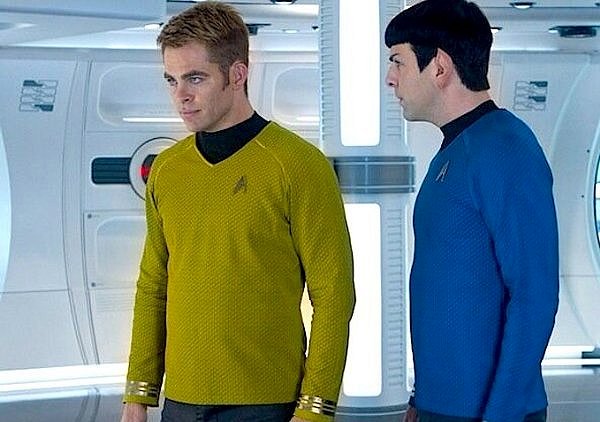
  • The characterizations of Kirk and Spock adhered to some of the traits that make the characters identifiable as such, but again I found them to be simulacrums who seemed more than just a bit "off." Chris Pine's Kirk is pretty much a dick and Zachary Quinto's Spock is at times overly emotional and even savagely violent in one notable instance. (Spock in a fistfight is a truly disheartening sight.) Of the Enterprise's "big three," the only one who came out smelling like roses was Dr. McCoy, once more played with eerily De Forest Kelley-esque gusto and grouchiness by Karl Urban. Spock fared okay (aside from his ludicrous brawl with Khan) but I didn't care for Kirk at all in this installment. All of the character's interesting and admirable traits were swapped out in favor of attempting to turn him into a blatant Han Solo clone — complete with Millennium Falcon knockoff spaceship — and I blame that squarely on the script and director J.J. Abrams' disinterest in STAR TREK, which is a matter of public record. At heart, he's a STAR WARS kid and after seeing this film I believe he's much better suited for handling the STAR WARS universe's brain-optional chapter play thrills (which is not to say that there are not good STAR WARS films) than he is at handling a science-fiction franchise that wears its interest in and exploration of basic humanity, be it Terran or extra-terrestrial, on its sleeve. Which is all for the good since he's ditched the TREK franchise to helm the new STAR WARS movies for Disney. I just hope whoever is tapped to take the wheel for TREK once Abrams has fucked off is someone who actually gives a damn about STAR TREK and what made it unique, enduring, and endearing.

"Captain, exactly who are we? You certainly are NOT James T. Kirk, and I sure as fuck am NOT Spock."

As previously stated, I did not hate STAR TREK INTO DARKNESS but I could not care less about seeing the filmmakers haul out stories we've already seen and that have become iconic in the annals of cinematic science-fiction. Yeah, they probably went in that direction thanks to focus group testing (never a good idea) or due to a perception that WRATH OF KHAN needed to be re-jiggered — like how PROMETHEUS treated the ALIEN franchise, only nowhere near as nonsensically — for the audience of the twenty-teens, but I say fuck that shit. If people want to see THE WRATH OF KHAN, that's what Netflix and cable are for. The STAR TREK concept is first and foremost supposed to be about seeking out new life and new civilizations, with the accent on "new," and there's a whole galaxy out there that at this point in the reset timeline has yet to be charted. A galaxy is big. I mean really fucking ginormously BIG, so how about a film of the Enterprise actually getting started on its five-year mission and actually doing some fucking exploration? The story possibilities are limitless! The new film ends with that supposedly being where it's all going but I'll believe it when I see it in narrative action. I just hope the next film doesn't turn out to be about a war with the Klingons.

BOTTOM LINE: It's a fast-moving way to spend two hours and twelve minutes, but STAR TREK INTO DARKNESS is a TREK film for undemanding audiences who just want the pretty CGI and 'splodey stuff, and for longtime fans who by this point are so brainwashed that they no longer care what the studio gives them, just as long as it bears the STAR TREK brand. Wait for cable.

Friday, June 8, 2012

PROMETHEUS (2012)


When Ridley Scott's ALIEN hit in 1979, it was a game-changer for the genre of cinematic science-fiction and earned classic status overnight for its blend of visually realistic and believable deep space adventure and outright horror. It also spawned a number of sequels, the second of which also quite rightly became a classic, and its creatures — known as "xenomorphs" — and their horrific life cycle became iconic, terrifying touchstones for the post-STAR WARS era. Having been sequelized to ever-diminishing returns (especially in the case of the execrable ALIENS VS. PREDATOR flicks), it was only a matter of time before Hollywood's mania for re-imaginings/reboots/remakes got around to the whole ALIEN thing, so now we get the ambitious PROMETHEUS, helmed by the director of the original ALIEN, and it's definitely a re-imagining/reboot/remake and possibly the most anticipated of this summer's potential blockbusters.

Opening with an archaeological discovery in the year 2089, PROMETHEUS details an expedition to a distant planet whose location was determined from ancient cave paintings and stone carvings found all over the world, crafted by completely unrelated cultures. The two archaeologists who discovered the imagery believe it to be an invitation for the inhabitants of Earth to go and meet the depicted giant spacefarers whom the archaeologists believe to be the creators of the human species. Upon arriving at the planet in question, the expedition discovers the derelict spacecraft from ALIEN, only it's buried so they think it's just some sort of underground crypt. The place displays the bio-mechanical visual tropes established in the first film and features a couple of rooms housing thousands of upright containers filled with an ominous oozing black glop that the expedition's obligatory artificial human/robot sneakily obtains a sample of. The presumed crypt is also littered with the bodies of dead giant aliens — dubbed "Engineers" by the archaeologists — so the head of one is brought back to the ship for study. As expected, all hell eventually breaks loose and very bad things happen to the crew as a number of suspicious aspects of the voyage's agenda begin to crop up. Why is the ship's medical pod only equipped for male patients? Why is a representative of the corporation that funded the mission along for the ride and why are her quarters a large and luxuriously-appointed self-contained escape pod? Why is the ship's artificial human/robot committing very questionable acts that completely violate Asimov's Three Laws? And exactly why did the Engineers seed the Earth with their DNA (which is an exact match with human DNA) and what are they doing with all those containers?

As previously stated, PROMETHEUS is a series reboot, and it takes the ideas and basic universe of the ALIEN films and plays with them in a number of ways, but for me it came off as a visually stunning hollow shell that failed to grab me. I did not connect with or have even the slightest interest in any of the bland scientist characters that meandered about during its running time, and more than once I looked at my watch and wondered when it would all finally end. In fact, about a third of the way through the film I was so underwhelmed that I seriously contemplated getting up and leaving. I'll try to stay as spoiler-free as possible, but here are the pertinent points:
  • For an attempted reboot of the franchise that pretty much defined the blended science-fiction/horror genre, there is absolutely no suspense and only the most minimal horror.
  • We do get creatures that are intended to be scary, but these re-imagined versions of the larval and adult versions of the xenomorphs and what looks like a fused proto-version of a facehugger and an eel fail to deliver in the scares department. There's also a creature that starts out resembling a sort of four-tentacled octopus wiggly (a "quatropus," if you will) and ends up as the biggest goddamned kinda-sorta facehugger you've ever seen. It would have been right at home in a Sinbad movie.
An Engineer ends up on the wrong end of an encounter with the biggest face-hugger ever.
  • And speaking of the quatropus, it's the end result of a ridiculous and dire Caesarian surgical procedure in which the previously-infertile female archaeologist (Noomi Rapace) finds herself in an advanced state of pregnancy after getting it on with her husband following the artificial human slipping him a sample of the black alien glop while he was on a booze-fueled bender. (pauses to catch breath) The terrified mom-to-be hauls ass to the aforementioned automated medical pod, dopes herself up and straps in as the unit carves her open, removes the wildly squirming quatropus and seals her gaping abdominal wound with surgical staples.
Apparently, having just endured an automated C-section to remove a rapidly-gestating extraterrestrial horror does nothing to hamper one's ability to take care of business.


All suited up, running away from imminent disaster and confronting extraterrestrial mayhem with a firefighting axe while traipsing about with a gut held together by surgical staples.

Literally at the moment this procedure is completed, she leaves the med-lab and spends the rest of the film running around in a full spacesuit and getting bumped about and bounced off of very hard surfaces and objects like she hadn't just had an unnatural horror ripped from her womb not even a half hour earlier. I can suspend a hell of a lot of disbelief for a science-fiction story, but I just couldn't buy that.
  • I may be looking at this from a cynical point of view, but this reboot appears to me to be a convenient way of ditching the majority of ALIEN visualist H.R. Giger's designs in favor of more predictable and generic creatures in a concerted effort to not have to pay or credit the groundbreaking Swiss artist for his indelible contributions to the look and feel of the franchise. The creepy and slime-laden look of Giger's concepts are utterly stripped away and the xenomorph eggs have even been reduced from fleshy oversized "footballs" to mass-produced, character-void containers. I'm guessing the prestige name of Ridley Scott will attract droves of ALIEN fans in hope of rendering this a hit and thus generating sequels to be passed off to any convenient hack director and equally hackish designers, and that prospect just fills me with inertia.
  • Among the many nonsensical examples of how people act put forth in the film's script, the most egregious are the numerous times wherein professional scientists proceed in handling what is the most important scientific discovery in all of human experience with not a lick of common sense or anything resembling considered procedure. There's little thought given to possible contamination from previously un-encountered micro-organisms on A GODDAMNED ALIEN PLANET other than a couple of token decontamination sequences, which are either forgotten about or not, depending on what the sloppy script calls for. Needless to say, this stupidity comes back to bite this crew of alleged professionals on the ass on several eye-rolling occasions. There are also several examples where no caution whatsoever is exercised in handling various extraterrestrial remains and compounds, and anyone with even half a brain will be astonished by those lapses.
  • The black goo that occupies the containers on the Engineers' ship is inconsistent in its effect on those who come in contact with it or ingest it, a fault that should have been dealt with before the final shooting script was approved. It causes different "cool stuff" to happen as the script dictates, and this occurs with no rhyme or reason.
  • The film utterly wastes beautiful and talented Oscar-winner Charlise Theron in the thankless role of the aforementioned corporate rep. She turns in her most lifeless performance since the title character in the live-action adaptation of AEON FLUX (and bad though that film was, it was a lot livelier and more visually imaginative than PROMETHEUS). She does have one fun character bit with ship's captain Idris Elba (aka Heimdall from THOR), but it's one minuscule moment of personality in a desert of ciphers.
  • The sole character that I gave a shit about was David, the ship's artificial human, well-played by Michael Fassbender.
He pretty much performs the same plot function as Ian Holm's Ash in ALIEN, but he's far more charming and sympathetic because he's essentially a slave who's got no choice in his actions.
  • Never show excerpts from a much better film in a mediocre movie, since that could serve to remind viewers of how there's much better fare out there to be had. In the case of this film, they unwisely and unnecessarily included a sequence from David Lean's LAWRENCE OF ARABIA that made me think of how much I would have preferred to be watching that instead.
  • Perhaps most dishearteningly, PROMETHEUS is highly derivative of a good number of science-fiction stories found in books, television shows and films, not just what came before in the ALIEN franchise, and as a result there's nothing here that we have not seen done somewhere else and usually in a much more interesting/engaging fashion.
The audience opinion at the screening I saw was hotly divided, with some declaring PROMETHEUS "a science-fiction masterpiece" while others disappointedly groused and one patron loudly exclaimed "BOOOOOOOOOOOO!!!" when the credits rolled (with a hearty Bronx cheer thrown in by Yours Truly). I've certainly seen worse movies but I was hugely disappointed and occasionally bored by PROMETHEUS, though your mileage may vary. If all you're interested in is great special effects and production design, you'll do just fine. (I did not see it in 3-D, though I've been told that the 3-D is exceptional.) Those who need more than that may end up feeling gypped, so if you're in that camp I suggest you see it with your expectations kept as low as possible.

No, this isn't Melody, Alan and Josie in a live-action re-imagining/reboot/remake of JOSIE AND THE PUSSYCATS IN OUTER SPACE (unfortunately).

Sunday, March 11, 2012

JOHN CARTER (2012)

By now you may have heard about Disney’s JOHN CARTER movie and how it’s likely to be considered a massive $250,000,000 flop (the actual budgetary figure varies depending on the source). The pre-release buzz tarred the film as looking uninvolving and dull, and upon release it was largely savaged by critics who deemed it, among other pejoratives, “unoriginal” and “derivative” of flicks like STAR WARS EPISODE II: ATTACK OF THE CLONES and AVATAR. Well lemme tell ya, Bunkie, it’s actually the other way around, so here’s a wee divergence for a short history lesson.

Where it all began.

The first of the John Carter pulp stories, originally issued as UNDER THE MOONS OF MARS and later re-titled A PRINCESS OF MARS when published in book form, appeared in the February 1912 issue of THE ALL-STORY pulp magazine and was the inaugural work of Edgar Rice Burroughs, the man who less than a year later would earn great wealth, fame and literary/pop culture immortality as the creator of Tarzan of the Apes. Over the course of eleven pulp novels, Burroughs spun fanciful tales of John Carter, a former Confederate officer and master swordsman who through rather weird means finds himself terrestrially displaced to the planet Mars — known to its native inhabitants as Barsoom — where he encounters a number of warlike races, all manner of strange creatures and a cornucopia of advanced-yet-quaint ordnance and sci-fi vehicles. He also wins the hand of a local princess whose beauty is described as “unequaled,” and from there the adventures cover a hell of a lot of old school ground, pretty much inventing many of the tropes that are now part of the DNA of science-fiction/fantasy adventures. If one does even a cursory overview of such stories over the past century, many of the common elements of the genre that we now take for granted or find rote can be traced directly back to the Rosetta Stone of Burroughs imagination. For the most recent example of what I’m talking about, look no further than James Cameron’s “revolutionary” AVATAR (2009), the monster box office hit that I was not alone in considering it to owe a sizable debt to much of what Burroughs came up with in the John Carter tales. The exotic alien world and culture, multi-legged beasties, an Earthman hero who goes native in a big way and marries the locals’ princess… All found in AVATAR and all cribbed from the first John Carter story written a hundred years ago, so don’t come crying to me about JOHN CARTER the movie being “derivative.”

My boyhood wish finally comes true, some thirty-six years after I first encountered the John Carter books.

Disney’s JOHN CARTER is a film I’ve waited for since I first read the initial novel thirty-seven years ago, and though not without some flaws here and there, I enjoyed it very, very much. It’s got all the action, romance, intrigue, cool extra-terrestrials — the awesome Tharks are among my all-time favorite alien characters — and the far-flung exotic planetscape that made Burroughs’ stories irresistible to me when I was between the ages of ten and fourteen (though it was unfortunately inevitable that the novels’ depiction of Barsoom’s culture as that of a planetwide nudist colony would be sanitized for the screen, especially since it’s a Disney film) and it made me feel like I was a kid again, even for the briefest of periods. Simply put, it was exactly what I needed to take me out of my currently miserable and frustrating existence for just over two hours, and I enjoyed it enough to happily pay NYC 3-D movie price to see it twice within twenty-four hours. (NOTE: I admit that I likely enjoyed it as much as I did thanks to having been a lifelong John Carter fan, so your individual mileage may vary.)

John Carter among the Tharks.

The film chronicles John Carter (Taylor Kitsch, who’s not bad in the part but exudes nothing of the Southern gentleman quality found in the novels) having adventures on Mars/Barsoom that drop him into the middle of a conflict between the warring city states of Helium and Zodanga, while he must also navigate surviving among the equally warlike Tharks, towering green warrior tribesmen with four arms. During all of this mayhem, Carter befriends the Thark chief, Tars Tarkas (Willem Defoe), and much-abused female slave Sola (Samantha Morton), as well as meeting the spirited and smokin’ hot Heliumite princess Dejah Thoris (Lynn Collins), while political machinations from a number of different parties spur the narrative’s finer points.

Boy gets to know girl during a road trip fraught with discovery and ass-kickings

If all of that sounds complicated or convoluted, it isn’t, and it all moves quite briskly while doling out heaping helpings of old-fashioned fun that evokes the sci-fi/fantasy/space opera thrills of yore, which is only appropriate when one recalls that this is the seed from which an entire genre germinated. What we have here is, when boiled down to its simplest descriptor, an old-fashioned pulp adventure yarn brought to vivid, fun life, and that’s really all there is to it. If you’re looking for Dostoyevsky, I politely suggest you look elsewhere.

Among the film’s many fun points, the following elements are the standouts:

  • The Tharks are everything I’d hoped they’d be (if depicted a good deal shorter than the average fifteen feet described in the books), especially Tars Tarkas (Willem Defoe, giving voice to an excellent CGI creation) and Sola (Samantha Morton, also voicing a CGI character).
The awesomeness of Tars Tarkas finally hits the screen.

Sola: a much put-upon warrior with a heart of gold.

Tarkas was the main reason I continued reading the books and when I was kid who devoured those works, I often imagined myself in his place in the adventures. He was just that cool. The one problem with Tars Tarkas and Sola in this film — which, let’s face it, is yet another origin story — is that they are not the focus of the narrative. Whenever they’re onscreen, they steal the movie, but John Carter himself is the true and obvious thrust of the tale, so Tars and Sola are understandably given less screen time. More’s the pity…

  • Woola, Carter’s assigned guardian animal — a “calot” in the books, but never identified as such in the film — also steals the movie.

He’s a large-ish, dog-like critter that’s the film’s grossest example of “Disneyfication,” a not unexpected process that altered the beast from the source material’s much more fearsome-looking creature, but even knowing the more visually badassed Woola from the books, I adored the cinematic version. And you and your kids will too.
  • Lynn Collins rocks as Princess Dejah Thoris, the film's best non-CGI character.
The casting of that character was a serious make-or-break element for the film, thanks to a century of her being burned into the pop culture DNA matrix as an impossibly beautiful, exotic woman who could easily and without hesitation dispatch her would-be assailants. Yeah, she was captured and rescued on a number of occasions in the books, but Dejah Thoris was a surprisingly capable heroine for her era and I would argue that she was the direct attitudinal progenitor to the likes of STAR WARS’ Princess Leia.

Lynn Collins, as seen when she's not being all Barsoomian.

Collins turns in a great performance and is very, very easy on the eyes, plus she wields a sword quite impressively. She’s the perfect fantasy female for guys like me, and I find it more than a little amusing to note that technically Dejah Thoris has joined the ranks of the Disney Princesses, what with having been brought to the screen and sanitized from the original iteration. (In her case, her 24/7 nudity obviously had to go).

The latest of the Disney Princesses.
  • The all-too-brief appearances by James Purefoy as Heliumite royal soldier Kantos Kan are terrific and genuinely funny, and I wish we’d had the opportunity to see more of him.

So, there’s a lot to enjoy in JOHN CARTER but Disney did a spectacularly poor job of marketing the film, which I believe is the key element in the film doing shithouse box office domestically. The trailers bit the big one, the posters and logo were the polar opposite of interesting or attention-getting, the words “of mars” were removed from the title shortly before the film’s release (reportedly due to Disney now-fired marketing head determining that the earlier MARS NEEDS MOMS tanked and therefore the word “Mars” was automatic box office poison), thus granting the film the utterly generic title of JOHN CARTER (they may as well have called it JOE BUDIDOWITZ: THE MOVIE, for all that the title imparted about other-worldly adventure, aliens and a hot space-babe) and there was no mention whatsoever of the character being from the same guy who created Tarzan.

The most boring movie poster ever?

In fact, if I didn’t know better, I would swear that the studio was making a concerted effort to sabotage its own release. Most of the critics have also been merciless and I wonder if that’s because they just don’t like this kind of material or they’ve just joined the overwhelming culture of Internet hating on something for months before it even comes out, thus already bearing a head and heart full of vitriol as they enter the screening room.

Whatever the case, the damage has been done and theater attendance on opening weekend was dismal. I saw the film twice, first at a decent multiplex not far from where I live in Brooklyn, and again the following night at Manhattan’s legendary Ziegfeld theater, and I can scarce recall seeing a big-budget sci-fi/action/adventure movie in its first few days where the theaters were so barren that their aisles should have been littered with bison skulls and tumbleweeds. The 4pm show on Friday yielded a turnout of just over twenty people (including me), many of whom were fans of the John Carter novels (a fact gleaned from overhearing their conversations on the way out), and the 7pm show on Saturday night at the Ziegfeld — a showtime that’s virtually always guaranteed to be sold out, almost no matter what movie may be playing there — saw an audience of maybe sixty-five or seventy people, including myself and the four friends who joined me.

Actual shot of the Ziegfeld's auditorium, ten minutes before the lights went down on Saturday night. The crowd did not come anywhere near to filling the theater's capacity of just over 1100.

We all enjoyed it and the majority of folks who’ve written in to comment about it on my Facebook wall shared in the fun, so hopefully positive word of mouth will help turn JOHN CARTER into a “sleeper” hit. Anything can happen and I hope it does well enough to generate a sequel, and I hope the studio stands behind it if it comes to pass.

Thursday, August 4, 2011

RISE OF THE PLANET OF THE APES (2011)

And lo, the gods of cinema did hear the hue and cry of the people, and finally they did right the grievous wrong that was the 2001 version of PLANET OF THE APES. A new APES film was bestowed upon the earth and it was good. Very, very, good. Yea, verily the curse of Tim Burton was broken, and there was much rejoicing.

-excerpt from The Chronicles of Cinematic Recompense

Like many children of the Seventies, I was a staunch supporter of the era's "Ape-mania," loving the PLANET OF THE APES movies and a good deal of their attendant fallout. The sci-fi pickings in the pre-STAR WARS days were pretty feeble, so when a series of films that were (mostly) pretty damned good came along, you cherished it. The APES movies all featured a good deal of social commentary/satire on subjects such as racism, religion vs. science/anthropology, nuclear self-destruction and the ethical vagaries of vivisection, and the pondering of those things while wrapped in allegorical sci-fi trappings was something that stirred the young minds of my generation. So when it was announced that there would be a new APES movie made in the wake of Tim Burton's decade-old abortion, I questioned whether the new film would follow Burton's brain-dead lead or be some kind of return to something a tad more intellectually stimulating. (In today's utterly mindless cinematic climate of movies by committee, I did not hold out much hope.) What I got was totally not what I expected and I could not be happier with the results.

In modern day San Francisco, scientist Will Rodman (James Franco) seeks a cure for Alzheimer's, something sorely needed by his aging father (John Lithgow) whose mind is deteriorating on a daily basis. Working within the corporate labs of the Gen-Sys pharmaceutical corporation, Rodman develops a serum that when tested on chimpanzees causes the brain to repair itself and generate new neural pathways, fixing Alzheimer's and boosting intelligence to amazing levels. Following an incident in which a particularly gifted female test subject, "Bright Eyes," goes berserk and escapes from the lab, resulting in her being gunned down by corporate security during the meeting that would have led to the greenlighting of the drug's testing on human subjects, it is revealed that that she was protecting the baby she had given birth to and hidden below her bed. Ruling the drug a failure, Rodman's money-hungry boss orders all of the test chimps destroyed, but since the baby was discovered after its mother's rampage and is thus known only to Rodman and the lab's chimp-handler, Rodman adopts the adorable little orphan and raises him at home in secret. For the next eight years, the chimpanzee, dubbed "Caesar," enjoys life in a loving home where he forms deep familial bonds with Doctor Rodman and his dad. Unbeknownst to his Gen-Sys superiors, Rodman continues the testing of the drug on his father and the results are both swift and spectacular. Meanwhile, Caesar displays intelligence far beyond the garden variety chimp, even exhibiting functioning and skills beyond humans of a relative age and development. (Though Caesar himself was not directly administered the experimental drug, his mother sure as hell was and the effects of the serum are proven to be genetically transmissible.) But things take a turn for the worse when the drug's effects upon the elder Rodman are reversed as the old man's body builds an immunity to it. Wandering into the street, the confused old man gets into a confrontation with the next door neighbor that is observed by Caesar, who launches into violent defense of his family member. Though the neighbor is not killed, poor Caesar is court ordered into the custody of a specialized home for great apes, a place where our simian protagonist experiences firsthand just how cruel man can be. It is during this incarceration that Caesar's resentment of mankind is forged, and from there he launches a revolt that — along with a couple of other factors that I won't spoil — leads to the beginning of the end for the human race's planetwide dominance.

RISE OF THE PLANET OF THE APES comes from out of nowhere (and from beneath the shadow of Tim Burton's atrocity) to not only be my favorite film of the summer blockbuster season, but also takes its well-deserved place as one of the best major studio films of the year. The script is surprisingly intelligent and does not at all cater to the moronic demographic Hollywood has spent well over a decade dishing out mindless celluloid candyfloss to by the truckload. I honestly believe the filmmakers involved looked at the Burton fiasco (and also some of the gaffes made in most of the films in the original series) and decided not to make the same mistakes as what came before. This is the origin story of Caesar I had never dared to hope for, and I have every intention of seeing it at least once more during its theatrical run.

Items of note in the film:
  • The excellent motion-captured performance by the brilliant Andy Sirkis, the guy who so deftly brought Gollum to life in LORD OF THE RINGS trilogy. His Caesar is simply impossible not to care about and root for, and I can honestly say that by halfway through the film, the entire audience wanted to see him and his all-ape army win. While Rodman's story is certainly interesting, the film belongs to Caesar and his point of view during its events.
  • The sometimes ham-fisted social commentary of the original series has been wisely kicked to the curb in favor of a hero's journey story fused with what can be seen as an animal rights piece from the point of view of animals.
  • The other featured apes are also pretty cool, especially Maurice the orangutan (think about that one for a minute, o my fellow geeks) and Duke, a very large and understandably pissed-off gorilla.
  • Pay attention whenever any TV news reports are seen, especially those relating to a space mission to Mars.
  • The effects on all of the apes are outstanding and believable. The somewhat spotty footage seen in the trailers and TV ads do not do the work seen onscreen justice, so don't judge the film on what you saw in the previews of the past few months.
And there has been much discussion in the media and in online geek forums of how obviously impossible it would be for a relatively small force of apes, even organized and super-intelligent ones, to take on armed police and the national guard and have even the slightest chance of winning, but let me assure you that that question is very directly addressed and the answer quite satisfyingly requires very little suspension of disbelief. Hell, I bought it and I am one exceedingly critical son of a bitch. Believe that!

BOTTOM LINE: I simply loved RISE OF THE PLANET OF THE APES and very highly recommend that you see it in the theater. A franchise movie of this caliber that does not talk down to its audience is rare indeed, and it should be shown appreciation with your box office cash. But one word of warning: The story gets very emotionally intense in some areas and it greatly affected the grownups in the audience, so bear in mind how children react to animal characters that they come to care about. Kids will love Caesar, so expect them to become quite upset during a lot of what he goes through. (Plus to say nothing of the awful demise of his mother.)