Search This Blog

Showing posts with label LET'S GET STONED. Show all posts

Sunday, August 30, 2020

BILL & TED FACE THE MUSIC (2020)

Older and no wiser: the long-awaited and most welcome return of Bill S. Preston (Alex Winter) and Ted (Keanu Reeves) Theodore Logan.

Just finished watching BILL & TED FACE THE MUSIC, and I found it to be considerably superior to the second entry in the series, BILL & TED'S BOGUS JOURNEY (1991), a film that is not without its supporters. And before we get to the review, the original BILL & TED'S EXCELLENT ADVENTURE (1989) is still the best of the unintentional but very much a trilogy. This current entry brings everything full circle, and who of us who saw the original when it came out would have expected a return to our heroes some 31 years later?

The film finds our hapless heroes, still brought to life by Alex Winter and Keanu Reeves — who slide back into the roles effortlessly — racing against the clock to simultaneously acquire the song that will unite humanity and save an unraveling universe, while also seeking to prevent their wives — 15th century princess, remember — from leaving them. Meanwhile, their daughters and female doppelgangers, Billie and Thea — they named their daughters after each other — go off on a trans-temporal adventure of their own as they assemble a band to play the song that their fathers are destined to craft, and in the process they set up "Bill & Ted: The Next Generation," should there be more of these.

 Thea (Samara Weaving) and Billie (Brigette Lundy-Paine): the next generation of time travelers?

Winter and Reeves return to their old characters deftly, having not lost a single step, and William Sadler returns as Death, reprising the role that was easily the best thing about BOGUS JOURNEY. Billie and Thea are basically Bill & Ted reborn as girls and they both work as distaff duplicates of their fathers, so they would be welcome if the torch is passed to them. Brigette Lundy-Paine is a standout as Billie, thanks to her nailing everything when it comes to a new embodiment of Reeves's Ted. She nails his manner of speech and his body language to an uncanny degree, and I would love to see more of her in the role. We also get Billie and Thea assembling an eclectic crew to travel through time with, including Jimi Hendrix, Luis Armstrong, Mozart, and others. It's a loony, convoluted mess that's a hoot to sit through, and it ends with quite an unexpected twist, actually...

There are no gags that went nowhere like in the previous film — one word: "Station," though station does briefly return as a nod to what came before — and the whole film is just a much-needed feel-good movie for this dire era. It's amusing on its own, but I think a lot of whether or not the viewer will enjoy it will be based on how much the viewer is already a Bill & Ted fan.

Bottom line: BILL & TED FACE THE MUSIC is just what we need right now, and I feel good for having sat through it. If I had seen it in the theater at full price, I would have exited satisfied and in a good mood.

Lastly, illegal "party favors" are recommended for full enjoyment. Trust me on that one!

Poster for the theatrical release. 

Sunday, April 19, 2020

JAY AND SILENT BOB REBOOT (2019)

Our heroes return.

Just sat through JAY AND SILENT BOB REBOOT (2019) and found it to be better than expected, though it's hands down the second-weakest entry in the series (after MALLRATS). As is repeatedly pointed out over the course of the movie it's basically a remake, er, "reboot" of JAY AND SILENT BOB STRIKE BACK (2001), along with elements and characters from the other films in the run, and once more our hapless heroes set off on a cross-country odyssey to prevent the making of a film about them, this time a reboot. 

Jay (Jason Mewes) pays tribute to Buffalo Bill.

It starts out rather rote and I almost turned it off, but things pick up considerably once we are introduced to Millennium "Milly" Faulken (Harley Quinn Smith in what is easily her best role) and her trio of girlfriends, and she is revealed to be the daughter that Jay (Jason Mewes) never knew he had fathered. Sadly, Jay and Silent Bob (Kevin Smith) are sworn to secrecy regarding Jay being Milly's dad, after which the girls hijack the stoners' road trip and force them to take them along to Hollywood. Wacky adventures ensue and Jay, who himself never met his dad, must come to terms with his sudden unexpected parenthood of a belligerent and dangerous 18-year-old girl. That's over-simplifying a plot that's already about as far from Dostoyevsky as one can get, so I suggest smoking a fat blunt and just going with it. 

Millennium "Milly" Faulken (Harley Quinn Smith). When casting your own daughter is a good idea.

The movie overall is just okay, and instead of simply rehashing JAY AND SILENT BOB STRIKE BACK, I would have preferred for writer/director/star Kevin Smith to have focused the narrative on the sub-plot of Jay and Milly. Along with his familiar shenanigans as the motor-mouthed and not-necessarily-bright Jay, Mewes solidly delivers in the heartfelt scenes between Jay and Milly. It's in no uncertain terms a surprising effort from him and is a crowning emotional through point in what would otherwise just be a silly and disposable movie. We also feel for Milly's half of the equation, as it's made clear that much of her attitude and aggression comes from always having longed to meet the father that she never knew, which Jay eventually twigs to, and it truly rips one's heart out as we see him struggle to keep his word about not revealing to Milly exactly who he is. There are a number of moments of verbal exchange between Jay and Milly that struck too close to home for me and I freely admit that I openly wept in certain spots. (Those who know me well in the world out side of facebook will understand why.)
BOTTOM LINE: The emotional arc for Jay is what makes this film worth sitting through, and I sincerely hope that Mewes goes forward to stretch his wings in parts that allow him more to do than resort to his signature and admittedly funny stoner antics. Not a full-on return to form for Kevin Smith, but parts of this are razor-sharp. C+ for the film as a whole entity, but an A+ for the realization of the Jay and Milly sub-plot.

Poster from the theatrical release.

Friday, December 6, 2013

RIFFTRAX LIVE: SANTA CLAUS CONQUERS THE MARTIANS (1964/2013)


Last night I went to the Rifftrax live screening of the classic seasonal bad movie SANTA CLAUS CONQUERS THE MARTIANS (1964) with three friends, and we had a blast.

For those not in the know, SANTA CLAUS CONQUERS THE MARTIANS is a cheapjack kiddie movie that played annually for ages on the now defunct kiddie movie matinee circuit, and it was in that context that I saw it several times during my childhood. Even as a wee moppet I knew it was a piece of shit, but I saw it numerous times during those days because it was always part of an all-day movie show where parents could drop off the little ones for three full features and a number of cartoons  and short subjects, giving mom and dad time in which to sleep, fuck, get wasted, have marriage-ending fights without the kids around, or a combination of some or all of the aforementioned activities. As a kid I found it an insult to my intelligence but as I got older and my fascination with bad movies blossomed, it took on a luster that few of the bad kiddie movies I endured could match. Its narrative of a party of Martians kidnapping Santa Claus (and an incidental brother/sister team of kids) in order to bring joy to the listless children of their world is ultra-juvenile, cheaply-made and very cheap-looking, boasts no special effects to speak of — which is a real problem for a movie involving technologically-advanced  space aliens and inter-planetary travel — contains one of the most irritating "comic relief" characters in the entire history of world cinema, possesses the screen debut of future sleaze-film star Pia Zadora, has robot and polar bear costumes that would not have passed muster in an Ed Wood flick, and features an incredibly annoying theme song that sticks in one's head like napalm while being so terrible that it comes back around to actually become endearing. In short, it's a masterpiece of crap.

The film rests on its laurels among the pantheon of classic bad movies, so it was perhaps inevitable that the crew at MYSTERY SCIENCE THEATER 3000 would find it perfect fodder for their weekly sarcastic evisceration of terrible cinema. Their version of it is now rightly hailed as one of the all-time greats from the series' ten-season run, so when the guys from Rifftrax — all of whom are alumni of MYSTERY SCIENCE THEATER 3000 and continuing that show's tradition for the 2000's — announced that they'd be doing a live theatrical simulcast of their take on SANTA CLAUS CONQUERS THE MARTIANS, I swore I would be there with bells on and I would drag as many of my friends as possible along with me. Two of the three friends who attended had never seen the movie before (much less with it being snarkily riffed upon by Mike Nelson, Kevin Murphy, and Bill Corbett), so they were unprepared for what they got.

Though I enjoy what the guys of Rifftrax do, not all of their efforts result in gems and their treatment of SANTA CLAUS CONQUERS THE MARTIANS, while certainly funny, simply could not hold a candle to the MYSTERY SCIENCE THEATER 3000 version. That was a bit of a disappointment but it was fun nonetheless, largely thanks to an unexpected bonus.

SANTA AND THE FAIRY SNOW QUEEN (1951): a jaw-dropping short of the highest (?) order.

The screening was preceded by the short SANTA AND THE FAIRY SNOW QUEEN (1951), a spectacularly warped kiddie time-waster that felt like it was made in the ERASERHEAD universe. Think "Five Characters in Search of an Exit" if it had been viewed through the effects of a potent cocktail of well tequila, muscle relaxers, and Nyquil. The shit was funny as hell and worth the price of admission. MST3K fans will enjoy it because it is extremely reminiscent of aspects from the legendary MR. B NATURAL. (Those who've seen that one will immediately get what kind of psycho vibe I'm talking about. In tonight's short there's a character named Snoopy who's a magical brownie played by a woman, which brings up all of the confusing androgyny that made MR. B NATURAL an instant classic.) 

Some of the live Rifftrax shows have come out on DVD — BIRDEMIC: SHOCK AND TERROR and MANOS:  THE HANDS OF FATE being the must-sees — and I'd be willing to bet that we'll be seeing this one available for at-home enjoyment soon enough. I recommend it, but mostly for SANTA AND THE FAIRY SNOW QUEEN. The MST3K version of  SANTA CLAUS CONQUERS THE MARTIANS is currently available in a two-movie DVD edition that pairs it with MITCHELL, a film considered by many fans to be the series' single funniest entry, so recommend picking that up in the meantime.

Friday, February 24, 2012

BUFFALO RIDER (1978)

If you’re of a certain age — specifically, a middle-aged American whose childhood/adolescence occurred between roughly 1973 through 1980 — you are likely to recall the spate of cheapjack "family" films featuring some random white dude or family of white folks, either in the past or the then-present, who lived in the woods or on the prairie with a legion of animal friends from assorted species. Those flicks did decent box office and were mostly marketed as children's matinee fodder, and god knows I saw several of them, most notably BROTHER OF THE WIND (1973), THE LIFE AND TIMES OF GRIZZLY ADAMS (1974) and THE ADVENTURES OF THE WILDERNESS FAMILY (1975). However, despite my regular attendance at Saturday afternoon movie matinees, one of that brief period's films that I never heard of until about a week ago is 1978's BUFFALO RIDER, and if I'd seen its trailer at the time, I would likely have gone to see it. I mean, just look at this:


A feature-length exercise in padding out a movie’s running time as much as possible, the film opens with an eight-minute “In Search Of…”-style history of the decline in the once-voluminous buffalo population and confusingly alternates between narration from some unidentified individual who claims to have heard the movie’s details from his grandfather, and the grizzled tones of a secondary narrator who is apparently meant to represent the common buffalo hunter (it’s never actually made clear). Tons of nature/animal footage unspools as the audience is filled in on the year 1871 seeing a new tanning process that made buffalo hide as easily rendered into numerous products as simple cowhide, thus escalating the already ruinous and wasteful efforts of sleazy buffalo hunters who skinned the beasts and left their carcasses to rot, leading to the tragic and staggering figure of some forty-million buffalo being slain between 1871 and 1875. This sequence also introduces us to a trio of scurvy buffalo hunters who serve as the flimsy story’s villains, and these guys would easily fit in as the standard unwashed human vermin common to Spaghetti Westerns and certain Sam Peckinpah horse operas, but more on them later.

According to the narrator, Jake Jones, the titular character, was (apparently) a thoughtful and silent former buffalo hunter who sickened of the slaughter and left to live as a buckskin-clad mountain man in the wilderness of Utah and Wyoming, until the Fall of 1881, when he encountered a baby buffalo whose mother had been killed by some scumbag hunters and was under attack by a pack of hungry coyotes. Jake and the buffalo fight off the coyotes and Jake decides to care for the orphaned calf, rather than let it fall victim to the assorted predators in the area (this despite Jake clearly having been established as one of those hardcore crunchy, bearded at-one-with-nature types). Deciding he would have to care for the buffalo until its wounds healed, Jake immediately ties up the poor beast and embarks on a long period of breaking the wild buffalo in a homemade corral. Despite already having a totally serviceable horse, Jake soon chucks a saddle on the buffalo — which eventually grows into a 2000-pound behemoth named Samson (a name the narrator oh-so-helpfully reminds us is “from the Bible”) — and learns to ride the clearly-unwilling shaggy bulldozer in a lengthy, slo-mo-accented sequence replete with “stirring” ‘70’s faux-frontier music and the frequently repeated and awful theme song, a tune that evokes ‘70’s-era TV commercials for pickup trucks and beer, and the lyrics of which bestow upon Jake the heroic nickname of “Buffalo Jones,” thus cementing him as a legend or something.

Once man and beast forge themselves into a clumsy team, the wafer-thin plot finally gets underway. In fact, calling it a plot is something of an overstatement since what we really get is mostly a series of sporadic events, punctuated with footage of animals that are meant to make the film’s kiddie audience “ooh” and “aah” at the wonders of nature, and counterpointed with occasional looks at the douchebaggery of the bad guy buffalo hunters. Said douchey hunters encounter Buffalo Jones when they try to kill his horned mount and end up shooting Jones in the process. Samson runs away from the hunter with Jones on his back and the pair stumble upon the conveniently-located home of another mountain man/minor-league gold-panner and his wife, who nurse Jones back to health and welcome him into their household. From there, the highlights (?) include:
  • An uneventful encounter with a “Grizzly” that’s actually clearly a standard black bear.
  • A feeble run-in with an Injun who wants to kill Samson because he’s perceived the beast as “big medicine” thanks to there being some crazy bearded hippie on its back. The Injun proves to be quite incompetent at his task and ends up with his jaw broken by Buffalo Jones’ rifle butt. Remember, this is supposed to be a family film.
  • Buffalo Jones’ friendship with a raccoon named Bandit, a creature whose presence is included solely to stretch out the running time. Once introduced, the focus of the narrative completely shifts to Bandit and his adventures in the desolate winter landscape as he faces a hungry cougar (featuring moments where I would have sworn the cougar was about to eat the poor raccoon’s head), endures an icy flash-flood and, despite having been clearly identified as a male, is suddenly revealed to be a female that gives birth to a pair of adorable babies, thus providing the film with yet more footage of cute l’il animals. All of this Bandit stuff goes on for a solid ten minutes, after which Bandit and her babies abruptly disappear from the film, never to be seen or mentioned again.
  • Uninteresting sequences in which we see the buffalo hunters going about their business and basically being a pack of repulsive assholes. Meant to establish character, all these bits do is make us fervently wish these goons were excised from the story because they seem to serve no purpose whatsoever, but our endurance is eventually rewarded (sort of)…
  • Buffalo Jones’ mountain man friend goes out hunting for game and runs into two hungry Grizzlies — this time actual bears of the proper variety — who very savagely fight in such a manner as to make me think the film’s animal wranglers had little or no control over what happened when they unleashed the bruins for the shoot. The bears bloodily tear the living shit out of each other and I swear it does not look faked in the least. Again, this is supposed to be a wholesome “family” film.
After all that filler, the plot kinda/sorta begins to go somewhere when the mountain man’s wife mentions her brother, his wife and their infant son are on their way to visit, at which point all that time wasted with the buffalo hunters finally serves a purpose. The hunters bushwack the innocent family, killing the adults and leaving the baby untended on the ground as they ransack the covered wagon for anything they can find, after which they head into the nearest town to trade what they’ve stolen for booze and other assorted frontier distractions. When the family does not arrive on time, Buffalo Jones hops on Samson for the first bit of actual buffalo riding in quite a while, and goes in search of the missing relatives (opting to ride Samson instead of a much swifter and more efficient mount, such as, oh, a horse). It takes Buffalo Jones four days to come across the dead couple and the pillaged wagon, where he finds the baby — who has miraculously held on for all that time without food, water, or a change of diapers, plus to say nothing of somehow managing not to be devoured by the local predators — and clues that incriminate the hunters who had earlier attempted to kill him. But vengeance must wait as the next twenty minutes of screen time are padded with Buffalo Jones’ four-day efforts to make it back to his mountain man friend’s shack, a journey including fending off hungry wolves, getting into a slo-mo fistfight with another cougar, a quick look-in on the squabbling hunters, tons of footage of Samson’s bulk providing difficulty in his making his way through deep snow, riveting close-up footage of Buffalo Jones reloading his pistol, Samson acting as a babysitter, Jones and Samson battling their way across a river’s strong current and, my personal favorite image, Buffalo Jones grabbing a big porcupine by its tail and making off with it so he can make a broth from its meat to feed the starving baby.

After dropping the baby off with the mountain couple, Buffalo Jones rides off on Samson in search of the killers, but first he runs into more film-padding in the form of a pack of wolves who want to eat him and Samson. (Jones does not simply whip out his gun and shoot the wolves because that would be douchey and against nature, something that forcing a buffalo to let him ride it obviously is not.) The hunters have split up, so Buffalo Jones tracks two of them to a saloon where, in the film’s most visually-outrageous moment, Jones rides his buffalo into the place and blazes away with his revolver, executing the two hunters and confusing the living shit out of the assorted drunken prospectors and mountain men in attendance. The remaining hunter is soon located and meets a deservedly horrible slo-mo end when he’s mercilessly trampled by Samson, while Buffalo Jones stoically drives the beastie. With justice served, Buffalo Jones and Samson ride off into the sunset and the narrator announces that the orphaned baby was his grandfather. That revelation was clearly meant to have a certain level of profundity but its desired effect merely elicits a dozy “And I care because…?” from the half-asleep audience.

BUFFALO RIDER is one very odd entry into its genre. Though ostensibly a family feature, the film is an uneasy fusion of the western, the ‘70’s post-hippie back-to-nature zeitgeist, and stoner entertainment that kind of floats from incident to incident in something akin to a dreamlike state. The virtually silent hero who rides a buffalo looks like a mythic figure straight out of a peyote-fueled mystic vision and the film’s whole vibe fairly reeks of good, skunky buds as inhaled in the back of a tricked-out van some thirty-plus years ago. If I still smoked weed, I’m betting this ultra-mellow oddity would not be half-bad to sit through while completely baked, but seen without illegal intoxicants its flaws are glaring. For a movie containing supposedly family-acceptable violence of both the human and animal varieties, it’s not at all exciting, and its story particulars at times feel as though they were communicated by a child randomly dropping building blocks into place and hoping the narrative makes sense and flows naturally. It's worth a look for western completists, but I most strongly recommend it for insomniacs who may find its meager charms a soothing lead-in to solidly nodding off.

Thursday, May 5, 2011

HORROR CLASSIC, OR NONSENSICAL PIECE OF CRAP? A look back at Don Coscarelli's PHANTASM (1979)

I was just fourteen when writer/director Don Coscarelli's PHANTASM first hit the screen, and its memorable TV commercials greatly intrigued me. Loaded with atmospheric imagery and the mysterious (and murderous) flying chrome ball, the ads were the perfect come-on to a young lad who was crossing over from childhood into young adulthood, displaying a tone not unlike some of the previously-encountered "kiddie" horror offerings, but it was rated R and therefore appeared guaranteed to deliver some true scares. It would be perhaps another two years before I actually got to see PHANTASM on cable, by which time the infamous "slasher" boom of the early-1980's was in full, gory swing and after being exposed to the avalanche of those orgies of unabashed gore, PHANTASM was perceived as something of a disappointment by many of my peers and even to this day the film is often cited as being an 88-minute load of bullshit that makes not a lick of sense. On the other hand, it is also considered by many to be very deserving of its considerable cult following, so what's the deal with this little low-budget horror offering that so polarizes viewers?

PHANTASM is less of a coherent narrative than a dreamlike stream of weird ideas and images that raise more questions than they answer. It's about an escalating series of eerie events as experienced by thirteen-year-old Mike Pearson (Michael Baldwin), whose parents have been dead for a couple of years and is being raised by his twenty-something brother, Jody (Bill Thornbury), and when the story opens we're told that the town has been plagued with a number of mysterious deaths. When Mike witnesses the creepy mortician, the Tall Man (Angus Scrimm), apparently stealing the body of a recent corpse and using superhuman strength to do so, he begins an investigation of the type common to kid's horror stories and Scooby-Doo cartoons. But in this case his world is turned into a never-ending nightmare of encounters with an aged, mute telepathic fortune teller who communicates through her pretty granddaughter, strange dwarves in monk robes, visits to a surreal mortuary that looks and feels like something straight out of a Ken Russell film, dreams that may or may not actually be happening to him, antique photographs that come to life and stare back at the viewer, and more freaked-out goings-on than one can shake a stick at. All of this stuff is followable in a linear fashion and it is a fascinating and visually creative cinematic journey, but nothing is ever explained to any level of real satisfaction. Is Mike actually experiencing all of this shit, or is he going insane? Who is the Tall Man? Exactly why is he stealing corpses to transform them into diminutive robed zombie slaves? Is he an alien? Is he from another dimension? Is this a horror movie or actually a bizarre science-fiction film in disguise?

Is this another planet? Another dimension? Both? Who the fuck knows???

And what exactly is that lethal flying ball, and why is it equipped to exsanguinate anyone unfortunate enough to find themselves its target?

The mysterious ball goes to work.

Fuck if I know, but I can tell you this: PHANTASM is something you should definitely check out at least once, because it's unique in the annals of horror cinema. It's not what I would call actually scary — although it could definitely fuck-up the under-tens if they sat through it — but it is creepy as hell, and its stark, almost fairytale-like vibe make it feel like a film imported from some off-kilter netherworld, a strange alternate place where everything seems just one step slightly removed from reality as we are familiar with it.

Coscarelli was only twenty-three when PHANTASM went into production and he was twenty-five when it was released, and I think that his youth had a solid impact on how different and completely unpredictable this film is, resulting in an odd fusion of the late-1970's horror aesthetic and an art film sensibility. It also displays healthy lashings of pre-EVIL DEAD blending of horror and humor in some of its sequences, especially the business with the severed finger that transforms into a very aggressive fly-monster puppet, and it treads that fine line with great aplomb. As for his intent when crafting the film, Coscarelli has stated he simply wanted to make a horror film with lots of creepy shocks, and that the details cited by some fans as having deeper meaning are simply just there and bear no symbolic significance (for example, the presence of a copy of Roger Zelazny's novel MY NAME IS LEGION on the desk in Mike's bedroom; it was selected "because it had a neat cover and looked good"). I, for one, think he created a thought-provoking study in mood and almost-hallucinatory nightmarishness, and while it may not be scary per se, it has stuck in my head for thirty years and it continues to please something deep within me. It works on what I refer to as "kid logic" and its childlike sensibility kind of makes me think of what would have happened if the adventures of Gumby and Pokey had been directed by a madman. I love it for that. However, those of you who would approach this film in search of genuine balls-out horror, scares, or outright gore are likely to be sorely disappointed and wonder what the fuck the big deal is, but I urge you to set aside whatever preconceptions you may have and meet it on its own terms.

PHANTASM was successful enough to spawn three sequels, of which I only saw the second, and I don't remember much of it so I can't tell you if any of the questions raised in the first film are in any way answered. But, having recently sat through the original for the first time in over two decades and finding my fascination with it re-kindled, I'm curious to check them out.

Poster from the original theatrical release.

Sunday, March 6, 2011

MATCHING ESCORT (1982)

I've been in a martial arts movie mood lately, especially of the occasionally outrageous 1980's wuxia variety, and this particularly crazed Taiwanese flick managed to more than fill that need.

For those not in the know, wuxia is perhaps the most venerable of the martial sub-genres, bearing a rich history spanning centuries of literature and other arts, with its best-known examples for western audiences being the elaborate CROUCHING TIGER, HIDDEN DRAGON (2000) and HOUSE OF FLYING DAGGERS (2004). Modern wuxia films are genuine spectacles, replete with high-flying wire-work meant to symbolically embellish the heroes' already considerable skills, romance and lavish sets and costumes, but the earlier examples of the form were often cheaply made and hastily shot, rife with over-the-top melodrama and much chewing of the scenery. But, if you ask me, that's what makes the old school examples a million times more fun than their modern descendants, and MATCHING ESCORT is a balls-out riot of superheroics and unintentional (?) hilarity.

First of all, as near as I can determine, the title MATCHING ESCORT has absolutely nothing whatsoever to do with the film's plot, so that's a win right out of the gate. And unless you're a regular watcher of films of this sort it's rather easy to lose track of what's going on in the story, but I assure you that it does have a linear narrative, albeit one that contains many elements that make not one lick of sense. The basic plot is once again the tried and true revenge saga, this time involving a very girly young woman named Pearl Fan (played by Cheung Ling of WOLF DEVIL WOMAN infamy), who, as a child, is forced to constantly wear heavy shoes of metal with no explanation from her dad.

Child abuse or training device: the metal shoes are locked to our young heroine's feet.

As the years pass, Pearl Fan gets used to the metal shoes and can move about as nimbly as a monkey while wearing them, and when she takes them off her agility and speed become downright superhuman.

Then comes the day when a pack of the evil sword-wielding assholes requisite for this kind of story show up at her dad's house and proceed to kill seventy-three family members and house staff, except for Pearl Fan, who is entrusted with a precious family heirloom — the Jade Lovebird pendant — and unwillingly spirited away by a loyal retainer. The retainer is swiftly killed and our heroine soon finds herself framed for her family's murder, so now she's on the run from both the legitimate authorities and the clan of mysteriously-motivated killers. Disguising herself as a boy (rather unconvincingly, but you just have to let that go) — one of the major tropes of the genre in stories featuring female heroes — Pearl Fan is chased to and dumped over a sheer cliff by the killers, who leave her for dead. But what they don't know is that she has fallen into a deep cave that resembles and even-lower-budget version of H.R. Pufnstuf's Living Island, where resides an hilariously kvetchy old crippled hermit named Uncle Strange. No, seriously.

Uncle Strange: Yoda he ain't.

Initially quite irritated at Pearl Fan for her unplanned landing in a vat of vaguely mystical potion that he'd been preparing for twenty years, a potion that would have somehow enabled him to exact revenge upon the villain who crippled his feet and cast him into the cave, Uncle Strange is moved by our heroine's desire for revenge of her own and so agrees to take her on as his pupil. (It soon turns out that Pearl Fan's quest for vengeance neatly/conveniently dovetails with that of Uncle Strange.) As this is a wuxia martial arts film, it has less to do with hand-to-hand styles than swordsmanship and more "romantic" action playing up the hero's grace and moral purity, so Pearl's training, such as it is, involves little more than a tad of hand techniques that will later allow her to catch and break sword blades with just two fingers (her later-displayed utter badassery with a sword is not explained but is accepted as a given for the genre's requirements).

A clearly not amused Pearl Fan demonstrates the bitchin' two-fingered sword-catching move.

She is also subjected to a regimen of assorted potions, strange fungi (Awright!) and unguents that grant her the necessary skills of a typical genre hero (the aforementioned 20-years-in-the-making potion presumably being some kind of Asian super-soldier serum), and she's ready to get down to the serious business of killing when Uncle Strange dies after physically transferring his energy to her (and hilariously freezing in position with his arm outstretched and a wild look on his face when he croaks). Once back in the outside world, Pearl Fan displays all the attributes one expects from a wuxia superhero, and her skills with a sword would make even the most adept of Jedi turn chartreuse with envy.

The newly-badassed Pearl Fan hands out free passes to the netherworld on a lonely beach.

The rest of the film is a series of genre trope-laden, dizzying and unrealistically bloody swordfights against her enemies and it's a hell of a lot of leave-your-brain-at-the-door fun getting to the inevitable outcome. The wild and utterly impossible acrobatics and swordplay are piled on quite generously, making the film a definite precursor to the kind of thing we so enjoyed in XENA: WARRIOR PRINCESS, only cartoonishly gorier.

Bad guy "Simon Cloud" meets his deservedly gory demise.

Our heroine, mowing down bad guys like weeds.

You've gotta love the heroine's moments of balletic poise in the brief moments between whirling arms and clashing steel.

There's also a disguised traveling prince — accompanied by the by-then-stock annoying comic relief servant whose basic character is meant to invoke Jackie Chan, only much more broadly — who's on hand to provide a love interest that literally goes nowhere and serves virtually no purpose to the story, so the less said of him the better.

The superfluous prince and his annoying servant.

(Oh, alright...Regarding the whole prince sub-plot, the story's Big Bad is revealed to have his eye on ruling the country and aims to kill the prince as part of his plans, but that sub-plot is given very short shrift and really doesn't add anything to Pearl Fan's narrative since you know going in that she's going to win in the end, so the governmental overthrow angle is totally superfluous.)

The film's ultra-flamboyant-looking Big Bad, who is quite appropriately named — and I'm not making this up — Lord Rouge.

If all of this sounds only slightly goofy and not like anything all that special, that's because I have thus far neglected to mention the overall "fairytale on mushrooms" feel and approach of the piece. There's not one single frame's-worth of realism in it and its look fuses low-budget cheapness with garish colors and occasionally weird-assed sets (Uncle Strange's cave being something straight out of a kiddie show's idea of "scary"). And of course all of the aforementioned physical impossibilities, and the ever-popular running-on-water move all add up to a heady cornucopia of wuxia junk food of the highest order.

Wire-work fun at its most endearingly cheesy.

Though nowhere near as brain-wrenchingly out of its mind as actor/director Cheung Ling's legendary WOLF DEVIL WOMAN (which I will definitely get around to reviewing one of these days), MATCHING ESCORT is a stone hoot and should be shared with friends and family as soon as possible. And although there is spewing arterial spray (translation: pressurized gallons of bright red paint) and some dismemberments here and there, the gore on hand is not scary at all and would only be disturbing to the youngest of viewers. I would not hesitate to show it to kids if seven and older, so use that caveat as a guide. Me? I plan to show this to my nephew, Nate, as soon as possible, and I also think my niece, Cleo, would totally dig it because it's about a "lady hero" (as she would have put it when she a tad younger) and it has violence. This film could easily have run on the late, lamented Channel 5 Saturday afternoon DRIVE-IN MOVIE weekly kung fu showcase of the early-through-mid-1980's with no editing for content, but that was then and this is now, so if run today the film's split-second decapitation and hand-lopping would likely be cut. If I had to rate this, I'd give it a PG, but the wussified MPAA would likely insist on a PG-13 or a wholly undeserved "mild R." RECOMMENDED.

The excellence that was Cheung Ling.

Wednesday, March 2, 2011

EXORCIST II: THE HERETIC (1977)

A portent of impending scares, or an invitation to yucks? You decide!
 

One of the universe's greatest truisms is that whenever anything is successful, a sequel is inevitable, so when William Friedkin's adaptation of William Peter Blatty's THE EXORCIST (1973) raked in the samoleons at the box office (over 66 mil in early-1970's dollars, and that ain't hay!) it was only a matter of time until a followup graced the screen. But any sequel to THE EXORCIST would have been a daunting task. How to follow an instant classic that shattered onscreen taboos regarding language, religious improprieties (Ouch! That crucifix!) and truly creative cussing while maintaining the high standard of quality set by the original would have proved daunting to any writer or director, and as per the nature of sequels one would assume that the general public would have been expecting more of the same, perhaps with the blasphemous ante being cranked up a notch or two. So what to do in order to meet the public's expectations and make an assload of box office at the same time? The answer to that question cannot be found in 1977's EXORCIST II: THE HERETIC, a literally unholy mess of a film whose reputation as possibly the single worst sequel in major motion picture history seems pretty much set in stone. 

Helmed by world-class oddball director John Boorman, the guy who gave us DELIVERANCE (1973) and the jaw-dropping Sean Connery vehicle ZARDOZ (1974), EXORCIST II: THE HERETIC unwisely chooses to focus on the possibility that Reagan McNeal (Linda Blair, reprising the role that made her famous) may still harbor memories of the excruciating details of her exorcism some three years prior to the events of this film. Sent by the Vatican to dig up all the necessary dirt while investigating the death of the priest who performed Reagan's excorcism — Father Merrin (Max Von Sydow, reprising his role as a much younger version of his character in the original film) — Father Philip Lamont (Richard Burton, looking and acting like he's in the midst of a week-long bender) journeys to Manhattan where a high school-aged Reagan lives and volunteers at a bizarro clinic that helps the mentally ill/challenged. The place is run by Dr. Tuskin (Louise Fletcher, here pulling a total one-eighty from her Oscar-winning role as Nurse Ratched in ONE FLEW OVER THE CUCKOO'S NEST), who breaks out this trippy-looking strobe light and bio-feedback headsets that looked like something you'd have found in a head shop at the time and uses it to hypnotize Reagan into remembering her forgotten experience of demonic possession. That turns out to be a bad idea because the second Reagan's fully under she starts sounding like Lucille Ball during her autumn years, her face gets all evil and fucked-up-looking, and the demon identifies itself as Pazuzu, a malevolent ancient Assyrian wind spirit and "one of the lords of the air." 

Whoa, dude! Trippy! But not scary.
  
As of that point the film nosedives into a nigh-incomprehensible mess of questioned faith, misguided attempts at psychedelia, bullshit psychobabble, flashbacks to Father Merrin's first exorcism, all manner of bizarre mystic visions and mumbo-jumbo, accented with Linda Blair performing in an utterly awful chorus line production of "Lullaby of Broadway," and the unforgettable sight of James Earl Jones as an African holy man in a ridiculous locust costume. It all culminates in a confusing fistfight between Father Lamont and Pazuzu in the form of Reagan's evil twin, a bout settled when the good Reagan arrives and fends off a swarm of demonically-controlled locusts by imitating the movements made by Jones' character during his youth as he used a bull-roarer to drive the evil bugs from his village, all while father Lamont literally tears out Pazuzu's heart.  

Now this is what the audience craved to see: Linda Blair battling locusts.
  
A lot more crazy shit happens, and if any of this sounds coherent, let me assure you that it isn't. 

When I first saw EXORCIST II: THE HERETIC during its network television premiere — the night after THE EXORCIST, so the edited-for-TV version of that was fresh in my mind — I watched it with my mom, and the two of us nearly laughed ourselves to death. To this day we can still crack each other up with random quotes from the film ("Pazuzu will help me find Kokumo!!!"), and while it is an unmitigated turd storm, I must confess to finding it entertaining as hell, and loaded to the gills with visuals that bring to mind Alejandro Jodorowsky in his more accessible moments. Boorman's visual imagination was given free reign, and the film is replete with beautiful and bizarre imagery and gorgeous cinematography. Too bad there wasn't a script good enough to properly complement Boorman's vision. Perhaps the saddest thing about EXORCIST II: THE HERETIC is that when it is carefully examined, there are the building blocks for what could have been a genuinely good and scary film that could have used the original flick as a starting point and really run with some of the story's themes. My two major points on this are as follows:

  • The first thing they should have done was lose Reagan entirely; she was successfully rid of demonic influence at the end of the first story, and not much the worse for wear thanks to having psychologically blocked out the entire hellish experience. By bringing her back when her arc was clearly over and done with for audiences who demand more of the same — or at the behest of studio execs who can't think beyond the immediately familiar — , the film renders Father Merrin's heroic efforts and sacrifice, as well as Father Karras', without meaning or impact, pissing all over the power of Catholicism that supposedly saved Reagan's soul. And when we find out that demons like Pazuzu run around possessing folks like Reagan because they are so pure and good that they have what amounts to superpowers, it throws a cheesy X-Men kind of vibe over the proceedings.
  • The film should have focused on Father Lamont's investigative efforts and his own crisis of faith in the face of the returned Pazuzu (who, by the way, was not identified in the original, but was implied to be the Devil himself; by having Pazuzu turn out to be pretty much just a badassed grasshopper, his terror level is considerably diminished). Lamont's tracing of Kokumo, the kid long ago exorcised by Merrin, could have gone down many fascinating and potentially terrifying avenues, all of which could have been well served by Boorman's imagination. The interaction between the Christian, specifically Catholic, powers that be and their opposite numbers has fueled horror stories from day one, and it wouldn't have taken too much effort to have come up with a great Campbellish "hero's journey" for Lamont that would have seen him lose his faith only to have it restored in the aftermath of the throwdown with Pazuzu. The long-running Vertigo comics series HELLBLAZER pulled off many such stories as a matter of course, so there's really no excuse, especially when tons of money are thrown into such a project (yes, I know HELLBLAZER was bastardized up the ass for the awful CONSTANTINE movie, so I won't even go there).
So, yes, EXORCIST II: THE HERETIC is a spectacular misfire, but there's too much good material to be found amidst this cinematic dog's breakfast to fully write it off as one of the worst films ever made. I've certainly seen far worse, both from low-budget schlockmeisters like Al Adamson and from the major studios, and unlike many other bad films, at least EXORCIST II: THE HERETIC entertained the crap out of me, something I cannot say about would-be blockbusters like SKY CAPTAIN AND THE WORLD OF TOMORROW, PEARL HARBOR, or LIVE FREE OR DIE HARD. Give EXORCIST II: THE HERETIC a second chance, and this time while you're laughing take note of the cool shit it possesses (sorry) and grieve for what could have been a glorious entry in the horror genre.
Poster from the original theatrical release.

Tuesday, November 9, 2010

AACHI & SSIPAK (2006)

Crazy. Just plain balls-out crazy. That's about the only way to describe the sheer insanity and wholesale carnage on display in Jo Beom-jin's AACHI & SSIPAK, a South Korean exercise in unbridled animated mayhem and humorous bad taste. I saw a free screening of it in Tribeca last night and I'm completely blown away.

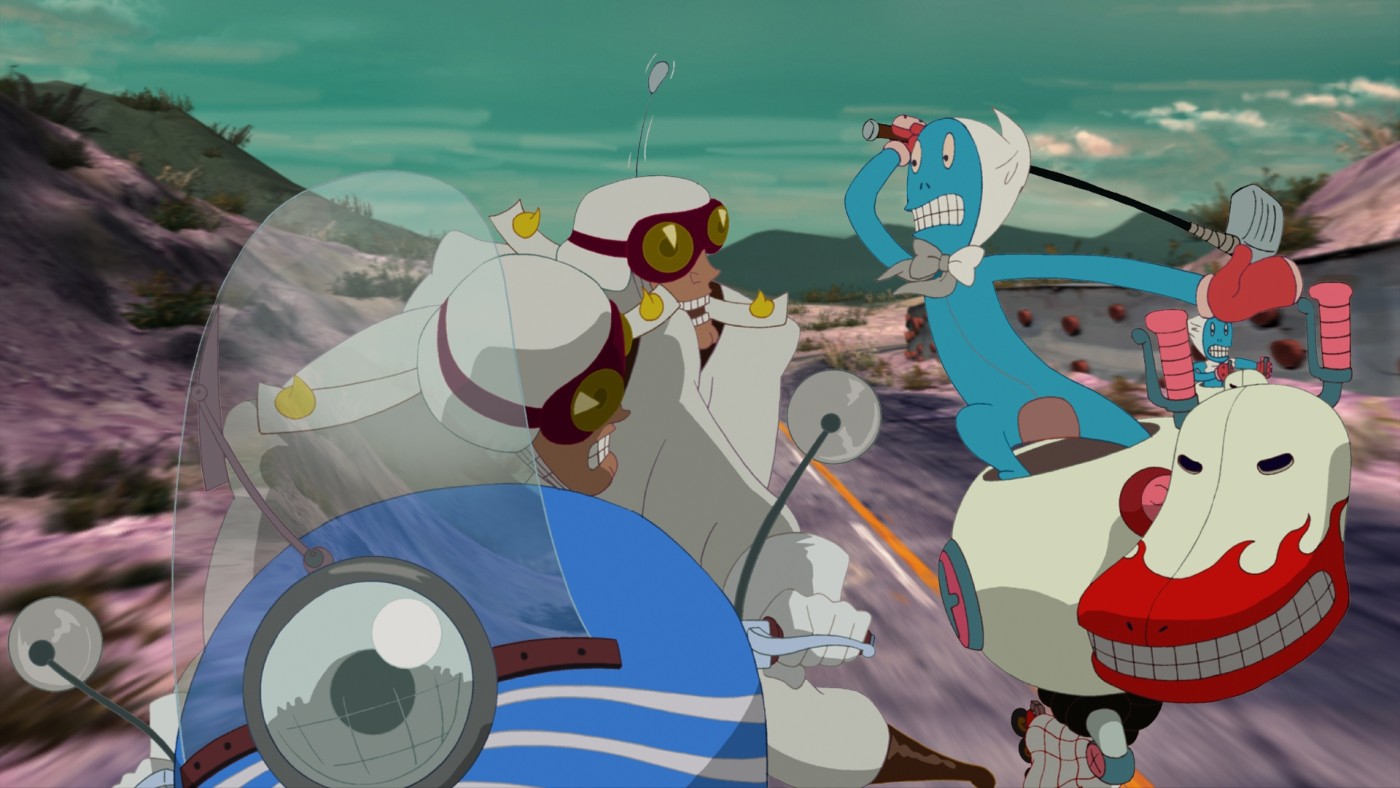
At an unspecified point in the future, the only renewable energy resource is human excrement, so the government anally implants citizens with an identity ring that takes note of when they drop a deuce, and the citizen's contribution to the fuel supply is rewarded with a narcotic Juicy Bar, an addictive taste treat that looks like a popsicle made from Windex. Unfortunately, a side-effect of Juicy Bars is that they can turn those who eat them into borderline-retarded blue mutants who can now only metabolize Juicy Bars for nourishment, and when the government cuts off distribution of the bars to the mutants, they band together under the leadership of the Diaper King and ravage armed Juicy Bar shipments as the ultra-violent Diaper Gang. In the aptly-named Shit City, Juicy Bars are abundant, so the gang has plenty to plunder.

Highway robbery: the Diaper Gang hijacks a shipment of Juicy Bars.

But the government isn't having that, so their resident very mad scientist, Dr. Strange, creates Geko, an inhumanly agile, motorbike-riding super-cyborg who's equipped with enough ordnance to overthrow a small country. Geko regularly annihilates droves of the Diapers, but their numbers seem limitless so his fight goes on and on.

Geko, the cybernetic one-man army, in action.

Into this maelstrom of violence ride the diminutive Aachi and his bald, shirtless friend, Ssipak, two biker punks who make a living by hanging around public lavatories and ripping off Juicy Bars from citizens while they're still on the bowl and selling the bars on the lucrative black market. After getting beaten up by prison-based gangsters whose territory they've horned in on, the pair find Jimmy the Freak, a flamboyant pornographer who's making an "artistic" film about a girl whose anus saves the world (don't ask), and the two get him Carlos Castaneda-level fucked-up on Juicy Bars in order to remote control his body and wreak vengeance upon the the crime boss whose boys had earlier assaulted them and made off with their ill-gotten loot. As the Diaper Gang also zeroes in on the crime boss and his Juicy Bar ring, all hell breaks loose, landing Jimmy in the clutches of the Diaper King, while the boys meet Beautiful, an avaricious porn actress who sought the lead in Jimmy's new film (and turned up her nose at his anally-oriented film concept, instead suggesting he focus on her world-saving tits).

Beautiful makes her pitch.

During the Juicy Bar-spurred madness, Jimmy explains to the Diaper King that all he needs to do to get all the Juicy Bars he and his people need is to find someone who takes exceptional dumps and implant them with several of those anal identification rings. In theory that would cause a decent dump to yield vast amounts of the bars, so Jimmy points the Diaper Gang in the direction of the perfect subject, namely Beautiful. Once kidnapped by the gang, Beautiful is unwillingly stuffed with the identity rings, only to be rescued in the nick of time by our heroes (at the insistence of the smitten Ssipak).

Beautiful, getting anally stuffed like a Thanksgiving turkey, just as our heroes arrive to literally save her ass.

With Beautiful now amounting to the goose that laid the golden eggs, the trio turn her defacatory yield into an avalanche of Juicy Bars ready for black market distribution and in no time the crew find themselves Tony Montana-level wealthy, which allows them to live out their dreams of tacky opulence.

Our newly rich heroes, stylin' and profilin'.

But such a state of affairs was not meant to last and the forces of the government, the Diaper Gang and the utterly mad Dr. Strange each converge to claim Beautiful (who has plans of her own for her cash cow ass) and shut down the crew's operation. While a cornucopia of mayhem and violence erupts from every conceivable direction, it's a race against time to save Beautiful from a horrid existence of rectal slavery as Aachi and Ssapik must simultaneously contend with the legion of Diaper Gang mutants, the guns-a-blazin' fury of Geko, evil government officials, and some special threats dreamed up by the psycho doctor.

The battle for Beautiful.

AACHI & SSIPAK is a delirious, beautifully-designed and colorful head-on collision of a NATIONAL LAMPOON sensibility, a HEAVY METAL-style anarchic and dystopian future, and the kind of wild sci-fi fun to be found in 2000 AD magazine during its classic period. It's also a real treat for film buffs because it references and pays homage to many of the films that it was influenced by, but, unlike a Quentin Tarantino crib-fest like KILL BILL VOL. 1, it never becomes a feature-length checklist of the filmmaker's sources.

Beautiful borrows a page from Uma Thurman during the film's "wealth" montage.

By far the best and most entertaining Asian animated movie I've seen in ages, I cannot recommend this highly enough for those of a mind to check it out. The only problem with doing so is that AACHI & SSIPAK is not yet legally available on DVD here in the States, obtainable only via "gray market" DVD if you know where to look, and on YouTube. At last night's screening, the show's host stated that the film is supposedly slated for legitimate release on DVD next year, so keep your eyes open. Until then, go here for the first fourteen minutes of the film. You will NOT be disappointed, so make sure to watch this as large as possible. (I would have embedded it, but embedding of this material was disabled by request.)

Aachi, shamelessly grooving on the profits garnered from Beautiful's bountiful turds.

Monday, October 4, 2010

SITA SINGS THE BLUES (2009)

You know how sometimes there comes a project that so overwhelms you with its quality and singular charm that you wish the artistic hand and mind behind it nothing but further success and accolades? That's exactly how I feel with regard to cartoonist Nina Paley and the Herculean effort she put into SITA SINGS THE BLUES, a very personal and compelling take on the great ancient Indian epic RAMAYANA, a work that serves as one of the cornerstones of Hindu literature and culture. I was totally blown away by its cornucopia of seemingly incongruous music, mythic culture and imagery, and the film came from out of nowhere to find itself on the short list of my favorite animated films. (It's a great movie in general, but as animation it's a unique work.) Those of you who read this blog with any kind of regularity know that I'm a very tough audience, so take this review at face value.

Told in a number of contrasting visual styles, the film looks at the RAMAYANA as recounted by a trio of contemporary Indians discussing it amongst themselves, providing the Western newcomer with a greatly abbreviated version that retains all of the important bits of the narrative while infusing the piece with healthy doses of modern irreverence. The meat of the tale relates the disintegration of the relationship between Rama — the ideal of the "perfect" man and seventh avatar of Vishnu, the supreme Hindu god — and his wife, Sita — perhaps the example of the "perfect" Indian woman and spouse, also an avatar of the goddess Laxmi, consort to Vishnu — but unlike most interpretations of its source material, Paley's film has the audacity (and sanity) to call into serious question Rama's treatment of Sita, especially when all she does is be selfless to a fault. You see, due to the political machinations of one of his father's wives, Rama is sent away from his father's kingdom for fourteen years just as he's about to take the reigns of rule from his dad; the scheming wife seeks to elevate one of her sons to the throne by way of cashing in a carte blanche wish promised by Rama's father, so she figures that sending the rightful heir away for fourteen years will amount to a case of "out of sight, out of mind." The dutiful Sita accompanies her hubby into the wilderness and while there she catches the eye of the rakshasa Ravana (a rakshasa is a kind of evil spirit, best known in the West for being a "monster of the week" on KOLCHACK: THE NIGHT STALKER back in 1974), the king of the land of Lanka, who abducts her with the intention of making her his bride.

Ravana puts on the moves, much to Sita's displeasure.

That opens a major can of whupass in the form of a righteous and quite understandably offended Rama, who is aided by the monkey warrior Hanuman and his army of loyal monkey badassess, leading to all-out war between the forces of good an evil.

Rama leads the monkey army into battle against Ravana.

Upon Sita's rescue, Rama promptly rejects his wife, believing her to have submitted to her demonic captor's advances. We, the viewers, know that isn't the case thanks to us having witnessed the details of Sita's captivity and her steadfast belief in her man coming to save her, plus her unwavering loyalty to him, yet despite her declarations of her innocence, Rama nonetheless demands that she undergo a very literal trial by fire via which her "purity" will be proven. If she lives and is unharmed by the flames, innocent. If not...

Rama, Hanuman and Sita.

Sita comes through it all without so much as an inch's worth of sooty sari, so Rama takes her back (which one would damned well hope he would since several of the major gods show up in testament to Sita's complete and utter innocence). But things once more go off the rails when Sita finds herself pregnant with Rama's twin sons, which, for no adequately explained reason, Rama believes the result of Sita's non-existent infidelity (again, her innocence was vouched for by the gods themselves), so he banishes his pregnant wife from his kingdom in order to maintain the respect of the citizenry. More happens after that, but the point is that Sita keeps receiving the doo-doo end of the lollipop, all while clinging to her love and respect for her husband, a state of being that was meant to be an inspiration to all women back in the days (or all Indian women, anyway).

Sita's narrative is interesting enough and obviously ripe for much discussion from a feminist point of view, but the piece is lent an interesting parallel by Nina Paley's injection of her own marital situation into the mix, rendered with a "squigglevision" visual style whose simple mundanity underscores the RAMAYANA's epic grandeur. When Nina's husband accepts a job that takes him away from his wife (and their cat) for a six-month contract job in India, the man undergoes some changes during his time over there, changes that really become apparent when Paley arrives in India to join him and discovers he has grown distant and indifferent to her.

A contemporary parallel narrative: Nina arrives in India to discover her man has gone through some unexpected and unfortunate changes.

Upon returning to the States for a short gig in New York, Paley finds herself dumped by her husband, via email, no less (his reasons are never actually explained, but they are not necessarily germane to the point and they're not the viewer's business anyway), which leads her to find a degree of solace in the ancient words of the RAMAYANA. Thus, as embodied by Paley as a modern avatar (in my interpretation, anyway), Sita's struggle becomes a universal trial shared by a 21st-century sister, a deeply moving example of how the arts so often reflect life and how even a work as seemingly hoary as the RAMAYANA can remain relevant so long after its composition and so utterly removed from the time, place and native culture of its intended audience.

The kind of animated visuals that make me regret giving up recreational hallucinogens. (Gotta love that strutting moon!)

The fascinating stylistic elements found in SITA SINGS THE BLUES are many and never are they exploited solely for their sheer visual gimmickry. Paley's design style is both crisp and lush, lending the RAMAYANA's subjects a visually-pleasing and colorful aspect, which is wholly appropriate when dealing with Indian mythic figures, several of whom have been depicted since Day One as possessing pigments of assorted non-human hues. Everything within the RAMAYANA's mythic landscape is alive with color and interest, so even if that were the only thing the film had going for it, the audience would still have something solid and legitimate to absorb. In fact, I would say this film has the most fully-realized animated world/universe in any film since YELLOW SUBMARINE (1968) and that is a compliment I do not hand out lightly.

The well-versed and often irreverent "Greek chorus" of shadow puppets, seen here discussing Sita and Rama. I found these guys both informative and occasionally funny as hell.

Offering a running commentary on the story's events are a trio of modern day Indians who are represented in ornate silhouette by shadow puppet figures. Serving as the film's "Greek chorus," the trio of two guys and a woman recount the story in a manner suggesting it's something they've experienced since perhaps as far back as childhood, and their conversational manner suggests a level of comfortable, intimate familiarity with the material, an aspect that will certainly make the piece much more accessible to the Western newbie. That comfort and familiarity also affords an unexpected and refreshing level of discourse involving inconsistencies in the venerable narrative that more hidebound and reverent adherents would overlook or accept due to the work's place as a literary landmark, but the film's narrators' approach the material like a bunch of fans discussing a beloved work over drinks during happy hour, having fun with the object of their shared interest and making a number of very valid points about its content when looked at from a modern post-feminist context. Rama's behavior is deservedly called into question — Dude, the gods exonerated your wife...Hell-loooooo!!! — but Sita also gets called on the carpet for her moon-eyed and doting acceptance of her husband's cruelties, a pattern described by one of the male narrators as "her big mistake." Definitely not an attitude that would have been so matter-of-factly expressed in the more patriarchal time and culture from which the RAMAYANA sprang.

Jazz Age vocalist Annette Hanshaw (1901-1985): the voice of SITA SINGS THE BLUES.

Accenting all of this, and to great effect, is the music of vocalist Annette Hanshaw, a singer whose understated-but-heartfelt tones lend appropriate voice to Sita's point of view. Displaying that haunting and haunted sound that only pre-1940's jazz and blues recordings have, Hanshaw's songs are so dead-on in synch with what's going on in the story, you'd swear they were recent recordings crafted especially for Paley's film, only slightly aurally tweaked to simulate the aforementioned period sound. Jazz and blues are not exactly my thing, but I do love the very old school stuff, so the tunes found in the film's soundtrack were right up my alley, so much so that I bought the album immediately after seeing the film for the first time.

Speaking of which, I first sat through SITA SINGS THE BLUES a week ago, and as of me sitting here writing this piece — it's nearing 1AM on this Monday morning — I just sat through it for the fourth time about three hours ago. I intended to write about it last Monday or Tuesday, but I didn't have the time to sit down and give it the attention it deserves. I have now rectified that situation and I strongly urge you to buy your own copy of the DVD. A decent cut of the sales goes to Paley, who busted her ass making this film almost totally by herself, a feat that is nothing short of mind-blowing when one considers that there are many animated features from the past decade or so that cost many times more and had dozens of animators on staff and yet aren't one tenth as good as this.

Here endeth the review/love letter.