Search This Blog

Sunday, June 23, 2013

THIS IS THE END (2013)

So I had a free movie ticket that I earned via my membership in the Regal theater chain's club, and I figured I'd finally use it. The problem was that the local Regal theater, the beautiful but ghetto-licious Court Street Stadium 12, is deep in the throes of the early portion of the summer blockbuster season, so most of its auditoriums were taken up with multiple screenings of the current top hits, the major of which I have already seen, so it was between THE PURGE and THIS IS THE END as the flick I would expend my freebie on. I chose THIS IS THE END and I could not possibly be happier with that decision.

The biblical apocalypse suddenly happens, complete with The Rapture, and a number of current movie stars find themselves trapped together at the house of James Franco (playing himself), where a party was in full swing until the end of the world breaks out. We're talking the earth opening up, earthquakes, yawning chasms of what is presumably hellfire, violence and total lawlessness in the streets, demons running around...You name it, and if it's bad, it's happening, so our trapped celebs — Seth Rogen, Jay Baruchel, Jonah Hill, Craig Robinson, and Danny McBride, all playing themselves — opt to sit it all out, safely (?) barricaded in Franco's house. Food and water are limited, nerves fray by the second, and as the group begins to accept that it's not just some horrific natural disaster but actually the motherfucking apocalypse, they also stop to ask why they, actors whose work supposedly brings joy to the masses, did not ascend to Heaven when the shit went down.

Once we're clear that the apocalypse has hit, there's really no plot to speak of, but the setup of the actors trapped together allows for an avalanche of hilarious character study featuring one of the most laugh-out-loud hysterical scripts to come along in ages. The performances are all good straight across the board and the cameos by a good number of celebs who are not the focus of the narrative are all a hell of a lot of fun. Here's the breakdown:
  • What could easily have been a smarmy, winking vanity project for most of those involved is instead a terrifically vulgar, flawlessly-acted breath of comedic fresh air.
  • The actors gamely make or submit to harsh-but-honest criticisms of their own cinematic career choices, with my favorite jabs being reserved for THE GREEN HORNET and the piss-poor stoner comedy YOUR HIGHNESS.
  • Eternal wimpy nebbish Michael Cera completely and utterly destroys his onscreen image with the best out-of-control playing against type since Neil Patrick Harris in the first two HAROLD AND KUMAR movies, and that's really saying something. 
Michael Cera, kissing his usual image goodbye with a vengeance.
  • None of the actors comes off as being a "better" person than anyone else, some of them even going so far as to portray themselves as selfish, annoying total assholes.
  • Emma Watson forever distances herself from Hermione in the HARRY POTTER flicks with her no-nonsense survival-minded turn here.
Hermione no more!
  • For once we see an apocalypse that features horrific demons on the loose — at least one of which is very horny, which is not a good thing —even going so far as to give us a Godzilla-sized Satan striding about on cloven hooves, with his thick volcanic cock a-swingin'.
  • Speaking of things satanic, we get very clever and funny shoutouts/references to both ROSEMARY'S BABY and THE EXORCIST, the latter of which is put to solid comedic use.
  • The heated Franco/McBride exchange regarding male masturbation as a territorial marking exercise is an instant classic.
  • Channing Tatum, I applaud you for being the best of sports, and I won't spoil the reason why.
  • How does one end a movie about the end of the world and the utter disintegration of law, decency, and humanity? By being totally ridiculous and turning what for all the world looks like a cop-out ending into a triumph of sheer idiocy and R-rated silliness...
Full of the contemporary stoner humor and bromance tropes that I've come to expect and mostly dread over the past fifteen years or so, the film nonetheless has a very active brain in its head and it treats its over-the-top goings-on with far more intelligence than something like this has any right to possess. Seriously, I wish more comedies were even half as genuinely funny as THIS IS THE END, so let's see if the love the film is receiving causes Hollywood to take note of just why it all works as well as it does and start making comedies that actually bring the laughs we pay good money to see. Enough with that Freidberg & Seltzer DATE/SCARY/EPIC/DISASTER MOVIE bullshit!


Original theatrical poster.

Saturday, June 15, 2013

MAN OF STEEL (2013)


Henry Cavill, the latest actor to bring Superman to cinematic life.

Ah, Superman...

I'm a lifelong lover of superheroes and their adventures and I enjoy the many flavors to be found within the genre, but sometimes I like to keep things as basic as possible and once more return to the grand-daddy of them all. Superman owns a very large and warm piece of real estate in my heart and mind, a residence he took up about the time I first saw George Reeves in the classic THE ADVENTURES OF SUPERMAN television series, and from there my enjoyment of the character grew exponentially with the discovery of his far-reaching world in the comics. At that point in my childhood — I was seven — DC Comics was issuing 100-page "Super-Spectaculars," which was a glorified way of saying "reprints with one new story thrown in for good measure," for all of their regular series and I devoured them like a starving man attacks a fresh plate of sirloin with all the trimmings. Cheap to produce from their existing back catalog, the 100-pagers probably seemed like a money-saving after-thought to the publisher, but to us kids who were hungry for material we had not been exposed to, those collections were a goldmine of old school lore and wonder. Yes, much of it was crazy and silly, but they were among the purest examples of the one element that made for perfect kid's comics entertainment, namely FUN, an element that is sorely lacking in most of the comics that are created today. (To be fair, today's comics are mostly being produced for now-grown kids who grew up on comics, and few publishers gave a damn about making comics for children anymore. More's the pity...) Of the DC stable of heroes, Superman's mythology was arguably the richest, flavored as it was with the sheer Americana of his immigrant origin (yeah, he's a space alien, but he still came to America from elsewhere), his always-do-the-right-thing attitude, the eternal two-person love triangle of Superman/Lois/Clark, all manner of fanciful and over-the-top antagonists — Lex Luthor, Mr. Myxyzptlk, Brainiac, Titano, the list goes on — and allies — Lori Lemaris, Batman (before he got "dark and gritty"), the Legion of Super-Heroes — which all added up to pure and colorful storybook fantasy updated for a 20th century audience.

Then came the Superman feature films, which are an admittedly mixed bag. There had been other adaptations of our hero to the silver screen before 1978's big-budget blockbuster, SUPERMAN, but those had been serials and animated shorts (plus "features" cobbled together from episodes of the old George Reeves show). The first true feature film was a spectacle that is now considered a classic, despite its uneven aspects, but the one thing that everybody, and I do mean everybody, agrees about when it comes to that film (and its spotty sequels) is that the then-unknown Christopher Reeve was simply born to play Superman, and his indelible interpretation shone brightly throughout his four movie adventures, even managing to come out of the toxic wreckage of both SUPERMAN III and SUPERMAN IV: THE QUEST FOR PEACE with the character's dignity intact. (No mean feat, that!) Then came SUPERMAN RETURNS (2005), a widely-reviled attempt at a series relaunch that was a creative and critical failure despite star Brandon Routh's game efforts in the title role. (He totally channeled Christopher Reeve for both Superman and Clark Kent, which in retrospect was a very good idea.) Special effects may have finally caught up to Superman's fantastic abilities, but even the mighty Kryptonian hero was felled by script that, well, sucked. And now comes the latest shot at kicking Superman into the 2000's, an effort no doubt spurred by the staggering box office success of Marvel Comics movies like the Iron Man films and last summer's mega-hit THE AVENGERS.

MAN OF STEEL is one of the rare movies where there's no real need to concern oneself with spoiler warnings when talking about it because, let's face it, it's a story whose basic elements we all have known since we were little. The particulars of Superman are so ingrained in us on a universally-shared cultural level that even immigrants whose command of the English language is far from stellar can communicate. In fact, I proved that very point last year to a friend as we drunkenly ordered a meal at a Brooklyn diner at Jesus o'clock in the morning. My friend argued that any reboot of the Superman franchise simply had to begin with the umpteenth telling of his origin story for those unfamiliar with the character, to which I countered that Superman is known everywhere by everyone, a state of affairs that goes back by generations, with parents explaining it all to their little ones even before those wee ones can read or see his adventures for themselves. To prove this, I told my friend to pick any person in the diner and I would bet that they knew Superman's origin. He scanned the eatery and settled on our waitress, a nice middle-aged woman of foreign Hispanic origin whose English was a tad problematic. When we called her over, I asked her, "You know Superman, right? Can you tell me where he comes from?" She processed my question and one could clearly see the translation circuits in her brain wrestling with the query, but then her eyes lit up with full comprehension and she responded with, "Oh, yes! Soopairmon! He come from..." She cut off her English description and mimed a rocketship falling to Earth. That was enough for me to win the bet and to prove the universality of the knowledge of Superman's origin. So, with a new movie we know the basic template, which can be boiled down thusly:

Superman is sent as an infant from a dying alien world, grows up in the American heartland with staunch "American" values, decides to use his incredible abilities to serve and protect mankind, and proves himself to be the world's champion during a time of dire need while also being one hell of a nice guy.

That's really all there is to it, and that's what MAN OF STEEL is all about, so the devil is in the details of this iteration's retelling. I won't bother with a detailed plot recap since what you just read above really is the movie in a nutshell, but I will state some pertinent points:
  • Though essentially a remake/fusion of elements from SUPERMAN (1978) and SUPERMAN II (1981), this latest reboot of the Superman mythos is very much a Superman for the early-2000's and I'm shocked to find that I'm cool with that. In fact, I'm not just cool with it. I liked it A LOT.
  • The cast is quite good across the board, with top honors going to Henry Cavill as Superman/Clark/Kal-El, who manages to make the character his own without aping Christopher Reeve's version. 
He's still the all-American farm boy we all know and love, but he's less fairy tale squeaky-clean/borderline sickeningly-sweet than he is a decent person who just happens to have powers and abilities far beyond those of mortal men. He's the demi-god in spandex made relatable in a way that is, to me anyway, more intriguing than the Reeve benchmark. (Which is in now way a slight on Reeve; his Superman was about as perfect as you could ask for, but Cavill's take is just as valid.)
  • The movie gets the Krypton stuff out of the way with expedience and briskness, though the "action hero Jor-El" reinterpretation struck me as rather silly. That said, this is a summer superhero movie for the 2013 audience, so I can't say I was surprised by that tweak.
  • I was initially concerned about the casting of Amy Adams as Lois Lane but I should not have worried. 
This is a different, and in my humble opinion, better Lois than we've seen previously, and long before the end of the film I came to like her a great deal. Gone is the catty/bitchy/sneaky/suspicious Lois who, for a supposed great journalist, often struck me as shrewish and largely unprofessional. (Plus to say nothing of obsessed, stalker-ish, and occasionally more than a little bit mentally deranged.)Thankfully, the script ditches the sexist stereotypes that made Lois one of my least-favorite characters since childhood, and replaces those hoary tropes with a capable, tough, and smart reporter who is in her own way just as brave and heroic as Superman. I look forward to seeing more of her.
  • Michael Shannon delivers a General Zod who actually possesses a motivation with considerably more gravitas than Terrence Stamp's undefined, take-it-for-what-it-is megalomania. 
Considering what we are told about how Kryptonians are bred and programmed at a genetic level for their society's tasks/classes, Zod's motivation makes a degree of admittedly twisted and fascistic sense, and if anything, I felt a certain amount of pity for him and his blind, genocidal single-mindedness.
  • Kevin Costner and Diane Lane are the perfect Pa and Ma Kent for the 2000's, and the segments featuring them add greatly to the narrative's sense of heart.
  • Christopher Meloni — one of my favorite actors, by the way — is on hand as U.S. military Col. Hardy, and he's pretty damned cool. 

During a lull in the first wave of violent carnage and destruction wrought by Superman's conflict with the bad Kryptonians, the at first understandably suspicious colonel witnesses Superman's efforts on behalf of his adoptive planet and his concern for the human soldiers and civilians and realizes that the guy in blue can be trusted. As his men lower their weapons while Superman frees himself from a burial mound of rubble, Col. Hardy takes a good, long, silent, appraising look at the earnest extra-terrestrial and utters the line that made me, as a lifelong fan of Superman and all that he stands for, tear up: "This man is NOT our enemy." The whole audience felt that one and a woman to my left let out a triumphant yelp (which she, embarrassed, immediately stifled).
  • With so much of the story being devoted to Superman figuring himself out and earning the trust of humanity, the fake Clark Kent persona is not seen at all until literally the last two minutes before the end credits roll, and I'm fine with that. I'm hoping the new take on the bumbling reporter aspect of the character will be less exaggerated and more in keeping with the new status quo set up in this origin movie. With Lois's curiosity about Superman's secret identity being rendered totally and thankfully irrelevant, there's no need for Clark to dork himself up any further than by donning a pair of spectacles. (That's not a spoiler; a number of people discover Clark's secret throughout the narrative, and it makes sense in every case.)
  • Regarding Superman's costume: I initially disliked the textured "alien" look of the outfit and was turned off by how dark and un-colorful it was, once again citing how it needs the red trunks as a design element to offset all of that blue, but I got used to the new look fairly quickly. It looks especially good when Superman is in flight.
  • There is no Kryptonite to be found, which is only a good thing. Its presence would offer nothing to this particular story and it has been overused in many tired and sometimes outright idiotic ways over the years. (SUPERMAN RETURNS takes the prize for the radioactive material's worst narrative use. If you've seen that film, you know exactly what I'm referring to.)
  • Lex Luthor is also refreshingly absent, though there are Lexcorp signs that pop up briefly. There are plenty of other adversaries of interest in Superman's lore, so it will be nice to see some of them pop up. Give me Brainiac and Maxima!
  • The special effects are excellent and they actually serve the narrative, rather than overwhelming it or being the film's raison d'etre. The designs for the technology on/from Krypton are a lot of fun and owe a debt to what John Byrne came up with when he rebooted Superman in the comics during the mid-1980's, and there are several visual/design nods to THE MATRIX that work because we are now far enough away from that uber-cribbed-from film to no longer see stuff that was influenced by it as a bold-faced ripoff. And Superman in flight has never looked better!
  • One of the problems I had with SUPERMAN II pops up again in this film, namely that a bunch of bad guy Kryptonians show up on Earth and instantly find themselves blessed with the superpowers that their species are granted by our solar system's yellow sun and our planet's lesser gravity. The script flat-out states that the Kryptonian body acts as a solar battery and converts that energy into kickass powers, but it would make sense for that battery to take some time to charge, after which training in the use of the powers in question would be a prerequisite to actually using them. Zod and his people very swiftly twig to their newfound super-ness and put it to immediate and devastating use, and though they have not mastered straight-up flying, they instead make prodigious leaps and deploy bursts of super-speed. I call "bullshit" on that, Superman has been honing his powers at least since adolescence, so I say he should be able to wipe the floor with a group that would amount to toddlers taking their first wobbly steps. Deadly, military-trained toddlers, but toddlers nonetheless.
  • One genuinely disturbing aspect of the film that greatly affected me (and one of the dear friends who saw MAN OF STEEL with me) is how during the apocalyptic set-to in Metropolis, the wholesale destruction of skyscrapers and throngs of terrified civilians fleeing through the streets as buildings collapsed around and on top of them took me out of the film and dropped me right back into the elevated B train as it crawled past the burning stumps of the Twin Towers on 9/11. That was a sight and smell that brought real-life horror and devastation up close and personal, and for a long time I could not look at movies with tableaus of city-destruction as being entertaining in any way (which is a huge problem for a hardcore fan of giant monster movies, especially those of the Japanese variety). Now, our big-budget special effects spectacles are technologically equipped to depict cityscape devastation to an alarmingly-detailed degree, and as a New York City resident I have a hard time sitting through such stuff. In the case of what we get in MAN OF STEEL, the city-destroying battles are loud, percussively edited, and excessive to a numbing level, with the resulting effect coming off like being on the receiving end of a heavy-duty bludgeoning. If you or your kids might find such material distressing on the big screen and augmented with Dolby sound, I suggest waiting for cable of home video.
  • My biggest gripe with the entire film is Hans Zimmer's utterly generic score. The music is about as rote as one can get from a big-budget superhero flick, and there's not even any signature motif that one can point to as a "Superman theme," per se. I'm glad they didn't use John William's absolutely perfect and unforgettable theme from the 1978 film. That piece will forever be synonymous with Christopher Reeve and applying it to any other iteration of Superman would be sacrilege, but it does suck that the Superman of the 2000's doesn't have a stirring theme tune of his own.
When all is said and done, I greatly enjoyed MAN OF STEEL — a film I completely expected to be the latest soulless and bloated blockbuster crapped from the puckered anus of the Hollywood factory, even going so far as to preemptively refer to it as "MAN OF STOOL" for the past few months — and I very much look forward to seeing what this creative team comes up with for our hero's further adventures. Some Superman purists may grouse, but they can suck it. The sequel has already been green-lit, so I hope the next installment is as much fun as this winning first salvo.


My favorite of the film's several theatrical release posters.

Saturday, June 1, 2013

GUEST REVIEW: AFTER EARTH (2013)


A friend who’s an unimpeachable source just wrote to me about seeing a free screening of AFTER EARTH and ranted at length (possibly drunkenly) about its horrors. I would have had him post directly to my Facebook wall and vent his spleen but he signed non-disclosure agreements with the studio, so let’s just call him “The Phantom Audience Victim.” What follows is what he had to say, word for word, with only minor editing for spelling and grammar:

You will never believe this but that new Will Smith movie, AFTER EARTH, is a fucking sequel to — drum roll please — BATTLEFIELD FUCKING EARTH!!! I wish, I WISH, I was joking but it's the same universe, the ships look the same, they mention the same alien species, and half the dialogue was basically a retelling of Dianetics. SCIENTOLOGIST PROPAGANDA!!!

The whole movie is about the fucking XENU DIANETICS VOLCANO!!! They go into story time about how that volcano is the "origins of humans" and bullshit. I WATCHED THE WHOLE THING!!! I was shocked!!! I had no clue it was all the scientology bullshit. Like you gotta understand this isn't like me trying to make connections that aren't there. It is straight up a sequel or something to fucking Dianetics.

I was horrified! I started making the connections in my head and they started talking about all the scientology crap and I was like... “What the fuck kind of bullshit trap did I step into?!!? That’s pretty much how it felt, slowly realizing it was scientology.

So like the whole volcano thing from Dianetics is the central focus point of AFTER EARTH and the whole like "galactic federation" crap and them coming back to Earth and then their explanation as to what happened to the people on Earth was pretty much word for word the synopsis to Dianetics, and the whole "emotion control" thing is a central point too. I feel dirty. I'm unclean. I literally sat through the spiritual sequel to BATTLEFIELD EARTH.

Columbia Pictures people made me sign all flavors of shit but even they were like, "Dude, when people realize what’s up with this, shit will hit the fucking fan!" NDAs and whatnot…

You’re the only person I told but, seriously, it's fucking propaganda!!! The whole goddamn movie is all this scientology shit and the scientology shit is not even subtle. If this wasn't a movie you’d have to pay for, I'd possibly even recommend you seeing it, just to be fully taken in completely by the absurdity of it all. I don't know what else to say, other than it sucked and the acting sucked and the story was predictable as all shit and it was fucking Dianetics propaganda. It was bad. REALLY bad. BATTLEFIELD EARTH bad. Oh, and boring as sin. It was like watching someone play a video game. Go to a location, fight some animal. Next location, animal. Next location, animal. And Will Smith's acting was soooooo wooden. No fucking emotion, and the kid walked around with only one emotion of that mix between scared and about to cry.

UGH.

It was so bad, even the Columbia people were like "yeah..."

To sum up: A vanity project loaded with nepotism and scientology overtones directed by M. Night Shamalamadingdong. If that doesn't sound like reason enough not to see it, then I don't know what is.

Tuesday, May 28, 2013

ROLLING THUNDER (1977)


NOTE: This is a review I wrote five years ago for my primary blog, THE VAULT OF BUNCHENESS, and I'm reprinting it here, with some minor updating, to honor this film finally receiving a legitimate release on DVD.

After years of hearing about it, when I finally saw director John Flynn’s ROLLING THUNDER, one of the better-regarded B pictures of the 1970’s, I was surprised by what it had to offer. Often lumped in with the ultra-violent action movies that played in the seediest of grindhouses, ROLLING THUNDER comes off as a breed apart from its contemporaries by virtue of it being a film that Sam Peckinpah happened not to make. Possessing far more emotional depth and introspection than you’d expect thanks to Paul (TAXI DRIVER) Schrader’s bleak script, as well as cribbing liberally from Peckipah’s THE WILD BUNCH, STRAW DOGS, and BRING ME THE HEAD OF ALFREDO GARCIA, the film enjoys a certain cult status yet remains somewhat obscure for no adequately explained reason.

William Devane stars as Air Force Major Charles Rane, freshly returned home to 1973 San Antonio, Texas after seven years of traumatizing abuse as a POW in Hanoi, with fellow soldier Corporal Johnny Vohden (Tommy Lee Jones) at his side. During his time in captivity, life in the States continued and Rane’s wife, accepting the possibility that her husband was most likely dead, found love with a local policeman, and being only sixteen months old when his father left for Viet Nam, Rane’s son came to view the cop as a surrogate father, so when faced with the sudden return of the husband/father the worlds of all involved become a quietly-tense emotional hell. Rane’s experiences in Hanoi have left him with deep psychological scarring and a sense of having no idea what to do with himself, but accepting its inevitability, he’s set to grant his wife a divorce but refuses to let go of his son. When his wife’s lover (the cop) shows up to talk things out with him, Rane reveals how “institutionalized” he is in the wake of years of incarceration and torture, demonstrating a masochistic pleasure in reenacting a nasty rope torture and explaining his philosophy toward those who tortured him: “I learned to love ‘em.”

When the town honors the Major for his service to his country, he’s presented with $2555 in silver dollars, one silver dollar for each day he was a captive, by Texas belle Linda Forchet (Linda Haynes), an attractive blonde who wore a bracelet in his honor for the past seven years. As his alienation from his family worsens, Rane again runs into Linda and as the two share a drink at the bar where she waitresses, Linda, a self-professed “groupie,” throws herself at the Major, but Rane politely declines her invitation. Upon returning to his home, Rane finds his house invaded by a group of lowlife redneck thugs — including James Best, aka Sheriff Roscoe P. Coltrane from TV’s THE DUKES OF HAZZARD — and some Mexican muscle who try to coerce him into handing over the silver dollars. His years of abuse have steeled Rane against getting roughed up, and when he stoically resists their violent efforts, including holding his fist over an open flame, the thugs force his right hand into the kitchen garbage disposal, reducing it to so much chopped meat. 

If you have a phobia about losing your hands, it may be advisable to give ROLLING THUNDER a miss.

At that point his wife and son come home and are threatened with death if he doesn’t give up the cash, but Rane’s son takes the bad guys straight to the silver dollars in an effort to save all their lives. That plan backfires when the thugs shoot all three of them, killing the mother and son while Rane somehow survives. All that over a mere twenty-five-hundred bucks and change. Nice.

Following weeks of convalescence, with the doting Linda a constant presence, and the acquisition of a hooked prosthetic to replace his mangled mitt, Rane hops into his red convertible with an unwitting Linda in tow and heads off to Mexico to exterminate the killers, with no more of a plan than to shake up local beer joints in hope of finding his quarry. Meanwhile, the cop realizes what Rane is up to and launches his own search for the whereabouts of the criminals, a search that results in the deaths of several bad guys and himself. But Rane is unaware of the cop’s fate and after meeting with disastrous results in his own search, Rane leaves a sleeping Linda (who has turned out to be a crack shot with firearms) in a fleabag motel and enlists the aid of Johnny Vohden, who is also having difficulty readjusting to civilian life and seeks to reenlist for ten more years for want of anything better to do with himself. Once again having a mission under a leader he respects, Vohden dons his uniform and displays a sense of happiness and purpose for the first time in the film. Armed for bear, the two track the villains to a Mexican whorehouse and sort the place out in a hail of bullets straight out of Peckinpah’s THE WILD BUNCH and scripter Schrader’s own finale from the previous year’s TAXI DRIVER.

That’s the basics of the story but the narrative is compellingly driven by the character studies of people who are tortured in both the literal and figurative senses of the word. Rane’s situation, Vohden’s need for purpose, and Linda’s history are all fascinating and elevate the material far above its perceived grindhouse categorization. If you’re looking for a vengeance yarn full of wall-to-wall carnage, you may be disappointed by ROLLING THUNDER, especially considering its reputation, and while it does have a couple of nasty moments and the Peckinpah-esque conclusion, the film has for more human concerns on its mind. All of the performances convey fully fleshed people rather than action movie clichés, and when stacked against many of it shooting gallery cinema contemporaries, ROLLING THUNDER is something very special indeed. I found my first copy of the film at the NY Comicon some five years ago, obtained from one of the usual handful of dealers in hard to find movies, and I would have gladly paid to buy a legitimate DVD, with the hoped-for extras of commentary and such, but at the time the film is not available on disc. That glaring omission in DVD availability has finally been rectified, and I intend to pick up the legitimate version as soon as possible.

Saturday, May 18, 2013

STAR TREK INTO DARKNESS (2013)

The U.S.S. Enterprise crashes and burns on the movie's poster. Was this an intentional comment on the film itself?

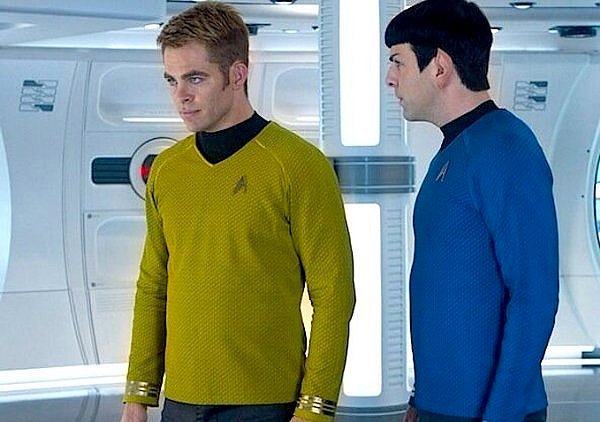
So I just got back from seeing STAR TREK INTO DARKNESS — no, the title does not possess a colon — and as I write this I have a disc of The Original Series playing  as a soothing bit of background ambience. There's a lot to cover here but one cannot really discuss the film without giving away the plot particulars, so allow me to state in short that the film, while not boring, gives the audience absolutely nothing new and comes off as a catalog of STAR TREK tropes enacted by simulacrums of the beloved characters for an audience that just wants the 'splodey action and pretty CGI effects candy while providing the mind and soul with little or nothing in terms of narrative meat. If you want a hollow amusement park ride spawned from one of the most seminal and influential science-fiction franchises in pop culture history, then this movie will likely please you immensely. If you are a fan of old school STAR TREK, the kind of space-set stories that were about people and examination of the human spirit within a futurist galaxyscape, then you will probably find a lot to grouse about and are advised to wait for cable airings. Unlike some of my peers whose opinions on STAR TREK I hold in considerable esteem, I did not think STAR TREK INTO DARKNESS was an outright piece of celluloid trash, but in no way did I come away from the film satisfied. In fact, if truth be told, I kind of checked out during the second half.

But what, you may ask, was it that did not turn me on about the latest trip into the void with the Enterprise crew? Allow me to answer that query in detail — a certain amount of familiarity with the lore of The Original Series is required — and before I do that, it's only fair to give the following caveat:

WARNING!!! HERE THERE BE SPOILERS!!! STOP READING RIGHT NOW IF YOU DON'T WANT TO KNOW EXACTLY WHAT THIS MOVIE IS ABOUT!!!

Are we good? Ready to continue? Okay, here's the skinny:

It's about a year after the events seen in the 2009 franchise reboot film (simply entitled STAR TREK, which I liked a lot) and Captain James T. Kirk (Chris Pine) violates the Prime Directive during an exploratory mission to a planet whose natives are still very much in a paleolithic state of development. Called on the carpet by Starfleet Command, Kirk finds the Enterprise returned to its original commanding officer, Christopher Pike (Bruce Greenwood) and himself demoted to its first officer after Mr. Spock (Zachary Quinto) unintentionally finks him out by telling the full truth about what happened in his mission report (which Kirk made no mention of in his submitted version). But Kirk's demotion proves to be a pointless plot beat because he's almost immediately reinstated as Captain of the Enterprise when Pike is killed during an attack at Starfleet headquarters in San Francisco by a mysterious terrorist named John Harrison (Benedict Cumberbatch) who apparently has Starfleet ties. Having already launched a devastating attack on the heart of London, Harrison flees Earth to hide out in a deserted section on the Klingon homeworld, Kronos, a planet Starfleet dares not risk voyaging to because their presence could launch all-out war with the already-hostile and encroaching Klingons. Motivated by desire to avenge his friend and mentor, Kirk begs Admiral Marcus (Peter Weller) to let him take the Enterprise on the search-and-destroy mission against Harrison that the Admiral has set in motion. Soon enough, our heroes end up on Kronos, loaded for bear with a compliment of 72 photon torpedoes of a design and purported destructive yield well advanced beyond anything in Starfleet's current arsenal. After an encounter with some Klingons that goes badly, the away team of Kirk, Spock, and Uhura (Zoe Saldana) are rescued by the very terrorist they came looking for, who promptly surrenders after hearing about the quantity of the aforementioned photon torpedoes. Once aboard the Enterprise, the true identity of Harrison is revealed, Starfleet proves to be less squeaky-clean than we had been led to believe, and it all culminates in lots of shootouts and 'splodey stuff.

Rather than explore the plot any further, I'll just get to the individual points of note:

  • John Harrison turns out to be none other than Khan, the reboot-verse's iteration of the villainous genetic superman from The Original Series series and the classic film STAR TREK II: THE WRATH OF KHAN (1982), and that revelation holds no weight in context with the reboot's timeline since Kirk and crew had never encountered him before. Khan and his fellow supermen were cryogenically frozen and set adrift in space (a la The Original Series entry "Space Seed") after they proved to be war criminals who sought the genocide of any and all who they deemed not as awesome as themselves. All of this is explained in the most elementary of ways and reminded me of how "Space Seed" would have read if scripted by a ten-year-old. It is also stated that Khan was found, unfrozen, and pressed into service by Admiral Marcus as the head designer of armaments and such for a secret branch of Starfleet that's meant to be a ruthless defense force for the Earth and other Federation worlds when hostile aliens come a-knockin'.
 Khan in the brig: Glory holes...OF THE FUTURE!!!
  • Scotty (Simon Pegg) is kicked off the ship early on, in a move that allows him to more or less save the day when the duplicitous Admiral Marcus reveals himself to be the king of the preemptive strike, what with his sabotaging the Enterprise to strand it after it inadvertently let loose Khan's 72 superhuman colleagues (whose cryo-tubes had been hidden inside the ersatz photon torpedoes) on the Klingon homeworld, where they would presumably kill the planet's entire populace. That's all good in theory, but Khan has proven to be incredibly intelligent and physically powerful, so it stands to reason that his frozen fellows would be as well, so after they wiped out the Klingons, what would stop them from taking the Klingons' space vessels and beginning a campaign of galactic conquest? Yeah, the admiral has at his disposal the massive and super-powerful dreadnought-class U.S.S. Vengeance (which was designed by Khan, so you know it's one bad bitch), but was he planning on hanging around in orbit of Kronos for however long it took for the augments to destroy the Klingon race? And what about those Klingon forces that were off-world, out and about in the galaxy conquering and enslaving worlds? Maybe I missed the finer points of that being explained as I retrieved a dropped cell phone from the theater's flypaper-sticky floor and returned it to its grateful owner, but none of that sounds feasible to me.
  • The Spock/Uhura romance is given a bit of attention, but overall it adds nothing whatsoever to the narrative. I thought giving Spock a romantic interest could have opened up some interesting possibilities for character exploration/development, but what scraps the ADD-riddled script by Robert Orci, Alex Kurtzman, and Damon Lindelof (he of PROMETHEUS infamy) doles out fails to provide any emotional resonance in that department, nor does it spark anything other than cursory and soon-forgotten interest. 
  • The new design for the Klingons, both the people themselves and their spacecraft, is generic and boring. Utterly void of personality. I will be very surprised if I see anyone cosplaying as them when the NY Comic Con rolls around this Fall.
  • The film is a shameless rehashing/re-imagining of stories and story elements from earlier installments in the franchise, and considering how the reboot could have given us something new and freshly-imaginative, what we get instead amounts to a roadshow version of the specific classics that got cherry-picked from. There's a laundry list of rehashed elements that I could cite but instead I'll spare you that and simply state that STAR TREK INTO DARKNESS can best be summed up as a half-assed remake of THE WRATH OF KHAN, dumbed-down for an undemanding audience that's content simply to see the familiar characters and situations once more trotted out like empty-calorie fast food and accented with 'splodey "BOOM" pyrotechnics designed for the 3D format. (I saw it in 2D and it was okay as such.)
  • The WRATH OF KHAN remake/re-imagining factor was frankly galling to me in its superfluousness. While not as egregious and un-creatively-insane as Gus Van Sant's almost-shot-for-shot remake of PSYCHO (1998), STAR TREK INTO DARKNESS unnecessarily retells the 1982 classic — the sole TREK film that really earned that descriptor — and juggles a number of its pieces to no real narrative purpose. The character of Carol Marcus (played by Alice Eve), who is a dead ringer for The Original Series' Nurse Christine Chapel, is reintroduced for no real reason and apparently ends up as the latest addition to the crew. (She also gets what may be the single most gratuitous underwear shot in motion picture history.) WRATH's saving the ship via fatally-irradiated self-sacrifice is re-staged, this time with the Kirk and Spock roles reversed, a switch that I'm guessing was made to poignantly stress how Kirk's attitude that he could never lose was utterly wrongheaded, but that lesson learned during his agonized death is proven narratively moot when he is revived and cured by an infusion of Khan's magic superman blood (which I guarantee will conveniently never be brought up again), which also renders Spock's grokking of the concept of taking one for the team equally moot while simultaneously cheapening the truly tragic emotional gravitas found in WRATH's climax (provided one has seen that film in the first place).
  • Upon Kirk's death, Spock cribs Shatner's famous apoplectic roar of "KHAAAAAAAN!!!" but it lacked the intensity of the original iteration and actually elicited laughter from the audience I saw it with. The scene is intended to be the polar opposite of camp, yet here it became unintentional camp.  
  • The characterizations of Kirk and Spock adhered to some of the traits that make the characters identifiable as such, but again I found them to be simulacrums who seemed more than just a bit "off." Chris Pine's Kirk is pretty much a dick and Zachary Quinto's Spock is at times overly emotional and even savagely violent in one notable instance. (Spock in a fistfight is a truly disheartening sight.) Of the Enterprise's "big three," the only one who came out smelling like roses was Dr. McCoy, once more played with eerily De Forest Kelley-esque gusto and grouchiness by Karl Urban. Spock fared okay (aside from his ludicrous brawl with Khan) but I didn't care for Kirk at all in this installment. All of the character's interesting and admirable traits were swapped out in favor of attempting to turn him into a blatant Han Solo clone — complete with Millennium Falcon knockoff spaceship — and I blame that squarely on the script and director J.J. Abrams' disinterest in STAR TREK, which is a matter of public record. At heart, he's a STAR WARS kid and after seeing this film I believe he's much better suited for handling the STAR WARS universe's brain-optional chapter play thrills (which is not to say that there are not good STAR WARS films) than he is at handling a science-fiction franchise that wears its interest in and exploration of basic humanity, be it Terran or extra-terrestrial, on its sleeve. Which is all for the good since he's ditched the TREK franchise to helm the new STAR WARS movies for Disney. I just hope whoever is tapped to take the wheel for TREK once Abrams has fucked off is someone who actually gives a damn about STAR TREK and what made it unique, enduring, and endearing.

"Captain, exactly who are we? You certainly are NOT James T. Kirk, and I sure as fuck am NOT Spock."

As previously stated, I did not hate STAR TREK INTO DARKNESS but I could not care less about seeing the filmmakers haul out stories we've already seen and that have become iconic in the annals of cinematic science-fiction. Yeah, they probably went in that direction thanks to focus group testing (never a good idea) or due to a perception that WRATH OF KHAN needed to be re-jiggered — like how PROMETHEUS treated the ALIEN franchise, only nowhere near as nonsensically — for the audience of the twenty-teens, but I say fuck that shit. If people want to see THE WRATH OF KHAN, that's what Netflix and cable are for. The STAR TREK concept is first and foremost supposed to be about seeking out new life and new civilizations, with the accent on "new," and there's a whole galaxy out there that at this point in the reset timeline has yet to be charted. A galaxy is big. I mean really fucking ginormously BIG, so how about a film of the Enterprise actually getting started on its five-year mission and actually doing some fucking exploration? The story possibilities are limitless! The new film ends with that supposedly being where it's all going but I'll believe it when I see it in narrative action. I just hope the next film doesn't turn out to be about a war with the Klingons.

BOTTOM LINE: It's a fast-moving way to spend two hours and twelve minutes, but STAR TREK INTO DARKNESS is a TREK film for undemanding audiences who just want the pretty CGI and 'splodey stuff, and for longtime fans who by this point are so brainwashed that they no longer care what the studio gives them, just as long as it bears the STAR TREK brand. Wait for cable.

Thursday, May 9, 2013

ELEGY FOR A TITAN: ONE FAN'S REMEMBRANCE OF RAY HARRYHAUSEN (1920-2013)


Ray Harryhausen, animating the transformed Sadi in the classic THE 7th VOYAGE OF SINBAD (1958).

(I begin typing while THE 7th VOYAGE OF SINBAD plays and Bernard Hermann’s pounding main title theme bosses its way out of my flatscreen TV’s speakers.)

How to even begin to express my feelings of loss with the passing of the god of stop-motion animation, the one and only Ray Harryhausen? Sure, the man had a good run of 92 years and left behind an unmatchable cinematic legacy, but this demise is especially painful thanks to just how large his presence loomed over so many of us for so many years.

If you have no idea who Ray Harryhausen was, think back to the old school movies you saw that took you to fantastical landscapes teeming with mythic beasts of myriad shapes and sizes (with a few extra-terrestrials included for variety). A good number of those films featured stop-motion animation painstakingly wrought by Harryhausen, and those creations were as magical as the sorcery encountered in the narratives. The man spent weeks and months of excruciatingly time-consuming frame-by-frame manipulations that rendered his lovingly-crafted foam rubber and armature models into living, breathing, rampaging characters, the memories of which stick in the viewer’s mind long after the house lights have come up or the DVD is removed from the player and returned to its plastic clamshell packaging.

During my often-lonely childhood, I devoured old sci-fi, fantasy, and horror movies whenever they aired on TV in those pre-cable days, with my favorite fare being anything featuring monsters. I was simply crazy for monsters and the bigger they were, the better, with their anti-social, destructive mayhem perhaps allowing me to process my own feelings of powerlessness and anger. I’m not certain I saw any of Harryhausen’s movies on one of those blessed local television showcases for old flicks, but I have carved-in-stone memories of seeing THE GOLDEN VOYAGE OF SINBAD (1974) on the big screen during its initial release. The TV commercial come-ons for the film caught my eye like a poorly cast three-pronged fishhook, so I had no intention of missing such a spectacle.

Black magic at its most lethal: Kali enters the conflict.

As I settled into the indoor nighttime of Westport, Connecticut’s Post Cinema, my impressionable eight-year-old self was simultaneously transported and utterly blown away by the film’s fantasy quest that thrust daring seafarer Sinbad into direct, terrifying conflict with an evil sorcerer whose powers commanded an assortment of horrors. A living juggernaut of a ship’s solid wooden figurehead, a bat-like spy in the form of a parrot-sized homunculus, and an agile, sword-wielding stone statue of the six-armed goddess Kali all strutted their fairytale stuff across the silver screen, along with a griffin and a cyclopean centaur, to greatly affect the mind of a child who longed to be anywhere other than where fate had cast him in the wake of a move from one coast to another. (The presence of smokin’-hot Caroline Munro as a bosomy slave girl was also a considerable plus and helped open my mind in other notable ways.) Upon leaving the theater, I was a kid transformed, now infused with a burning hunger for more fantastic cinema bearing the mark of this wizard named Harryhausen.

Having seen the restored, uncensored version of the original KING KONG (1933) earlier that year — the film that over the subsequent decades asserted itself in my consciousness as my all-time favorite movie — I noted many similarities in that film’s animated monsters and how they moved/emoted when compared to what Harryhausen had wrought, so it came as no surprise when I discovered that Harryhausen had seen KONG during its first run. That significant formative experience set him on his life’s path and led him to apprentice under Willis O’Brien, the man who animated King Kong and his numerous prehistoric opponents. (At the time I knew who Willis O’Brien was but I did not truly dig deep into his history until a year later, when I wrote a detailed and passionate report on the making of KING KONG for a 4th grade assignment. Used to her students turning in essays on sports figures and TV stars, my teacher was rather surprised by that one.)

The second step in my Harryhausen education came during a series of weekend theatrical matinees that ran during my ninth year. Each week, Fairfield, Connecticut’s Community Theater screened double and triple-features of old children’s films that parents could drop their kids off at and leave them there all day, and the weekly fare featured mostly cheapjack time-wasters like the culled from Swedish television Pippi Longstocking films (which looked cheap and shoddy even to us under-tens; the books were infinitely better), an occasional 1960’s Italian superhero movie, zero-budget dubbed Mexican imports from schlockmeister K. Gordon Murray, and the occasional Toho giant monster city-stomper to liven things up (those always went over quite well), and it was at one of those matinees that I first encountered THE 7th VOYAGE OF SINBAD. 

Considered by many to be the finest fantasy film ever made — an opinion I disagree with in favor of the 1940 version of THE THIEF OF BAGDAD — 7th VOYAGE is a visually-stunning, colorful, exciting, and just plain balls-out fun Arabian Nights-style adventure yarn, and it is arguably the first feature that really allowed Harryhausen the ideal showcase for his singular talents.


The Cyclops, aka the garden variety fauna of the island of Colossa.

The monsters that populate the remote island of Colossa (I love that name!) were gigantic, aggressive, and ravenous, and Harryhausen imbues each with a fleshy, palpable urgency that left other such 1950’s fare in the dust. While perfectly suitable for all ages, the encounters with creatures like the Cyclops (once seen, never forgotten, and perhaps the film's signature monster), the two-headed roc, the sword-slinging skeleton warrior, the princess’s handmaiden who is transformed into a disturbing, writhing snake-woman (until the transformation goes horribly wrong), and that poor, beautiful dragon were all scary as hell in a child-friendly way. 

Coupled with the lush fantasy of Arabian opulence from a bygone era, THE 7TH VOYAGE OF SINBAD is the rare fantastic yarn that hits every note precisely, resulting in one of the very few absolutely perfect fantasy movies. It’s a classic for a reason and that reason’s name is Ray Harryhausen.

Another of those Community Theater weekend matinees brought the eager kiddie audience the epic JASON AND THE ARGONAUTS (1963), and minds that had already been blown by Sinbad’s Arabian exploits were further expanded by Jason’s excursion into Greek mythology. I’d been a hardcore Greek mythology buff since I was seven years old, so I was more than ready for a film of JASON’s caliber, and what I got from it exceeded even my wildest expectations. Crammed from top to bottom with gods and monsters and bolstered by a solid script from Greek mythology expert Beverly Cross, the film is an experience on par with THE 7TH VOYAGE OF SINBAD and it’s kind of impossible to truly determine which is a better film. If you’re a Harryhausen fan, it’s likely that either 7th VOYAGE or JASON is your favorite of his works, and I’ve seen the debate as to the comparative merits of both movies get quite heated. I personally used to lean more firmly into the camp supporting JASON AND THE ARGONAUTS, but I now have to grudgingly admit that THE 7TH VOYAGE OF SINBAD strikes me as the superior film, simply by virtue of it having a complete narrative. JASON AND THE ARGONAUTS, kickass though it certainly is, reaches its climax with the successful heist of the Golden Fleece but abruptly comes to an end shortly thereafter, leaving all of the other hanging plot threads unresolved with hints of a possible sequel that never came. But that’s all apples and oranges.


The monsters in JASON AND THE ARGONAUTS are all compelling and brilliantly realized, but the true classics therein are the enormous metal titan, Talos, and the group of skeleton warriors that give Jason and his fellows one hell of a fight (which amazingly eclipses the set-to with the lone skeleton combatant in 7TH VOYAGE). That skeleton battle is now hailed as one of the greatest moments in any film ever made, and its impact has to be experienced on the big screen to truly get what a big deal it is. The same can be said of the reveal of Talos, the sequence that was the first movie moment to elicit an exclamation of “HOLY SHIT!!!” from me.


The horror of Talos.

By the mid-1970’s, Harryhausen was in his mid-fifties and slowing down, be he continued to animate. Between seeing THE GOLDEN VOYAGE OF SINBAD in the theater and the release of SINBAD AND THE EYE OF THE TIGER (1977), I managed to see all of Harryhausen’s prior films on television and researched the hows and whys that went into their creation. Some were better than others and all were of interest and entertaining, but the days of Harryhausen’s brand of entertainment were numbered and the release of STAR WARS in May of 1977 ushered in a new era of special effects extravaganzas, films crafted by artists who became effects wizards thanks to their budding imaginations being fueled by Harryhausen, an innovator those craftsman spoke of with unabashed reverence.

Following the middling results of SINBAD AND THE EYE OF THE TIGER, Harryhausen’s final film, CLASH OF THE TITANS (1981), was a return to the realms of Greek mythology, and while beloved by many who saw it as impressionable youngsters during its initial release, it doesn’t hold a candle to the sheer wonders found in JASON AND THE ARGONAUTS (which is admittedly one hell of a hard act to follow). It is entertaining, though, and the sequence in the lair of Medusa is one of Harryhausen’s incontestable masterpieces. The design of Medusa largely deviates from her classical iteration, but the changes made all worked spectacularly to create one of cinema’s most horrific and memorable monsters. The sequence is a tour de force of eerie lighting (Medusa’s lair is illuminated by flickering torches), use of silence against which the monster’s rattling tail becomes undeniably ominous, and edge-of-your-seat suspense. Even in the era of movie spectacles like THE EMPIRE STRIKES BACK (1980), it is beyond my powers of reasoning to ponder just how CLASH OF THE TITANS didn’t garner the visual effects Oscar for the Medusa sequence. Even if Medusa had been the only monster in the movie, it would have been worth sitting through the entire film just to see her.

CLASH OF THE TITANS' Medusa: a tour de force of a swan song.

After CLASH OF THE TITANS, Harryhausen retired, which only made sense because, seriously, where do you go after Medusa? He occasionally showed up at conventions and retrospectives of his work, and I was fortunate enough to meet the man twice.

The first of those meetings occurred at a Dragon Con in Atlanta during the late 1990’s, where he was doings signings and a slideshow presentation on his career. During that talk, he discussed his work and I swear you could have heard a pin drop as the lecture hall packed with fans hung on his every utterance. He even brought along the actual puppets of the ghouls from SINBAD AND THE EYE OF THE TIGER, the living figurehead from THE GOLDEN VOYAGE OF SINBAD, and sword fighting skeleton from THE 7TH VOYAGE OF SINBAD and when he set them upon the long table, the throng of camera-wielding fans was at the ready. To fans of his oeuvre, seeing those figures was like bearing witness to holy relics.

When the presentation concluded, I fought my way through the tumult of the con’s signing area and, armed with my VHS copy of JASON AND THE ARGONAUTS, made a beeline toward where Harryhasuen was to begin signing. As I approached, I expected a line of fans that would rival the exodus scene from THE TEN COMMANDMENTS (in terms of both sheer volume and imagined stench). When I arrived at the allotted table, there sat Ray Harryhausen himself, one of the most revered living gods in the entire history of geekdom, with naught but two fans seeking his autograph, and otherwise ignored while there were other allegedly greater luminaries to meet. Yes, you read that right. ONLY. TWO. FANS.  Appalled by the lack of interest and respect he’d received, I went up to him and did my best to keep my undying admiration and adoration to a reasonable enough level of expression to be able to have a coherent conversation with him while he signed my tape’s box and an 8x10 of himself and some of his creations.

That photo hung framed on my wall for years, and is now filed in a handsome leather presentation binder with my other autographed photos. (I put it away to prevent it fading.)

Harryhausen bore the aspect of a beloved uncle or grandfather, his voice all kindness and mellow tones, and like one would expect from a storyteller of his magnitude, the anecdotes about his career and interests flowed from him like a river. But the best part of all of that was when I mentioned how the original KING KONG was my all-time favorite movie, Harryhausen’s eyes lit up and we spent the next half hour geeking out like kids over how much we loved that film. Getting to geek out with my idol over our mutual favorite film is one of the very small handful of moments in my life where everything seemed right in the world, and it is a cherished memory that I will hold dear in my heart and mind until the day when I no longer draw breath.

Then came the shocking moment when he told me he’d finished writing an exhaustive autobiographical coffee table book, but he expressed dismay at not being able to find a publisher for it. Yes, you read that right. Ray effin’ Harryhausen kept having his lovingly-prepared, loaded-to-the-gills book rejected due to “perceived lack of interest.”

Yeah. Let that one sink in for a moment.

Outraged, I told him I had a friend in attendance at the con who was a publisher and I’d be happy introduce them to one another. Ray was pleased that I wanted to help, so I corralled the friend in question and left them alone to talk. Nothing came of their meeting but the huge book did eventually find a publisher and it saw print a few years later. It’s called RAY HARRYHAUSEN: AN ANIMATED LIFE, and I cannot recommend it highly enough. It’s a must-own for all Harryhausen enthusiasts and a must-read for all serious film buffs, so if you can only own one book on this singular artist and his work, this is the sole book you’ll ever need.

My second meeting with Harryhausen came in 2003, at a double feature screening of THE 7TH VOYAGE OF SINBAD and JASON AND THE ARGONAUTS at Manhattan’s famed Lincoln Center that also served as a signing for his aforementioned book. I of course bought a copy and waited on the signing line — this time of a respectable length — and when I made it to him I mentioned our conversation about KING KONG. He remembered me but the length of the line rendered further conversation impossible, so I wished him well and once more thanked him for his influence. And once I began making my way to the auditorium, I bumped into an adorable old lady who was none other than Kathryn Grant, Princess Parisa herself, from 7TH VOYAGE! I recognized her and asked if she’d sign my book, which she very sweetly did. After that, I settled in for the double feature, which began following an introduction from Harryhausen, who sat and watched the movies with the packed crowd of ardent fans. As previously stated, both films are spectacular on the big screen, but it’s another thing entirely to see them with the Master himself in the audience. Each creature drew loud rounds of applause, but when the skeleton battle in JASON was about to start, a hush fell over the theater. As “the children of the Hydra” sprouted from the earth, a smattering of applause began, a smattering that erupted into full-blown applause and resonant cries of approval and praise when the skeletons let out that war whoop and got down to the business of killing. In short, no man could have asked for a more fitting and heartfelt acknowledgement of his achievement.

And now it’s ten years later and Ray is gone. There’s really nothing left to say, other than that his like will never pass this way again and that we all owe him an un-repayable debt for enriching the lives of the big and small the world over. Ray, I didn’t know you personally for more than an hour, but I honestly and very deeply loved you for what you gave to me when I needed it most. You fed my young imagination with a feast that just kept on giving, and that is the greatest gift of them all.

Requiescat en pace.