Search This Blog

Showing posts with label EPICS. Show all posts

Thursday, December 19, 2024

HERCULES (2014)

Dwayne Johnson, making for an impressive Hercules.

Finally got around to checking out HERCULES (2014). Taking place after the completion of the famous twelve labors, this gives us a Hercules (Dwayne Johnson) who leads a band of mercenary heroes, including Ian McShane as a skilled spearman who sees visions of his death,  

and the athlete Atalanta (Ingrid Bolsø Berdal), here reimagined as an Amazon archery badass.  

Though widely lauded for his amazing feats and status as a demi-god, Hercules bears the guilt of having killed his wife and children, a state of mind that holds him back from true greatness, but he nonetheless leads his companions when they are hired to lead the army of Thrace against savage marauders. But all is not as it seems, with neither Hercules's culpability for his family's murders nor with the people he and his stalwart crew were hired to rout. And, interestingly, there is question as to whether the mythic hero is actually the son of Zeus, or is he just a figure whose legend grows with each retelling?

Basically a matinee popcorn muncher, I can see why this flopped, as it's little more than a throwback to the seemingly endless Italian mythological muscleman flicks of the 1950's and 1960's peplum wave, only with the production values to make it look quite lavish. It's nothing great, but lovers of ancient world epics and mythic adventure will find it an agreeable way to pass just over ninety minutes. Dwayne Johnson makes an appropriately beefy Hercules, and his band of mercenaries are all a lot of fun. It's the kind of thing I would have absolutely loved if I'd seen it at age nine, and even at my current age of fifty-nine, I was entertained. Recommended as a minor diversion for mythology goons and peplum addicts.


Poster for the theatrical release.

Friday, December 29, 2023

NOT TONIGHT, I'M ON MY PYRAMID


Once again I cannot sleep, a state brought about by general anxiety over my mother and the endlessness of kidney failure/dialysis and by the fact that insomnia is just one of the many possible side-effects of the illness. I tried using Melatonin tonight but it did not work, so I lay awake staring at the ceiling, alone in my head with my thoughts. I finally gave up trying to sleep and instead sought a long, boring movie to hopefully lull me to sleep. I chose CLEOPATRA (1963), the legendary ultra-expensive Liz Taylor epic whose box office failure nearly bankrupted 20th Century Fox. 

I saw CLEOPATRA in bits and pieces during my adolescence, when it used to run divided into parts over five days on The 4:30 Movie in the '70's, but I had never watched it from start to finish, and without commercials. Seeing it while under the thumb of insomnia as I have several hours to go until I must get out of bed, dress, and await pickup for dialysis affords me a new and interesting perspective on it. Yes, it's ridiculously bloated at over four hours, but it's not as dull nor as camp as its infamy suggests or as I remembered it being. It's lavish to the point where the budget practically pours off of the screen, and that extravagance makes it a festival of eye candy. Sure, the dialogue is often stilted, but that was, and frankly still is, par for the course with Hollywood historical epics, and at least it has a huge cast of top-shelf actors to deliver it. With that taken into consideration, I don't buy Liz Taylor as the very Ptolemaic Cleopatra from a visual standpoint (translation: she does not work as an inbred ethnic Greek; way too white), but she wears the gorgeous costumes quite fetchingly and delivers the queen's unflappable arrogance as easy as breathing. (Perhaps expressing more than a little of her own personality.) 

Anyway, I do not find CLEOPATRA to be anywhere near as bad as contemporary reviews and most opinions of it popularly espouse. It's simply the last huge Hollywood epic of the classic era, bigger than most, but also no worse than many. If you ask me, its only real crime was being an exorbitant flop, and critics and the audience always love to dog pile on a loser when it's down. For me the bottom line is that it's saving my sanity during my latest bout of inability to sleep, and for that I am most grateful to it. 

That said, it's back to ancient times with Liz and Dick...

Saturday, September 24, 2022

THE VIKINGS (1958)

From 2008.

WARNING: This film is so manly, your eyeballs may explode.

Hollywood from roughly 1949 through the early 1960's was for some reason overrun with historical/religious epics, grand-scale entertainments featuring casts of thousands running around with fake swords and whatnot, getting into all kinds of carnage and daring-do, and usually somehow sandwiching a romantic angle into the whole shebang. Among the most notable examples of this genre are SAMSON AND DELILAH (1949), the unintentionally hilarious THE TEN COMMANDMENTS (1956), BEN-HUR (1959) and the film that some consider the manliest movie ever made, Stanley Kubrick's SPARTACUS (1960), each foaming at the mouth with lashings of sex and/or violence that could be gotten away with in such a repressive era by being presented in an "historical" context. All are very entertaining and all have carved out well-deserved places in cinema history, but there is one such movie that seems to have been glossed over in favor its more lavishly-appointed brethren. That film is Richard Fleischer's THE VIKINGS, and after years of hearing many glowing reviews I have finally seen it for myself. (Hey, it was only eight bucks on DVD thanks to the Virgin Megastore's "Virgin Sacrifice" sale, so I figured why the hell not?)

The funny thing is I thought I had seen this flick on TV during my growing up years, but I definitely had it confused with some other rape-and-pillage opus that wasn't even one fifth as fun (I think I had it confused with 1964's THE LONG SHIPS, which isn't bad and showcases an unforgettable torture scene featuring "the Mare of Steel"). Believe me, if I'd seen THE VIKINGS as a kid I would have remembered it vividly, because while other films in the historical epic genre may have featured sex and violence, none of them did it with the sheer zeal and love of mayhem displayed here. In fact if you try to think about it as a film being released today, THE VIKINGS would definitely get a strong PG-13 for content alone as is, and if made today the amount of fake blood would probably have been upped a tad, likely garnering the end result an R rating. No bullshit, for its time this is some pretty harsh stuff, and since the rating system did not yet exist, kids could pay their matinee money, sit down in the indoor twilight, and revel in the joyous brutality that unspooled. 

The story opens with an animated bit that swiftly explains the Viking raids on England — and looks to me like the inspiration for Terry Gilliam's illuminated manuscript cutout bits in MONTY PYTHON AND THE HOLY GRAIL (1975) — and wastes no time on such irrelevance as credits, dropping us smack dab into a violent massacre of the English led by Viking king Ragnar (Ernest Borgnine). 

Ragnar's high school year book photo, ca. 837 AD. Voted "Most likely to rape, pillage and vandalize." 

As his men lay waste to dozens of innocent people, Ragnar stops off for a refreshing bit of rape, an act that, unbeknownst to him, sires a son. The woman he violated conveniently turns out to be the Queen of England, and since her union to the now tits-up king was famously fruitless, she births the baby in secret and sends him off to Italy where he'll never be discovered. In the meantime the throne is taken over by Aelle, a ruler-type common to stories such as this insomuch as he's a fey asshole with a bad hairdo who treats everybody like shit and has people executed for the slightest of infractions. Years later he discovers one of his advisors is the guy who's funneled the Vikings info on the easiest spots along the coast to ravage, and once discovered he hightails it to the north and moves in with Ragnar's rowdy band. We then meet Ragnar's over-the-top anti-hero of a son, Einar (Kirk Douglas in full-on testosterone mode), a violent, boozing rakehell who's so in love with his own beauty that he refuses to spoil his looks by growing a beard.

Kirk Douglas (and chin) as Einar.
  
Then Tony Curtis shows up as Eric, a much-put-upon slave who spends his time either looking wistful or glowering like he was about to turn into the Wolf Man. 
 
Tony Curtis as Eric, looking manly (for once).

In no time flat we realize Eric's actually the baby who was sent to Italy, but those wacky Vikings raided the ship he was on and instantly enslaved his ass. There's no love lost between Einar and Eric — especially after Eric orders his pet falcon to rip Einar's face off, resulting in scars and the loss of an eye — a situation made more poignant by them having no idea that they share a father. But what kind of Viking saga would this be if they concentrated on emotions and family dysfunction and stuff when they should rightly be dishing out heaping helpings of drunkenness, carnality, and (for the time) graphic violence? Thankfully we get lots of scenes taking place in Ragnar's mead hall, a place where it seems like the party is simply incapable of stopping, no matter how drunk and violent the revelers get. I mean, really, in what better setting could you plan out profitable raids and kidnap plots? 

The romance angle enters the story when King Asshole, er, Aelle arranges to marry the Welsh Princess Morgana (Janet Leigh, just one year away from the screen's most memorable death scene, namely the shower stabbing in PSYCHO) for political reasons, so Ragnar decides to abduct the girl just for shits and giggles. If you've ever seen an epic that has to do with ancient warriors and some chick, you can see the triangle in this one coming a mile away as Einar makes plain his desire to take Morgana as his queen and rape the living shit out of her (he likes it when his women put up a fight, particularly if it involves scratching). Eric stands around looking doe-eyed while treating her with kindness and helping her escape, and Morgana instantly falls in love with Eric, who's definitely a step up from that douchey king. Anyway, one thing leads to another as Morgana ends up back in Aelle's clutches, Eric loses his hand for pissing off the king, Ragnar gets torn apart by a pit full of starving wolves, and the Vikings sail down from Norway to kick some castle ass like you've never seen (Eric and Einar form a truce until they rescue Morgana). The final battle is totally badassed and must have knocked people out when it first showed up on the big screen. 

THE VIKINGS is a lot of fun and is definitely a good way to pass nearly two hours on a rainy weekend afternoon, so if you enjoy manliness, historical epics, and wish-fulfillment stories of endless heavy-metal partying, wenching, and engaging in exactly the opposite of the kind of behavior your parents would approve of, this is the flick for you. Oh, and director Richard Fleischer's also responsible for the big-screen adaptation of MANDINGO (1975), so make of that what you will. TRUST YER BUNCHE!!! 

The 1958 theatrical poster.All this balls-out machismo can be yours for a mere eight bucks at your local Virgin Megastore! Free chest hair with every purchase!

Thursday, September 1, 2022

THE LONG SHIPS (1964)

Ever wanted to see a movie where a pack of horny Vikings unexpectedly find themselves on the loose in a Moorish harem? Well, here's the movie for you! Opening with a portentous back story about a gigantic bell — "The Mother of Voices" — being crafted from the melted-down solid gold spoils of the Crusades, THE LONG SHIPS is the rollicking tale of Rolfe (Richard Widmark, chewing the scenery like nobody's business), a Viking whose ship and crew were lost in a crash-landing near Byzantium, where he spent two years recovering in the care of some monks. 

Richard Widmark, in the midst of an all-scenery diet as Viking scallywag Rolfe. 

 Learning of the legend of the bell, Rolfe makes a meager living in the Muslim streets as a storyteller and makes the mistake of recounting said legend within earshot of some sword-wielding toughs in the employ of Sheik Aly Mansuh (Sidney Poiter, rockin' a James Brown "process"). In no time he's hauled off for torture in hope of extracting the bell's location since Mansuh wants to claim the bell in the name of the Muslim ancestors who got raped, pillaged and murdered to obtain all the gold that went into its manufacture, but the simple truth is that Mansuh's a greedy, sadistic fuck who just wants to add to his already-Croesus-like riches. Rolfe escapes and makes it back to his homeland, where he's not exactly greeted with open arms. The loss of his ship, coupled with some dirty dealing by the local king, has bankrupted his ship-builder dad, and Rolfe is revealed to be considered a lifelong and notoriously towering liar, so when he suggests trying to go after the bell he's greeted with derision. But the necessity to bail himself out — to say nothing of simple human avarice — convinces his dad to aid in the theft of the asshole king's newly-crafted death ship, so in no time at all Rolfe and his little brother, Orm (Russ Tamblyn, aka Riff in WEST SIDE STORY), have rounded up an equally-greedy crew and stolen the king's daughter, Gerda (Beba Loncar) as a hostage (and convenient love interest for Orm). Thus are the seeds for manly pillaging adventure sown.

Cue Yngwie Malmsteen: "I am a Vikiiiiiiiiiing...
 
 From that point on it's one scrape after another for Rolfe and the gang, and while the film feels a bit overlong it's still a lot of fun due to THE LONG SHIPS being a lot more intentionally humorous than just about any other swashbuckling/manly epic I can recall. Widmark looks to me like he understood just how hoary and cheesy his role is, so he performs Rolfe like a smarmy 20th century douchebag and the results are at times jaw-dropping, predating David Carradine's quite similar turn as the titular character in KILL BILL Vol. 2 (2004), only with laughs. Rolfe is impossible not to enjoy and in no time I found myself saying aloud, "This guy's a complete ass-munch!" as he lied without shame or fear of consequence and fucked-up nearly everything he set out to do (although he inevitably comes out on top of things, otherwise the film would have been over about ten minutes in). Other than the powerful motivating factor of sheer greed, there is no reason why any Viking in his right mind would follow him, something his crew (and the kidnapped princess) find out the hard way. 
 
Rolfe bravely (?) awaits his ride on "the Mare of Steel."
 
Also of note is Sidney Poitier's played-so-straight-it's-hilarious villainous role as Mansuh, a Moorish asshole with a mean streak as long as the wall around Byzantium. Nearly every interaction he has with other characters involves some form of torture or violence or the threat thereof, and that treatment even extends to the hot wife (Rosanna Schiaffino) he honestly loves (when she gets out of line he threatens her with a variety of nasty indignities, including being sold off as a slave). I can't recall ever seeing Poitier in a bad guy role, but he's fantastic here and is a joy to watch. Mansuh is one of that rare breed of villains that you totally root for just because you want to see what kind of douchey move he'll pull next, and in that respect he more than does his job. Case in point: after capturing Rolfe and his men for a second time — right after they've had a bit of fun with the ladies in the harem —Mansuh decides to kill Rolfe and enslave his men, ordering them to build him a sturdy Viking-style ship in which to navigate the dangerous seas in search of the Mother of Voices, and his method for Rolfe's execution is both inspired and unspeakably vile. Rolfe is sentenced to "ride the Mare of Steel," in other words he's to be sent on a crotch-first trip down an evil-looking thirty-foot, steeply-inclined razor's edge, which is demonstrated by a poor bastard from Mansuh's own troops who is volunteered for the purpose so Rolfe and company can witness how a true Muslim dies (this is after much bragging of Viking bravery by Rolfe and his men). 
 
The Mare of Steel. Kids, do not try this at home.
 
Too bad this came out in 1964, because that would have made for one hell of a gore effects showcase in the seventies or eighties! 
 
Other than its slight overlength and a theme tune that's repeated so often that it will annoy the shit out of you because of its ubiquity — however it gets played so often your annoyance with it will eventually be worn down to a state of amusement — , THE LONG SHIPS is a lot of fun that would make for an ultra-butch double-feature with 1958's THE VIKINGS. However I would warn women from partaking of that testosterone overload because they just might end up with beards and chest hair as a result of such a concentrated blast of manliness. 
 
The DVD edition: if it looks like Widmark's character just shit his pants, that assessment's not too far off the mark.

Sunday, April 17, 2022

YET ANOTHER OBSERVATION ON THE TEN COMMANDMENTS (1956)

Man, slave girl Lilia (Debra Paget) goes through some shit in THE TEN COMMANDMENTS (1956).

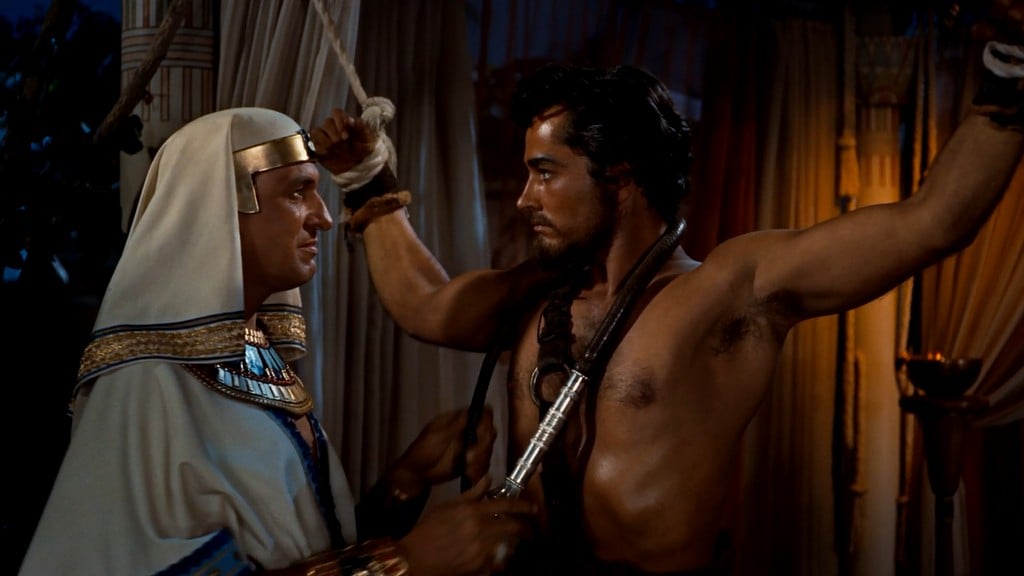
First she gets conscripted as a sex slave/flagellation victim by Egyptian master builder Baka, then when he's killed by Moses she ends up as the property/sex slave of scumbag Dathan (Edward G. Robinson) for several years, and finally, once the Jews make their way out of Egypt and she is reunited with her true love, Joshua the stone cutter (John Derek), she is ordered by Dathan to be tied down on the altar of the golden calf as a human sacrifice the minute Moses fucks off up the mountain to receive the titular laws from Gawd and the Jews suddenly throw a wild party/orgy that apparently includes every form of wickedness and perversion known to man. She gets saved from that sorry fate at the last possible second, but the poor girl simply could not catch a break during the movie's 3 hour and 40 minute running time.

ANOTHER OBSERVATION ON THE TEN COMMANDMENTS (1956)

This time around with THE TEN COMMANDMENTS (1956) finds me paying closer attention to certain plot details. For example: In the scene where the vile Dathan (Edward G. Robinson) has acquired the slave girl Lilia (Debra Paget) as part of a massive and lucrative "thank you" package from soon-to-be pharaoh Rameses (Yul Brynner), and he has her dressed in sexy finery by his house slaves. He orders a purple flower removed from her hair and replaces it with a "more appropriate" white one, a clear symbol letting us know that she is a virgin. Now she is not only very much unwillingly Dathan's property to do with as he pleases, but her compliance to his sexual whims will prevent Joshua the stone cutter (John Derek), from being sent to an horrific life in the copper mines (a promise that is never kept, unbeknownst to her), so she utterly surrenders her dignity and weeps while swearing to Dathan that she will do anything to save her love's life. 

It was always obvious to me what Lilia was being leveraged into, but this was the first time I noted the flower as a virginity signifier. Makes the scene that much more tragic, once one grasps that rather obvious symbol that I somehow missed for over forty years.


AN OBSERVATION ON THE TEN COMMANDMENTS (1956)


Watching THE TEN COMMANDMENTS from an adult perspective — and a dirty-minded one at that — is a totally different experience than it was when I was a kid. Seeing this sequence again right now, I only just noted that Baka (Vincent Price) had those tethers at the ready in his lounging area when about to whip Joshua the stone cutter (John Derek) to death. Baka was clearly a slimy motherfucker, as evidenced by his conscripting slave girl Lilia (Debra Paget) into unwilling sexual slavery and his statement that he would only keep her "for a little while," then return her to her life of everyday slavery "a bit more worthy." If he had those tethers ready, what the hell kind of scene was he into, and how many previous slave girls (and boys; he seemed like he would be rather fluid) must he have whipped into oblivion?

Monday, April 11, 2022

A FOOL FOR YUL


Yul Brynner as Rameses, a larger than life antagonist perfect for one of classic Hollywood's greatest spectacle films.

This Friday evening, Passover, will find me bundled up (after the day's dialysis session) for my annual screening of THE TEN COMMANDMENTS (1956), a film that I have loved since childhood and one that's on my short list of favorite classic Hollywood epics. Its scale and sweep are vast, and the piece is dominated by Yul Brynner as Rameses, a charismatic villainous turn for the ages. The guy wields unlimited power and has no concept of just how much of an asshole he really is, so since childhood I have enjoyed the character and performance that much more by thinking of Ramses as perhaps the only time the screen will ever see the Sub-Mariner's look and overall character perfectly portrayed (despite the only water in the film being the Nile and the Red Sea, neither of which does Rameses live in).

Wednesday, October 27, 2010

CALIGULA (1979)

Here's where this site finally does the world a public service. Despite all you may have heard about the infamous CALIGULA, I'm here to tell you that's it's an overblown testament to across-the-board excess, turgidly dull, and certainly not worth the waste of two-and-a-half hours of your life. It even stars my favorite actor, Malcolm (A CLOCKWORK ORANGE) McDowell, and I still can't stand it! I mean, how do you make a movie so absolutely loaded to the gills with extremely graphic gore and hardcore sex — two elements I adore — and still have it turn out so fucking boring?

The film has no real story — no surprise since the script was penned by that pretentious and overrated A-hole Gore (MYRA BRECKENRIDGE) Vidal — and is just an escalating parade of explicit images that seek to titillate the viewer, and as such it could be considered a success, provided you're just looking for entrails and pussy, but the whole in-your-face experience is simply numbing after its all-too-generous running time. The film also famously roped a slew of A-list thesps to appear in what was originally to be an R-rated look at the mad emperor's rule and eventual assassination, but then money man Bob "Penthouse" Guccione, aided by his pal Giancarlo Lui, shot and inserted majorly-explicit sex stuff while the film was in post-production that pissed off many of the cast and alienated many critics, to say nothing of presumably annoying the piss out of the porno audience who wanted to see just the wet shots with no attempt at anything else. I've seen porn audiences who don't care if a given skin flick is shot in a moldy basement while the talent fuck on a stained mattress just as long as there's action, which CALIGULA certainly has, but it's trying to be way too highbrow while also striving to appeal to the trenchcoat brigade, and that's a recipe that just doesn't work.

The only positive things I have to say about the film are few, but they are strong draws to the curious, so let me break it down for you:
  • The sets, costumes, and other related stuff are just as opulent as anything found in the historical epics of decades past, so even if the movie itself is largely boring, you can at least enjoy the pretty images.
  • The film barely goes for two or three minutes without something pornographic or violent happening, and the nudity/sex ranges from simple nekkid chicks to full-blown orgies of flesh featuring scores of humpers, complete with the camera practically shoved up every nearby orifice.
  • One of my favorite actors, Helen (PRIME SUSPECT) Mirren, is in CALIGULA, and she does get nekkid.
Not that she's ever been shy, but I'm just saying. She even has a three-way with Caligula and his sister (that's Helen with the long-assed wig.)

However, I'm only noting that scene because it exists, not because it's all that hot.
  • My man Malcolm McDowell gives perhaps his most over-the-top performance here, and that's really saying something. I love the guy and it's a joy to see him chew the scenery with that patented loony smirk upon his face while wearing an assortment of staggeringly flamboyant togas.
But the one thing, — THE ONE THING!!! — that keeps CALIGULA in my DVD collection is the contribution of Lori Wagner and Anneka di Lorenzo, two lovelies who are featured as regulars in Cal's live-in entourage. These benevolent goddesses make the entire film worth sitting through thanks to what is, in my humble opinion, the greatest hardcore lesbian scene ever committed to celluloid.

Lori and Anneka, sittin' in a tree...

Their scene is interspersed as counterpoint with the aforementioned three-way and in every way their bedroom arabesque blows the competition out of the water. Incredibly sensual, tender, and downright steamy, the sequence is commanded by Anneka di Lorenzo, who claims in the unimaginably boring making-of documentary to have never previously had sex with another woman... Well, all I have to say to that claim is, "Yeah, RIGHT!" The girl eats clam like a goddamned sea otter and it's truly a joy to behold. I usually find lesbian scenes, even the hardcore ones, boring as shit, but this sequence is an exception of unparalleled magnitude.

The greatest scene in motion picture history.

The only thing that stops it from being absolutely perfect is the cutting back and forth to Cal's listless threesome, and its relative brevity. Any fool could have seen that the Wagner-di Lorenzo segment was a winner, so why did Guccione fuck it up with intercut hetero stuff? Surely the man was mad.

So now you know all you need to know about CALIGULA, and you can proceed at your own risk. But I'm tellin' ya, that lesbian scene...WOOF!!!

Yes, this is real.

Friday, June 4, 2010

BEN-HUR (1959)

Your eyes are full of hate, Forty-one. That’s good. Hate keeps a man alive. It gives him strength.
-Roman Consul Quintus Arrius, to a seriously pissed-off Judah Ben-Hur.


Awesome, a word oft bandied about with little consideration for what it actually means and frequently applied to movies of dubious quality such as INDEPENDENCE DAY, TRANSFORMERS and the loathsome ARMAGEDDON. Well lemme tell ya, bunkie, you ain’t seen awesome until you’ve seen William Wyler’s 1959 epic-to-end-all-epics, the truly motherfucking awesome BEN-HUR. There were cinematic epics before and after BEN-HUR, including a silent version of the same story, but none of them stands as prominently in the hearts and minds of movie-lovers as this Charlton Heston landmark of widescreen spectacle. I’m a huge fan of the historical/biblical epic genre and while I favor Cecil B. DeMille’s eye-popping and mind-blowing THE TEN COMMANDMENTS (1956), I am only a certain type of hair away from ranking BEN-HUR as Number One in the field (with SPARTACUS coming in as a close third). Believe me, I totally understand the point of view of those who hold it as the end-all, be-all of the form, and I understand it more fully after having had the pleasure of seeing it projected at Lincoln Center with my Marvel Bullpen brother and dear friend Big Black Paul, a lover of classic cinema whose encyclopedic knowledge of movies far eclipses my own.

For those of you who somehow managed to miss it, BEN-HUR (subtitled “A Story of the Christ”) begins some twenty-six years after the birth of Jesus (which we witness during a pre-credits sequence) with the arrival of Messala (Stephen Boyd), the new Roman tribune of Jerusalem, at his new post. Assigned to quell the local dissidents — especially some pain-in-the-ass carpenter — Messala seeks the aid of his boyhood friend, wealthy merchant and local nobleman Judah Ben-Hur (Charlton Heston in all his tooth-clenching, nostril-flaring glory).

A joyous reunion, soon to turn bitter.

The two meet with joy, but their happiness turns sour when Ben-Hur flat out refuses to betray his own people and fink on those who oppose the Empire’s stranglehold on Judea for the sake of Messala’s political career. The refusal shocks, disappoints and angers Messala, him having counted on unquestioning support from his former best friend and all (it’s also quite clearly alluded to that Messala considers his feelings for Ben-Hur to be a case of “unrequited love;” you could get away with such stuff back in the days, but you couldn’t have Messala plainly state, “Hey, Judah…Ever thought about riding me like the camel you always wanted for Hanukkah?”), so when an unfortunate accident nearly kills the Roman governor during a parade, Messala seizes the opportunity and has Ben-Hur and his family (his mom and sister, to be specific) arrested and thrown in jail, intending to make an example of Ben-Hur by proving he’s gotta be a hard-assed bastard if he’s willing to destroy the life of a close friend, thus scaring the locals into being good little Red Sea Pedestrians.

Ben-Hur’s life turns into a shitstorm of outright misery and awfulness as he’s sentenced to life as an oarsman on a Roman warship, a fate from which people simply do not return, but he vows to Messala’s face (through that famous snarl and gritted choppers) that he’s not only gonna return, but he’s also gonna hand Messala the ass-whuppin’ to end all ass-whuppin’s, and if there’s one thing I’ve learned from the movies it’s that if Charlton Heston expresses a desire to fuck you up, you’d damned well better dig a ditch and get the hell in. Messala however, not being around during an era that had the movies, did not learn this valuable life lesson, so he arrogantly waves Judah goodbye and sends him of to his considerably more than three-hour tour. But while making the tortuous march through the desert to the ship, Ben-Hur nearly succumbs to exhaustion and thirst and is shown kindness and given a drink of water by some unknown longhair in a dress whose face we never see, but we do hear a lot of “Aaaah aaaah aaaaah” churchy music, so it’s obvious that it’s the good ol’ Nazarene. In fact, J.C.’s so cool that he even scares off a whip-wielding centurion just by looking at the guy (that scene always cracks me up and comes off like a tough guy stare-down at a Fear show)!

"Don't make me break my foot off in your Roman ass!"

Anyway, that dose of water — presumably infused with some of the Holy Spirit — rejuvenates Ben-Hur and gives him the strength to live, allowing him to survive and grow strong through over three years of rowing as a galley slave (although I very much doubt the Prince of Peace would have been down with Ben-Hur carrying on solely so he could eventually plant his size thirteen sandal straight up a Roman pretty boy’s tuchas).

A man kept alive by hate.

Ben-Hur’s fortunes take a turn for the better when command of the ship he’s on is turned over to Quintus Arrius (Jack Hawkins), a high-ranking Roman military officer and veteran of more battles than any man should have to endure, now assigned to rout the seaways of some pesky Macedonian pirates. Arrius takes note of Ben-Hur’s practically radioactive hatred and force of will and offers to free him in exchange for gladiatorial training — the one thing, short of Ben-Hur engaging in mortal combat with a giant monster and using only his dick as a weapon, that could possibly have made this movie any better — but Ben-Hur opts against it in favor of his belief that he’ll eventually get free and gain his revenge. That moment comes when the Roman fleet and the pirates have a kickass and ultra-violent sea battle — we actually see Ben-Hur set a guy’s head on fire, for fuck’s sake! — during which our hero saves Arrius’ life. Arrius returns to Rome with a spectacular victory and, being a stand-up guy who doesn’t forget a favor, publicly adopts Ben-Hur as his heir.

Arrius shows his gratitude.

During his time in Rome Ben-Hur becomes a champion charioteer in the Circus Maximus (which we are told about rather than shown; I guess the movie was long enough already), but he must fulfill his quest and while on his way home he runs into Arab sheik Ilderim (Hugh Griffith, in a deservedly Oscar-winning role), a nomadic racing nut who owns a quartet of the most gorgeous horses you will ever see, and the two become pals when Ben-Hur offers his experienced eye in giving the sheik tips on how to maximize his horses’ racing potential. The sheik pleads with our hero to drive his team to victor in Rome, but Ben-Hur declines the offer in favor of finding out if his mother and sister are still alive, even after discovering he’d be racing against that douchebag Messala; the setup is simply perfect since during the race just about any amount of foul play and violence can be gotten away with, but our hero just has to find his folks.

Ben-Hur returns to Jerusalem, nearly giving Messala a heart attack when he strolls in looking like a million bucks after what was intended to be a death sentence, and demands to know the whereabouts of his family when he returns the next day (you’ve gotta see Messala during this bit; I kept looking to the floor for a golden puddle beneath his toga). His family is indeed alive, but they’d been forgotten for years and the filthy conditions of their tiny cell have caused them to contract leprosy. Rather than have him see them in such a wretched state, his mom and sis swear Ben-Hur’s “who cares” love interest, Esther (Haya Harareet), to silence as they leave to take up residence in the Valley of the Lepers. Esther tells Ben-Hur they’re dead, so he sets off to Rome to take part in one of the most awesome (the term being properly used here) sequences in the entire history of world cinema, the Great Chariot Race, and finally exact his long-in-coming and hard-earned vengeance.

Messala versus Ben-Hur: it gets no more personal than this, kids.

It at this point that the movie just plain goes completely berserk and the chariot race will blow your fucking mind, no two ways about it. In fact all of the genuinely spectacular stuff that litters the flick from start to finish is a visual smorgasbord, and you won’t be bored by any of it. Also in fact, this film is probably right at the top of the heap of flicks that proudly show just how little CGI really adds to contemporary movies. Other than a few matte paintings and a little bit of blue screen work, what you see onscreen is the physically extant performance of actual human beings, both actors and cinematic craftsmen, that brings the ancient world to completely believable and teeming life, and the scenes of marching troops and thronging crowds were real people, the audience for the chariot race including some eight-thousand (!!!) extras. That, along with its strong narrative, is what I mean by awesome, and if you ever get the chance to see BEN-HUR on the big screen you should under no circumstances miss its myriad wonders.

The Circus Maximus: eight-thousand extras, no bullshit.

The grandeur of Rome: the soldiers keep marching, and marching, and marching...

But there’s an interesting thing about this film, and that’s its stated purpose as a “story of the Christ.” When you get right down to brass tacks, it’s the story of one man’s burning hatred and his desire for vengeance against his former best friend, an extremely personal revenge story loaded with highly entertaining action and violence, and Jesus is almost an afterthought. Sure, his gift of water gives Ben-Hur the will to go on, which, if truth be told, is completely necessary for the plot, but after that J.C. is really only there to be sought by one of the wise men who attended the Nativity. Said wise man, Balthasar (Finlay Currie), runs into Ben-Hur a few times and tries to get him to listen to Jesus and put aside his need for violence, so I guess that small bit of good values is how they got away with so much in this film in 1959. It always felt to me that after the climax of the chariot race the film’s true narrative thrust is over and done, but the movie goes on for about another half hour as Ben-Hur finds his family aren’t dead and he and Esther try to get them to Jesus, only to arrive as he’s on his way to the crucifixion. Of course there’s the expected miracle cure for leprosy and happy endings all around, but it still feels to me like the filmmakers said, “Well, Messala’s dog food, so that’s that! Hey, wait a minute…. Oh, shit! Isn’t Jesus supposed to be in this movie? We’ve gotta shoot some more footage, pronto!”

Call me hard-hearted, but I never bought the romance between Ben-Hur and Esther, coming as it does from seemingly out of nowhere and evincing no trace of passion or chemistry whatsoever, nor did I care about Ben-Hur’s mom and sister; sure their being alive provides a feel-good ending, but to me this is all about the bitterness between Ben-Hur and Messala. But why am I splitting hairs? None of the classic epics are absolutely perfect and BEN–HUR is one of the true classics of cinema, so I should just shut the fuck up. TRUST YER BUNCHE and see this one for yourself. Seriously, it’s one of the all-time greats and your movie education is sorely lacking for not having experienced it.