Search This Blog

Saturday, May 18, 2013

STAR TREK INTO DARKNESS (2013)

The U.S.S. Enterprise crashes and burns on the movie's poster. Was this an intentional comment on the film itself?

So I just got back from seeing STAR TREK INTO DARKNESS — no, the title does not possess a colon — and as I write this I have a disc of The Original Series playing  as a soothing bit of background ambience. There's a lot to cover here but one cannot really discuss the film without giving away the plot particulars, so allow me to state in short that the film, while not boring, gives the audience absolutely nothing new and comes off as a catalog of STAR TREK tropes enacted by simulacrums of the beloved characters for an audience that just wants the 'splodey action and pretty CGI effects candy while providing the mind and soul with little or nothing in terms of narrative meat. If you want a hollow amusement park ride spawned from one of the most seminal and influential science-fiction franchises in pop culture history, then this movie will likely please you immensely. If you are a fan of old school STAR TREK, the kind of space-set stories that were about people and examination of the human spirit within a futurist galaxyscape, then you will probably find a lot to grouse about and are advised to wait for cable airings. Unlike some of my peers whose opinions on STAR TREK I hold in considerable esteem, I did not think STAR TREK INTO DARKNESS was an outright piece of celluloid trash, but in no way did I come away from the film satisfied. In fact, if truth be told, I kind of checked out during the second half.

But what, you may ask, was it that did not turn me on about the latest trip into the void with the Enterprise crew? Allow me to answer that query in detail — a certain amount of familiarity with the lore of The Original Series is required — and before I do that, it's only fair to give the following caveat:

WARNING!!! HERE THERE BE SPOILERS!!! STOP READING RIGHT NOW IF YOU DON'T WANT TO KNOW EXACTLY WHAT THIS MOVIE IS ABOUT!!!

Are we good? Ready to continue? Okay, here's the skinny:

It's about a year after the events seen in the 2009 franchise reboot film (simply entitled STAR TREK, which I liked a lot) and Captain James T. Kirk (Chris Pine) violates the Prime Directive during an exploratory mission to a planet whose natives are still very much in a paleolithic state of development. Called on the carpet by Starfleet Command, Kirk finds the Enterprise returned to its original commanding officer, Christopher Pike (Bruce Greenwood) and himself demoted to its first officer after Mr. Spock (Zachary Quinto) unintentionally finks him out by telling the full truth about what happened in his mission report (which Kirk made no mention of in his submitted version). But Kirk's demotion proves to be a pointless plot beat because he's almost immediately reinstated as Captain of the Enterprise when Pike is killed during an attack at Starfleet headquarters in San Francisco by a mysterious terrorist named John Harrison (Benedict Cumberbatch) who apparently has Starfleet ties. Having already launched a devastating attack on the heart of London, Harrison flees Earth to hide out in a deserted section on the Klingon homeworld, Kronos, a planet Starfleet dares not risk voyaging to because their presence could launch all-out war with the already-hostile and encroaching Klingons. Motivated by desire to avenge his friend and mentor, Kirk begs Admiral Marcus (Peter Weller) to let him take the Enterprise on the search-and-destroy mission against Harrison that the Admiral has set in motion. Soon enough, our heroes end up on Kronos, loaded for bear with a compliment of 72 photon torpedoes of a design and purported destructive yield well advanced beyond anything in Starfleet's current arsenal. After an encounter with some Klingons that goes badly, the away team of Kirk, Spock, and Uhura (Zoe Saldana) are rescued by the very terrorist they came looking for, who promptly surrenders after hearing about the quantity of the aforementioned photon torpedoes. Once aboard the Enterprise, the true identity of Harrison is revealed, Starfleet proves to be less squeaky-clean than we had been led to believe, and it all culminates in lots of shootouts and 'splodey stuff.

Rather than explore the plot any further, I'll just get to the individual points of note:

  • John Harrison turns out to be none other than Khan, the reboot-verse's iteration of the villainous genetic superman from The Original Series series and the classic film STAR TREK II: THE WRATH OF KHAN (1982), and that revelation holds no weight in context with the reboot's timeline since Kirk and crew had never encountered him before. Khan and his fellow supermen were cryogenically frozen and set adrift in space (a la The Original Series entry "Space Seed") after they proved to be war criminals who sought the genocide of any and all who they deemed not as awesome as themselves. All of this is explained in the most elementary of ways and reminded me of how "Space Seed" would have read if scripted by a ten-year-old. It is also stated that Khan was found, unfrozen, and pressed into service by Admiral Marcus as the head designer of armaments and such for a secret branch of Starfleet that's meant to be a ruthless defense force for the Earth and other Federation worlds when hostile aliens come a-knockin'.
 Khan in the brig: Glory holes...OF THE FUTURE!!!
  • Scotty (Simon Pegg) is kicked off the ship early on, in a move that allows him to more or less save the day when the duplicitous Admiral Marcus reveals himself to be the king of the preemptive strike, what with his sabotaging the Enterprise to strand it after it inadvertently let loose Khan's 72 superhuman colleagues (whose cryo-tubes had been hidden inside the ersatz photon torpedoes) on the Klingon homeworld, where they would presumably kill the planet's entire populace. That's all good in theory, but Khan has proven to be incredibly intelligent and physically powerful, so it stands to reason that his frozen fellows would be as well, so after they wiped out the Klingons, what would stop them from taking the Klingons' space vessels and beginning a campaign of galactic conquest? Yeah, the admiral has at his disposal the massive and super-powerful dreadnought-class U.S.S. Vengeance (which was designed by Khan, so you know it's one bad bitch), but was he planning on hanging around in orbit of Kronos for however long it took for the augments to destroy the Klingon race? And what about those Klingon forces that were off-world, out and about in the galaxy conquering and enslaving worlds? Maybe I missed the finer points of that being explained as I retrieved a dropped cell phone from the theater's flypaper-sticky floor and returned it to its grateful owner, but none of that sounds feasible to me.
  • The Spock/Uhura romance is given a bit of attention, but overall it adds nothing whatsoever to the narrative. I thought giving Spock a romantic interest could have opened up some interesting possibilities for character exploration/development, but what scraps the ADD-riddled script by Robert Orci, Alex Kurtzman, and Damon Lindelof (he of PROMETHEUS infamy) doles out fails to provide any emotional resonance in that department, nor does it spark anything other than cursory and soon-forgotten interest. 
  • The new design for the Klingons, both the people themselves and their spacecraft, is generic and boring. Utterly void of personality. I will be very surprised if I see anyone cosplaying as them when the NY Comic Con rolls around this Fall.
  • The film is a shameless rehashing/re-imagining of stories and story elements from earlier installments in the franchise, and considering how the reboot could have given us something new and freshly-imaginative, what we get instead amounts to a roadshow version of the specific classics that got cherry-picked from. There's a laundry list of rehashed elements that I could cite but instead I'll spare you that and simply state that STAR TREK INTO DARKNESS can best be summed up as a half-assed remake of THE WRATH OF KHAN, dumbed-down for an undemanding audience that's content simply to see the familiar characters and situations once more trotted out like empty-calorie fast food and accented with 'splodey "BOOM" pyrotechnics designed for the 3D format. (I saw it in 2D and it was okay as such.)
  • The WRATH OF KHAN remake/re-imagining factor was frankly galling to me in its superfluousness. While not as egregious and un-creatively-insane as Gus Van Sant's almost-shot-for-shot remake of PSYCHO (1998), STAR TREK INTO DARKNESS unnecessarily retells the 1982 classic — the sole TREK film that really earned that descriptor — and juggles a number of its pieces to no real narrative purpose. The character of Carol Marcus (played by Alice Eve), who is a dead ringer for The Original Series' Nurse Christine Chapel, is reintroduced for no real reason and apparently ends up as the latest addition to the crew. (She also gets what may be the single most gratuitous underwear shot in motion picture history.) WRATH's saving the ship via fatally-irradiated self-sacrifice is re-staged, this time with the Kirk and Spock roles reversed, a switch that I'm guessing was made to poignantly stress how Kirk's attitude that he could never lose was utterly wrongheaded, but that lesson learned during his agonized death is proven narratively moot when he is revived and cured by an infusion of Khan's magic superman blood (which I guarantee will conveniently never be brought up again), which also renders Spock's grokking of the concept of taking one for the team equally moot while simultaneously cheapening the truly tragic emotional gravitas found in WRATH's climax (provided one has seen that film in the first place).
  • Upon Kirk's death, Spock cribs Shatner's famous apoplectic roar of "KHAAAAAAAN!!!" but it lacked the intensity of the original iteration and actually elicited laughter from the audience I saw it with. The scene is intended to be the polar opposite of camp, yet here it became unintentional camp.  
  • The characterizations of Kirk and Spock adhered to some of the traits that make the characters identifiable as such, but again I found them to be simulacrums who seemed more than just a bit "off." Chris Pine's Kirk is pretty much a dick and Zachary Quinto's Spock is at times overly emotional and even savagely violent in one notable instance. (Spock in a fistfight is a truly disheartening sight.) Of the Enterprise's "big three," the only one who came out smelling like roses was Dr. McCoy, once more played with eerily De Forest Kelley-esque gusto and grouchiness by Karl Urban. Spock fared okay (aside from his ludicrous brawl with Khan) but I didn't care for Kirk at all in this installment. All of the character's interesting and admirable traits were swapped out in favor of attempting to turn him into a blatant Han Solo clone — complete with Millennium Falcon knockoff spaceship — and I blame that squarely on the script and director J.J. Abrams' disinterest in STAR TREK, which is a matter of public record. At heart, he's a STAR WARS kid and after seeing this film I believe he's much better suited for handling the STAR WARS universe's brain-optional chapter play thrills (which is not to say that there are not good STAR WARS films) than he is at handling a science-fiction franchise that wears its interest in and exploration of basic humanity, be it Terran or extra-terrestrial, on its sleeve. Which is all for the good since he's ditched the TREK franchise to helm the new STAR WARS movies for Disney. I just hope whoever is tapped to take the wheel for TREK once Abrams has fucked off is someone who actually gives a damn about STAR TREK and what made it unique, enduring, and endearing.
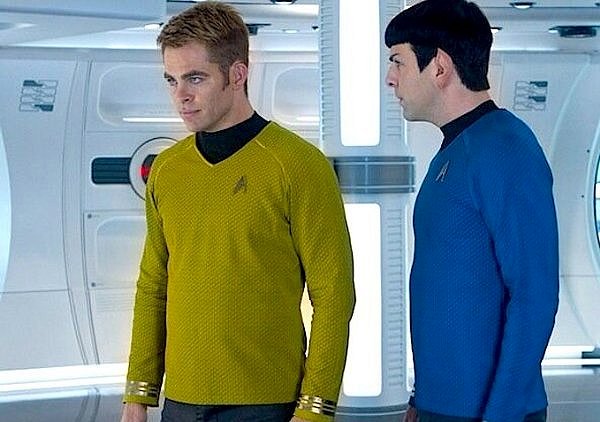
"Captain, exactly who are we? You certainly are NOT James T. Kirk, and I sure as fuck am NOT Spock."

As previously stated, I did not hate STAR TREK INTO DARKNESS but I could not care less about seeing the filmmakers haul out stories we've already seen and that have become iconic in the annals of cinematic science-fiction. Yeah, they probably went in that direction thanks to focus group testing (never a good idea) or due to a perception that WRATH OF KHAN needed to be re-jiggered — like how PROMETHEUS treated the ALIEN franchise, only nowhere near as nonsensically — for the audience of the twenty-teens, but I say fuck that shit. If people want to see THE WRATH OF KHAN, that's what Netflix and cable are for. The STAR TREK concept is first and foremost supposed to be about seeking out new life and new civilizations, with the accent on "new," and there's a whole galaxy out there that at this point in the reset timeline has yet to be charted. A galaxy is big. I mean really fucking ginormously BIG, so how about a film of the Enterprise actually getting started on its five-year mission and actually doing some fucking exploration? The story possibilities are limitless! The new film ends with that supposedly being where it's all going but I'll believe it when I see it in narrative action. I just hope the next film doesn't turn out to be about a war with the Klingons.

BOTTOM LINE: It's a fast-moving way to spend two hours and twelve minutes, but STAR TREK INTO DARKNESS is a TREK film for undemanding audiences who just want the pretty CGI and 'splodey stuff, and for longtime fans who by this point are so brainwashed that they no longer care what the studio gives them, just as long as it bears the STAR TREK brand. Wait for cable.

Thursday, May 9, 2013

ELEGY FOR A TITAN: ONE FAN'S REMEMBRANCE OF RAY HARRYHAUSEN (1920-2013)


Ray Harryhausen, animating the transformed Sadi in the classic THE 7th VOYAGE OF SINBAD (1958).

(I begin typing while THE 7th VOYAGE OF SINBAD plays and Bernard Hermann’s pounding main title theme bosses its way out of my flatscreen TV’s speakers.)

How to even begin to express my feelings of loss with the passing of the god of stop-motion animation, the one and only Ray Harryhausen? Sure, the man had a good run of 92 years and left behind an unmatchable cinematic legacy, but this demise is especially painful thanks to just how large his presence loomed over so many of us for so many years.

If you have no idea who Ray Harryhausen was, think back to the old school movies you saw that took you to fantastical landscapes teeming with mythic beasts of myriad shapes and sizes (with a few extra-terrestrials included for variety). A good number of those films featured stop-motion animation painstakingly wrought by Harryhausen, and those creations were as magical as the sorcery encountered in the narratives. The man spent weeks and months of excruciatingly time-consuming frame-by-frame manipulations that rendered his lovingly-crafted foam rubber and armature models into living, breathing, rampaging characters, the memories of which stick in the viewer’s mind long after the house lights have come up or the DVD is removed from the player and returned to its plastic clamshell packaging.

During my often-lonely childhood, I devoured old sci-fi, fantasy, and horror movies whenever they aired on TV in those pre-cable days, with my favorite fare being anything featuring monsters. I was simply crazy for monsters and the bigger they were, the better, with their anti-social, destructive mayhem perhaps allowing me to process my own feelings of powerlessness and anger. I’m not certain I saw any of Harryhausen’s movies on one of those blessed local television showcases for old flicks, but I have carved-in-stone memories of seeing THE GOLDEN VOYAGE OF SINBAD (1974) on the big screen during its initial release. The TV commercial come-ons for the film caught my eye like a poorly cast three-pronged fishhook, so I had no intention of missing such a spectacle.

Black magic at its most lethal: Kali enters the conflict.

As I settled into the indoor nighttime of Westport, Connecticut’s Post Cinema, my impressionable eight-year-old self was simultaneously transported and utterly blown away by the film’s fantasy quest that thrust daring seafarer Sinbad into direct, terrifying conflict with an evil sorcerer whose powers commanded an assortment of horrors. A living juggernaut of a ship’s solid wooden figurehead, a bat-like spy in the form of a parrot-sized homunculus, and an agile, sword-wielding stone statue of the six-armed goddess Kali all strutted their fairytale stuff across the silver screen, along with a griffin and a cyclopean centaur, to greatly affect the mind of a child who longed to be anywhere other than where fate had cast him in the wake of a move from one coast to another. (The presence of smokin’-hot Caroline Munro as a bosomy slave girl was also a considerable plus and helped open my mind in other notable ways.) Upon leaving the theater, I was a kid transformed, now infused with a burning hunger for more fantastic cinema bearing the mark of this wizard named Harryhausen.

Having seen the restored, uncensored version of the original KING KONG (1933) earlier that year — the film that over the subsequent decades asserted itself in my consciousness as my all-time favorite movie — I noted many similarities in that film’s animated monsters and how they moved/emoted when compared to what Harryhausen had wrought, so it came as no surprise when I discovered that Harryhausen had seen KONG during its first run. That significant formative experience set him on his life’s path and led him to apprentice under Willis O’Brien, the man who animated King Kong and his numerous prehistoric opponents. (At the time I knew who Willis O’Brien was but I did not truly dig deep into his history until a year later, when I wrote a detailed and passionate report on the making of KING KONG for a 4th grade assignment. Used to her students turning in essays on sports figures and TV stars, my teacher was rather surprised by that one.)

The second step in my Harryhausen education came during a series of weekend theatrical matinees that ran during my ninth year. Each week, Fairfield, Connecticut’s Community Theater screened double and triple-features of old children’s films that parents could drop their kids off at and leave them there all day, and the weekly fare featured mostly cheapjack time-wasters like the culled from Swedish television Pippi Longstocking films (which looked cheap and shoddy even to us under-tens; the books were infinitely better), an occasional 1960’s Italian superhero movie, zero-budget dubbed Mexican imports from schlockmeister K. Gordon Murray, and the occasional Toho giant monster city-stomper to liven things up (those always went over quite well), and it was at one of those matinees that I first encountered THE 7th VOYAGE OF SINBAD. 

Considered by many to be the finest fantasy film ever made — an opinion I disagree with in favor of the 1940 version of THE THIEF OF BAGDAD — 7th VOYAGE is a visually-stunning, colorful, exciting, and just plain balls-out fun Arabian Nights-style adventure yarn, and it is arguably the first feature that really allowed Harryhausen the ideal showcase for his singular talents.


The Cyclops, aka the garden variety fauna of the island of Colossa.

The monsters that populate the remote island of Colossa (I love that name!) were gigantic, aggressive, and ravenous, and Harryhausen imbues each with a fleshy, palpable urgency that left other such 1950’s fare in the dust. While perfectly suitable for all ages, the encounters with creatures like the Cyclops (once seen, never forgotten, and perhaps the film's signature monster), the two-headed roc, the sword-slinging skeleton warrior, the princess’s handmaiden who is transformed into a disturbing, writhing snake-woman (until the transformation goes horribly wrong), and that poor, beautiful dragon were all scary as hell in a child-friendly way. 

Coupled with the lush fantasy of Arabian opulence from a bygone era, THE 7TH VOYAGE OF SINBAD is the rare fantastic yarn that hits every note precisely, resulting in one of the very few absolutely perfect fantasy movies. It’s a classic for a reason and that reason’s name is Ray Harryhausen.

Another of those Community Theater weekend matinees brought the eager kiddie audience the epic JASON AND THE ARGONAUTS (1963), and minds that had already been blown by Sinbad’s Arabian exploits were further expanded by Jason’s excursion into Greek mythology. I’d been a hardcore Greek mythology buff since I was seven years old, so I was more than ready for a film of JASON’s caliber, and what I got from it exceeded even my wildest expectations. Crammed from top to bottom with gods and monsters and bolstered by a solid script from Greek mythology expert Beverly Cross, the film is an experience on par with THE 7TH VOYAGE OF SINBAD and it’s kind of impossible to truly determine which is a better film. If you’re a Harryhausen fan, it’s likely that either 7th VOYAGE or JASON is your favorite of his works, and I’ve seen the debate as to the comparative merits of both movies get quite heated. I personally used to lean more firmly into the camp supporting JASON AND THE ARGONAUTS, but I now have to grudgingly admit that THE 7TH VOYAGE OF SINBAD strikes me as the superior film, simply by virtue of it having a complete narrative. JASON AND THE ARGONAUTS, kickass though it certainly is, reaches its climax with the successful heist of the Golden Fleece but abruptly comes to an end shortly thereafter, leaving all of the other hanging plot threads unresolved with hints of a possible sequel that never came. But that’s all apples and oranges.


The monsters in JASON AND THE ARGONAUTS are all compelling and brilliantly realized, but the true classics therein are the enormous metal titan, Talos, and the group of skeleton warriors that give Jason and his fellows one hell of a fight (which amazingly eclipses the set-to with the lone skeleton combatant in 7TH VOYAGE). That skeleton battle is now hailed as one of the greatest moments in any film ever made, and its impact has to be experienced on the big screen to truly get what a big deal it is. The same can be said of the reveal of Talos, the sequence that was the first movie moment to elicit an exclamation of “HOLY SHIT!!!” from me.


The horror of Talos.

By the mid-1970’s, Harryhausen was in his mid-fifties and slowing down, be he continued to animate. Between seeing THE GOLDEN VOYAGE OF SINBAD in the theater and the release of SINBAD AND THE EYE OF THE TIGER (1977), I managed to see all of Harryhausen’s prior films on television and researched the hows and whys that went into their creation. Some were better than others and all were of interest and entertaining, but the days of Harryhausen’s brand of entertainment were numbered and the release of STAR WARS in May of 1977 ushered in a new era of special effects extravaganzas, films crafted by artists who became effects wizards thanks to their budding imaginations being fueled by Harryhausen, an innovator those craftsman spoke of with unabashed reverence.

Following the middling results of SINBAD AND THE EYE OF THE TIGER, Harryhausen’s final film, CLASH OF THE TITANS (1981), was a return to the realms of Greek mythology, and while beloved by many who saw it as impressionable youngsters during its initial release, it doesn’t hold a candle to the sheer wonders found in JASON AND THE ARGONAUTS (which is admittedly one hell of a hard act to follow). It is entertaining, though, and the sequence in the lair of Medusa is one of Harryhausen’s incontestable masterpieces. The design of Medusa largely deviates from her classical iteration, but the changes made all worked spectacularly to create one of cinema’s most horrific and memorable monsters. The sequence is a tour de force of eerie lighting (Medusa’s lair is illuminated by flickering torches), use of silence against which the monster’s rattling tail becomes undeniably ominous, and edge-of-your-seat suspense. Even in the era of movie spectacles like THE EMPIRE STRIKES BACK (1980), it is beyond my powers of reasoning to ponder just how CLASH OF THE TITANS didn’t garner the visual effects Oscar for the Medusa sequence. Even if Medusa had been the only monster in the movie, it would have been worth sitting through the entire film just to see her.

CLASH OF THE TITANS' Medusa: a tour de force of a swan song.

After CLASH OF THE TITANS, Harryhausen retired, which only made sense because, seriously, where do you go after Medusa? He occasionally showed up at conventions and retrospectives of his work, and I was fortunate enough to meet the man twice.

The first of those meetings occurred at a Dragon Con in Atlanta during the late 1990’s, where he was doings signings and a slideshow presentation on his career. During that talk, he discussed his work and I swear you could have heard a pin drop as the lecture hall packed with fans hung on his every utterance. He even brought along the actual puppets of the ghouls from SINBAD AND THE EYE OF THE TIGER, the living figurehead from THE GOLDEN VOYAGE OF SINBAD, and sword fighting skeleton from THE 7TH VOYAGE OF SINBAD and when he set them upon the long table, the throng of camera-wielding fans was at the ready. To fans of his oeuvre, seeing those figures was like bearing witness to holy relics.

When the presentation concluded, I fought my way through the tumult of the con’s signing area and, armed with my VHS copy of JASON AND THE ARGONAUTS, made a beeline toward where Harryhasuen was to begin signing. As I approached, I expected a line of fans that would rival the exodus scene from THE TEN COMMANDMENTS (in terms of both sheer volume and imagined stench). When I arrived at the allotted table, there sat Ray Harryhausen himself, one of the most revered living gods in the entire history of geekdom, with naught but two fans seeking his autograph, and otherwise ignored while there were other allegedly greater luminaries to meet. Yes, you read that right. ONLY. TWO. FANS.  Appalled by the lack of interest and respect he’d received, I went up to him and did my best to keep my undying admiration and adoration to a reasonable enough level of expression to be able to have a coherent conversation with him while he signed my tape’s box and an 8x10 of himself and some of his creations.

That photo hung framed on my wall for years, and is now filed in a handsome leather presentation binder with my other autographed photos. (I put it away to prevent it fading.)

Harryhausen bore the aspect of a beloved uncle or grandfather, his voice all kindness and mellow tones, and like one would expect from a storyteller of his magnitude, the anecdotes about his career and interests flowed from him like a river. But the best part of all of that was when I mentioned how the original KING KONG was my all-time favorite movie, Harryhausen’s eyes lit up and we spent the next half hour geeking out like kids over how much we loved that film. Getting to geek out with my idol over our mutual favorite film is one of the very small handful of moments in my life where everything seemed right in the world, and it is a cherished memory that I will hold dear in my heart and mind until the day when I no longer draw breath.

Then came the shocking moment when he told me he’d finished writing an exhaustive autobiographical coffee table book, but he expressed dismay at not being able to find a publisher for it. Yes, you read that right. Ray effin’ Harryhausen kept having his lovingly-prepared, loaded-to-the-gills book rejected due to “perceived lack of interest.”

Yeah. Let that one sink in for a moment.

Outraged, I told him I had a friend in attendance at the con who was a publisher and I’d be happy introduce them to one another. Ray was pleased that I wanted to help, so I corralled the friend in question and left them alone to talk. Nothing came of their meeting but the huge book did eventually find a publisher and it saw print a few years later. It’s called RAY HARRYHAUSEN: AN ANIMATED LIFE, and I cannot recommend it highly enough. It’s a must-own for all Harryhausen enthusiasts and a must-read for all serious film buffs, so if you can only own one book on this singular artist and his work, this is the sole book you’ll ever need.

My second meeting with Harryhausen came in 2003, at a double feature screening of THE 7TH VOYAGE OF SINBAD and JASON AND THE ARGONAUTS at Manhattan’s famed Lincoln Center that also served as a signing for his aforementioned book. I of course bought a copy and waited on the signing line — this time of a respectable length — and when I made it to him I mentioned our conversation about KING KONG. He remembered me but the length of the line rendered further conversation impossible, so I wished him well and once more thanked him for his influence. And once I began making my way to the auditorium, I bumped into an adorable old lady who was none other than Kathryn Grant, Princess Parisa herself, from 7TH VOYAGE! I recognized her and asked if she’d sign my book, which she very sweetly did. After that, I settled in for the double feature, which began following an introduction from Harryhausen, who sat and watched the movies with the packed crowd of ardent fans. As previously stated, both films are spectacular on the big screen, but it’s another thing entirely to see them with the Master himself in the audience. Each creature drew loud rounds of applause, but when the skeleton battle in JASON was about to start, a hush fell over the theater. As “the children of the Hydra” sprouted from the earth, a smattering of applause began, a smattering that erupted into full-blown applause and resonant cries of approval and praise when the skeletons let out that war whoop and got down to the business of killing. In short, no man could have asked for a more fitting and heartfelt acknowledgement of his achievement.

And now it’s ten years later and Ray is gone. There’s really nothing left to say, other than that his like will never pass this way again and that we all owe him an un-repayable debt for enriching the lives of the big and small the world over. Ray, I didn’t know you personally for more than an hour, but I honestly and very deeply loved you for what you gave to me when I needed it most. You fed my young imagination with a feast that just kept on giving, and that is the greatest gift of them all.

Requiescat en pace.


Saturday, May 4, 2013

IRON MAN 3 (2013)

And so it is that we’ve arrived at what could be considered the end of “The Iron Man Trilogy,” the uber-successful movie series featuring an A-list Marvel Comics character I never expected to see receive his own franchise or win the hearts and minds of the general public. I don’t think I need to tell you that the lion’s share of the franchise’s success can be credited to star Robert Downey Jr.’s performance as billionaire/tech genius/playboy Tony Stark, whose take on the character has become so indelible that I and many other comics fans now hear his voice when we read Stark on the four-color page. I’ve known Iron Man since discovering him I those tatty old Marvel Superheroes cartoon’s from the 1960’s where he was memorably voiced by John Vernon (aka Dean Vernon Wormer in NATIONAL LAMPOON’S ANIMAL HOUSE), so that was the voice that stuck in my head from the time I was five years old through when I saw the first Iron Man movie some five years ago. Now it’s all Downey, baby, and I’m fine with that. But enough of my Downey-worship, what you wanna know is whether or not the latest adventure of ol’ shell-head is worth your hard-earned cash, so here’s the skinny in a nutshell:

Following the decidedly mixed results of 2010’s IRON MAN 2, this third installment picks up not long after the harrowing events of last summer’s MARVEL’S THE AVENGERS and finds Tony Stark a man on insomniac edge. Suffering from PTSD in the wake of unexpectedly finding himself face-to-face with actual Norse gods, the jade-hued embodiment of limitless anger, a legendary super-soldier, and a heavily armed extra-terrestrial invasion force that pretty much leveled a decent portion of Midtown Manhattan. Unable to sleep and expending his energy in continuing to upgrade his armor — he’s just completed the prototype for Iron Man Mark 42 — Tony’s a paranoid mess who at least has it together enough to realize that in the wake of his experience with the invasion of New York City he would have likely gone mad if not for the love of his right hand woman, Pepper Potts (Gwyneth Paltrow, who has made the character her own).

But as he refuses to actually deal with his considerable emotional/psychological turmoil, Stark comes into conflict with Aldrich Killian (Guy Pearce), the once-disabled founder of Advanced Idea Mechanics and creator of Extremis, a virus that allows regeneration of tissue and limbs while also providing its users with augmented strength, speed, and the ability to generate heat of up to 3,000 degrees Fahrenheit. Killian offers to partner with Stark’s company in the production of Extremis but Pepper, now the CEO of Stark Industries, politely turns him down flat, citing that Extremis has potential to be weaponized and Stark Industries no longer goes in for that sort of thing. (There’s also a bit of history between Stark and Killian that also figures into things.)

And following Pepper’s run-in with Killian, she and Stark catch a news report on the latest deadly bombing attack by the Mandarin (Ben Kingsley), a master terrorist whose strikes at American targets prompt the President (William Sadler) to deploy Stark’s best friend, Col. James “Rhodey” Rhodes, (Don Cheadle) in Stark-made star-spangled armor as the Iron Patriot, whose mission is to locate and take out the violent fear-monger. As the plot threads involving Killian and the Mandarin converge, it all turns quite personal for the tortured Tony as his cliffside home is destroyed, Pepper is put in mortal danger, and the safety of the world hangs in the balance. It’s a lot for Tony to deal with and by the end of the film’s nearly two-and-a-fifteen-minute running time, our hero is stripped down to damned near nothing and must regain his legendary cool while also settling the hash of Killian and the Mandarin.

IRON MAN 3 is a marked step up from the series’ second installment, which left the majority of its audience unsatisfied and/or disappointed — I enjoyed it because it was pretty much what an old school Iron Man comics story was, specifically a soap opera with lashings of superheroics and high-tech armor — but while I enjoyed this latest chapter in Tony’s story, I found the film to be rather an odd duck. The script is the work of Shane Black, the scribe behind the original LETHAL WEAPON, and it has all the earmarks of his brand of narrative. It feels a lot more “studio” than the previous films and that tone at times distracted me from the story’s dire proceedings. It also feels like a weird entry in the more recent run of James Bond films, only with Bond and gadget-master Q fused into one suave and snarky entity. That’s not necessarily a bad thing but it felt kind of off for me. Nonetheless, many of the elements that worked in the previous films (and THE AVENGERS) are present, with Downey at the forefront where he so richly belongs. He’s still the same loveable asshole, only now with his vulnerability informing his actions, and we genuinely root for him to get his shit together. I really, really love Downey’s Stark and any excuse to see him strut his stuff onscreen will lure me in, so even with its 007-ish vibe, it’s still very much a character-driven piece and its cast gives it its all. And special note should be made of Ty Simpkins as Harley, a child who unexpectedly finds himself as Stark’s much-needed helper when the shit goes down. Harley has a troubled home situation, is smart and a bit of an engineer himself, and yet he’s played non-precociously with a high degree of believability. He’s no nauseating Hollywood-style mini-adult, and is refreshingly recognizable as that rarest of the rare in mainstream movies: a kid who simply behaves in ways we recognize as how kids act. His relationship with Stark is both touching and funny, and I genuinely hope this role opens doors for Simpkins.

Now let’s get to the huge white elephant in the room, namely Ben Kingsley as the Mandarin.

Somewhat infamous as the Marvel Universe’s most flagrant “yellow peril” stereotype, the Mandarin’s over-the-top Cold War Fu Manchu nastiness earned him my respect as my favorite Iron Man antagonist when I was a child because it was always fun to see a brilliant and evil person of color go head-to-head with Tony Stark as an equal. 

Yellow peril, Marvel-style: The Mandarin in his original iteration.

In recent years, the Mandarin was updated to be far less of an offensive Chinese stereotype and that revamping only made him that much more interesting to me, so as the Iron Man movies grew in popularity the inclusion of the Mandarin was more or less inevitable. 

The more recent version of the Mandarin.

Then came the announcement that the character would indeed be the main threat in IRON MAN 3, only he would be played by Ben Kingsley in a conscious effort to avoid offending anybody.

Let it suffice to say that I was not pleased.

Marvel had already solidly redefined the Mandarin to be in every way an equal to Tony Stark and he was nothing but formidable in that iteration, so I was pissed off by what was to me yet another example of something awesome being pussied-out by P.C. watchdoggery. As the film unfolded, my anger gave way to respect for how cleverly the whole “problem” was handled, and it is at this point that I can no longer discuss the Mandarin of the film without resorting to some major spoilers, so instead I’ll leave off from the subject and make it clear that what they did with the non-Chinese mandarin was a stroke of genius.

As previously cited, the film is very much a character-driven piece, and as such the ratio of superheroics in relation to plot and character development is relatively small — seeming perhaps even smaller since the movie is 135 minutes long — but what we do get of armored action is simply spectacular. The sequence involving Air Force One was quite thrilling and brilliantly orchestrated for maximum audience effect. That said, the climactic bit involving numerous Jarvis-controlled suits of armor is a tad gratuitous but fun nonetheless, though the sheer number and variety of briefly-glimpsed armors and their functions does smack of “Look, kids! Soon to be on toy store shelves near you!!!” But whatever, it’s all very entertaining and may end up being considered the best in the series.

And as I said at the beginning, IRON MAN 3 could be considered the end of a trilogy. Over the course of four films (including THE AVENGERS), Stark has grown as a person and had a number of hard-won epiphanies, so in the very unlikely event that the studio decided this was it for Tony on the big screen, IRON MAN 3 would be a satisfying end to his adventures. See the film for yourself and you’ll see exactly what I mean. RECOMMENDED.

And to any parents who may be curious, I'd say this film is suitable for kids age 10 and over. Its length and emphasis on dialogue over action may wear on younger viewers, plus the scenes of explosive terrorism could be scary for the wee ones. (Plus to say nothing of the timing of the film's release occurring not long after the terrorist bombing of the Boston Marathon...)

Oh, and make sure to stay all the way through the end credits for an Easter egg that wraps the whole thing up in a very amusing bow. Trust me, it’s worth the wait.


Saturday, April 13, 2013

RED NINJA: THE MOVIE 3 Film Collection (1967)


How cool would it have been to grow up in a country and culture where they actually made decent and fun live-action kid's shows where the heroes were ninjas and it was explicitly stated up front that the heroes killed their enemies? That's just what Japanese kids got when Toei's KAMEN NO NINJA AKAKAGE ("Akakage, the Masked Ninja") debuted, and its over-the-top and often anachronistic content went over big with the audience. And while us round-eyes were no strangers to crazy Japanese live-action superhero fare — thanks to daily after school airings of ULTRAMAN, JOHNNY SOKKO AND HIS FLYING ROBOT, SPACE GIANTS, and SPECTREMAN — Akakage's show never made it to the States, presumably because of its (mild) sword-related violence and the occasional gruesome deaths of its villains. (A nasty immolation springs to mind.) Too bad, because its creator, manga legend Mitsteru Yokoyama, already had a massive fan following in the States thanks to GIGANTOR (though that American iteration did not credit him as its creator) and capitalizing on the popularity of that animated giant robot cult favorite might have gotten some American distributor's attention (though the show would have definitely required some cuts here and there for violence).

Yuzaburo Sakaguchi as stylish ninja Akakage.

Yeah, the stuff the Japanese found suitable for children would never have flown here in its uncut form and that's a shame because Akakage — whose name translates as "Red Shadow" — is a hero very much cut from the same wholesome cloth as our own homegrown Lone Ranger (complete with mask that barely obscures his features yet somehow allows him not to instantly be recognized). He's dutiful, extremely capable, kind, loyal to his friends and the good guy feudal lords who employ  his services, and he rocks a bitchin' hairdo and stylish red scarf, so he's a perfect role model for impressionable kiddies. Plus, he kicks truckloads of ass!

A typical day at work for Akakage, and he isn't even impressed with himself.

Aided by his partners, cheery veteran ninja Shirokage ("White Shadow," played by Fuyukichi Maki) and kid ninja Aokage ("Blue Shadow," played by Yoshinobu Kaneko, kid brother of fellow child actor  Mitsunobu Kaneko of JOHNNY SOKKO AND HIS FLYING ROBOT renown), Akakage fearlessly takes on all manner of weirdo cults, sorcerers, assassins, thieves, and even giant monsters, with tons of mayhem ensuing in the process, all in steadfast service to keep Japan safe and free. And while the series may not have aired in the U.S., a number of theatrical films were cobbled together from multi-episode arcs of the show and dubbed for release in English-speaking countries. I have no accurate information on when that would have occurred but by the sound of some of the familiar actors voicing the characters, voice actors I recognize from scores of Shaw Brothers kung fu flicks that played theatrically and on TV in the U.S. from roughly the mid-1970's through the early 1980's, I'd guess they were released internationally around 1980 through perhaps 1982. That would have been the perfect time in which to capitalize on the public's fascination with ninjas in the wake of hit low-budget movies like the American-made ENTER THE NINJA and REVENGE OF THE NINJA. Those films particularly captured the imaginations of kids who were too young to get in to see the R-rated thrills contained therein, so the movies made from the old Toei ninja kiddie show were just the thing to scratch that itch. Renaming Aokage as "Watari" in an attempt to cash-in on the name recognition of the character played by Kaneko in the very popular 1966 kid's fantasy film WATARI THE NINJA BOY — a film I'm not sure got much release outside of Japan, though it did play in Italy — and naming at least two of the films after Watari, the movies were unleashed upon an international audience and only made it to American video shelves three years ago. Being a fan of Japanese superhero shows and also being familiar with the image of Akakage after years of seeing him in magazines and items bearing his likeness at conventions (though I did not then know his name), I picked up the DVD on a whim because it cost less than ten bucks and listed itself as containing three movies. A bargain, right?

Well, released under the title RED NINJA, the DVD is a two-sided collection that allows American viewers our first good look at Akakage and his pals, and I have to report that it's a pretty mixed bag. The material's TV origins are readily apparent and I don't see that aspect being a problem for those of us of a certain age who were raised on this kind of program, but modern audiences may be put off by the perceived cheapness that was part and parcel with live-action Japanese superhero shows of its era. Also, the episodic nature of the strung-together serialized installments can cause the narrative to just go on and on and on, which can lead to tedium in spite of there being a lot of action. And when viewed in a concentrated dose, Akakage's adventures come off like one brain-dead action set-piece after another while the already minimal and kiddie-simplistic plots become more or less beside the point.

As for the characters, I really, really liked Akakage and would be willing to see the rest of this series in its original form. His partners, the elder Shirokage and the tweener Aokage, form with Akakage a potentially interesting "three ages of the ninja" dynamic, but that aspect is not really explored, save for Shirokage occasionally teasing or chiding Aokage for being an undisciplined kid (he doesn't really mean it). Shirokage's a lot of fun, being uncharacteristically cheerful for an  elder master of over-the-top ninjutsu, and his signature move is to whip out a huge kite that he and Aokage often ride into the sky to give battle against ridiculous airborne foes. Aokage, as expected for a show of its vintage, is another in the very long line of incredibly annoying child characters in Japanese fare. It's definitely a cultural thing (or at least it used to be) and it's particularly grating to the sensibilities of most American fans of this genre. Aokage, while a capable ninja warrior and spy, is often portrayed doing broadly-cutesy and "funny" things, sometimes in fast-motion accented with "wacky" music, and those antics bring the narratives to a dead halt. While the series was a wild, over-the-top melange of superhero adventure stories, ninja and samurai tropes, giant monsters, and quest/mission tales, the forced humor just does not fit in with the rest of the ingredients.

When taken at face value for what they are, Akaage's adventures can be acceptable cheesy fun, but I recommend breaking each film up into twenty-minute segments and watching them in such increments over the course of a few days rather than in one sitting. That way they don't become tedious and you won't be subjected to Aokage's buffoonery in saturation doses.

But the one thing the potential buyer of this set needs to know is that while it bills itself as containing three movies, that's not exactly the case. Side A of the sole disc contains NINJASCOPE: THE MAGIC WORLD OF NINJAS, which introduces us to Akakage and his teammates, while Side B features WATARI THE CONQUEROR and WATARI AND THE FANTASTIKS. The snag here is that the latter two are exactly the same movie, with the only difference being that they have different titles. My theory on this is that perhaps that film went out to different territories for theatrical release under different titles and the issuers of this DVD set didn't bother to note that they were the same movie. Either that or the company knew what was up and didn't care, figuring that the cheap price of the item would mitigate the dishonesty. Whatever the case may be, if you buy it you only get two movies. And of the films on the disc, I'd say the dual-titled film on Side B is the more entertaining one, though NINJASCOPE does include a giant fire-breathing toad monster that's about a notch or two better than most of the creatures found in one of the era's Daiei Gamera series. Smoke a few bonghits and kick back a few beers, and they're an okay way to kill some time.  

Sunday, April 7, 2013

THE BODYGUARD (1976)


After years of being available in a crappy pan-and-scan print, the Americanized version of 1973's Sonny Chiba opus KARATE KIBA is available in a nice widescreen edition, proving once and for all that a gilded turd is still a turd.

This grindhouse mainstay opens with the following narrated text crawl:

"The path of the righteous man and defender is beset on all sides by the inequities of the selfish and the tyranny of evil men. Blessed is he who in the name of charity and goodwill shepherds the weak through the valley of darkness, for he is truly his brother's keeper, and the father of lost children.

"And I will execute great vengeance upon them with furious anger, who poison and destroy my brothers; and they shall know that I am CHIBA the BODYGUARD when I lay my vengeance upon them.

"Ezekiel 25:17"

Sound familiar? It should if you've seen PULP FICTION, since Quentin Tarantino, a notorious Sonny Chiba groupie, lifted it (Surprise!) for duty as Sam Jackson's thoroughly badassed signature line in that film.

Anyway, THE BODYGUARD is a dull waste of time that has pretty much the least amount of martial arts I've ever seen in a film allegedly of the martial arts genre. As a matter of fact, the flick's more of a routine crime flick that features Chiba — whose character's name, "Kiba," is re-dubbed "Chiba" so we're supposed to think the movie's a document of Sonny's day-to-day adventures — as an international crimefighter/bodyguard/badass-for-hire who announces on live TV that he's out to take down the mob and other such drug-dealing punks after he singlehandedly thwarts an airplane hijacking by Mafia goons, which is odd since every single supposed Mafioso in evidence is played by a Japanese guy).

Chiba's live TV demonstration of his badassery.

In no time Chiba finds himself bodyguarding a mysterious woman (Judy Lee) who gives him not one shred of information as to who she is or why she needs protection from the armed killers who dog her every step, and the resulting plot is so turgid that even us die-hard Sonny Chiba fans just will not care. The characters jump from one scene of standing around and gabbing about deceptions and double-crosses to another, filling the screen with endless talking heads while it should rightfully be filled with images of Chiba beating the motherfucking piss out of all comers while gouging out their eyeballs and tearing off their nuts with his bare hands every three minutes. The camerawork is often amateurishly hand-held, the bane of seventies Japanese action flicks, and the whole thing comes off as less lively than any given episode of a routine cop show. By the time we find out that Chiba's client was the mistress of a slain Mafia capo and is doing her damnedest to get her hands on a cool million's-worth of heroin so she make a final big score, most audience members will have turned off the DVD or fallen asleep.

The one almost-decent action scene features Chiba on the other side of a closed door, a barrier he punches through to grab the arm of a guman; once the gunman's limb is secure in his grasp, Chiba gives the guy a nasty, bone-protruding compound fracture and then rips off said limb for later use as a throwing weapon. That sequence takes up maybe two minutes out of a total of nearly ninety, and from that bit of business to the next set-to it's a long, dry haul.

So basically THE BODYGUARD sucks ass. I've tried about five times over the years to sit through it in its entirety while sober, having made it all the way through once in the early nineties while drunk out of my mind after coming home from eight hours of hard drinking at Bar X (a favorite hangout of the Marvel Bullpen in those days), and I was only able to make it through last night because of the widescreen format allowing me to see shots and compostions that were cut off and thereby rendered incomprehensible by the pan-and-scan VHS version. Needless to say, I'd missed absolutely nothing.

'70's-era martial artists Aaron Banks and Bill Louie: Unintentionally the most entertaining aspect of the American version of this film.

The only thing keeping this sleep aid in my collection is a mind-boggling bit of nonsense tacked onto the early moments of the film by the American distributor: a hand-held camera's point-of-view wanders the then-sleazy streets of Manhattan's Times Square, eventually staggering up the stairs of a martial arts studio. In this dojo with walls papered with 42nd Street grindhouse karate movie posters stands Bill Louie, an apparently Hispanic martial artist in a stylish sweatsuit — he's a dead ringer for Freddie Prinze, the guy from TV's CHICO & THE MAN, not his son who starred in SCOOBY-DOUCHE and other like crap — who hands out ass-whuppings on what I presume are his students, all while doing his best impression of Bruce Lee's moves and cat-in-a-vise screeches. Observing this is Aaron Banks, a Semitic/Italian-looking dude in a karate gi, who notes upon Louie's completion of his fit of Bruce-ism, in a John Wayne/Brooklyn accent no less, "Thats pretty good. But here's how Sonny Chiba woulda done it." Banks then launches into full-on post-THE STREET FIGHTER Chiba histrionics, savagely assaulting a couple of students, one of whom he suspends off the mat by a good grip on the guy's clockweights, after which he puts his fist to the face of the other poor bastard with a jump-cut that makes it look like the dude's being hit by a flesh-and-bone sledge hammer. Composing himself, Banks stands up and Louie comments, "Yeah, but Bruce had more speed and science. He'd probably have done something like this..." Louie stoops and picks up a pair of matched nunchaku — or "chucks," if you prefer — then launches into a totally gratuitous display with them while shrieking like a madman, culminating in him catching the flails under his arms and uttering a triumphant and Flip Wilson-esque "WHOOOO!" Banks looks thoughtful and says, "Yeah...I can see your point." (I can't.) "By the way, where is Sonny Chiba?" He and Louie contemplate that question for a moment, chins in hands and practically saying, "Hmmm..." at which point the actual movie lurches to a start. I've seen this sequence many times and, much moreso than the arm-removal, it's the only genuinely entertaining moment in the entire film. Avoid THE BODYGUARD like you'd avoid having one of those handheld apple-corers shoved up your anus. TRUST YER BUNCHE!!!

"I'm gonna kick my own ass for starring in this piece of shit!"

Thursday, April 4, 2013

THE CHALLENGE (1982)

The 1980's were a generally terrible period for western-made martial arts movies, featuring an assortment of bland Chuck Norris vehicles and a glut of almost uniformly awful ninja movies, but one quality American production slipped through the cracks and is largely forgotten today, despite the considerable talent that went into its making. That film is 1982's THE CHALLENGE, directed by John Frankenheimer (RONIN), scripted by John Sayles (THE HOWLING), and starring Scott Glenn (THE RIGHT STUFF) opposite legendary Kurosawa leading man Toshiro Mifune, (SEVEN SAMURAI, THRONE OF BLOOD, RED BEARD) and considering how across-the-board good it is, I'd like to know why the hell it took so fucking long to get a legitimate release on DVD. THE CHALLENGE had a virtually non-existent theatrical run — under this title, as well as THE EQUALS and SWORD OF THE NINJA — and a blink-and-you-missed-it VHS release, so was there some orchestrated conspiracy to keep this ignored classic out of the moviegoing public's eye?

Not-so-lovable loser Rick (Scott Glenn), the film's ugly American.

The story follows Rick, a so-so has-been-who-never-was of a boxer who's pretty much relegated to being a punching bag of a sparring partner in an LA boxing gym. The guy's unrefined muscle, which is exactly what a Japanese paraplegic hires him to be during a trip to Japan on an errand to return a rare sword to his family, one half of a pair dubbed "the Equals." But what looked to be a piece of cake bodyguarding gig quickly goes sour when Rick finds himself in the middle of a decades-long and deadly-bitter feud between two sides of a noble family, with each faction seeking to possess the reunited swords. On one side there's master-warrior good guy Teru Yoshida (Toshiro Mifune) and his forest-dwelling martial disciples, while the villain of the piece is Teru's modernized (read "evil") asshole of a corporate-head brother, Hideo (Atsuo Nakamura), who's a samurai badass in his own right and who also has an assortment of yakuza killers and a heavily armed private army at his disposal. Upon reaching Japan, Rick is paid and given his walking papers, but the bad guys stop him before he reaches the airport and make him an offer he can't refuse: infiltrate Teru's order, pretend to be interested in learning his ways and, once ensconced as a disciple, steal Teru's sword and hand it over to Hideo. Oh, and refusal to comply equals death on the spot, so what's a guy to do?

Rick very reluctantly joins Teru's group of old school budoka and endures their rigorous training, learning much of the mental, physical, and spiritual disciplines that make Teru and his followers both practical, hardcore badasses and "pure" embodiments of the warrior ethic, all the while keeping an eye open for an opportunity to make off with the sword. When that moment comes, Rick leaves the mountain retreat with the weapon in hand but there's enough decency within him to make him turn around and return, apologizing for his lapse in behavior — and then seeing that his every step was dogged by concealed, expert archers who at any moment during his escape attempt could easily have made sure he'd never have gotten away alive — after which he butches up and immerses himself into his training in earnest, finding his way as both a warrior and a man in the process. There's also a rather unnecessary romantic subplot in which Rick falls in love with Teru's daughter (Donna Kei Benz), but I guess if she wasn't around to get kidnapped by the bad guys there wouldn't have been an excuse for Teru and Rick to storm Hideo's corporate fortress and hand out gory ass-kickings and disembowelings like Halloween candy.

And at this point I guess it's fair to include a SPOILER WARNING: IF YOU DON'T WANT TO KNOW HOW THE FILM ENDS, KINDLY SKIP THE NEXT TWO PARAGRAPHS.

The final fifteen minutes or so of the film are a spectacular culmination to the inter-familial war that had been brewing, no two ways about it. Having fought their way up the various levels of Hideo's corporate building after taking out dozens of guards who were armed with machine guns, the heroes confront Hideo in his study and the moment when the brothers must duel to the death is at hand, so Hideo orders all of his troops to stand down. The master swordsmen begin their duel as Rick and Teru's daughter watch in breathless silence, but the fight is cut short when one of Hideo's overzealous henchmen — a nasty piece of work named Ando — shoots Teru in the shoulder, interrupting the sanctity of the brother-against-brother battle. A furious Hideo beheads Ando on the spot and expresses regret to Teru that their fated skirmish didn't play out as he would have liked, but the now-purified Rick picks up Teru's sword, thereby representing his master's teachings, and steps in to take Teru's place.

Perhaps the most unfair sword fight in movie history.

Insanely overmatched, Rick enters the fray and is immediately chased all over the study like a three-legged mouse avoiding a healthy and vicious tomcat, taking considerable damage as he resorts to fighting dirty, using everything from a stapler to a bookcase as defensive weapons. It soon becomes clear that there's no fucking way Rick will survive this fight unless he gets very, very lucky, so when Hideo's sword gets stuck in a cubicle-divider after a sword thrust, Rick seizes the moment and cuts Hideo's head in half, right down to the neck. The camera then cuts back to the wounded Teru and his daughter, both of whom notice the lack of combat noise from the other room and now expect the worst. The pair are visibly shocked to see a bloodied and staggering Rick emerge with the Equals, at which point he composes himself enough to lay the weapons at his master's feet and kneel in front of the old man, the very picture of Zen serenity. THE END.

What impressed me most about that scene was how it finally played out: Even though Rick soundly defeated Hideo, the heroes would still probably never leave the building alive or would likely face incarceration for multiple counts of homicide at the very least, but that's not what's important here. The Equals were reunited and the morally upstanding characters made it happen, and that's all that matters, with Rick's journey being crucial to the outcome. And unlike dozens of other martial arts films I could name, Rick doesn't evolve overnight into a guy who could take on scores of bad guys with a sword and his fists, instead embracing the spirit of a warrior and coupling that with his street smart, anything goes pugilistic skills when push came to shove. When I first saw THE CHALLENGE and witnessed Rick about to take on Hideo I exclaimed, "Oh, get the fuck outta here!," but I was pleasantly surprises to see that filmmakers didn't buy it either and instead had Rick get his ass handed to him in no uncertain terms until he seized that fortuitous split-second opportunity.

Everything about this movie works — I'll let the romance angle slide — and it holds the viewer riveted from start to finish, so why did THE CHALLENGE languishing in totally undeserved obscurity for over three decades? I don't understand it and if you ever get to see it for yourself, neither will you.

Poster from the original theatrical release.