Search This Blog

Showing posts with label JAPANESE FLICKS. Show all posts

Friday, August 9, 2024

KYOSHIRO NEMURI: IN THE SPIDER'S LAIR (1968)


Anti-hero ronin Kyoshiro Nemuri (Raizo Ichikawa) confronts one of the most vile bitches in samurai cinema history. (I would call her the "hard C-word" and she would deserve it, but I am too much of a gentleman.)

After decades of hearing it touted as an all-time classic, I finally saw KYOSHIRO NEMURI: IN THE THE SPIDER'S LAIR, and maybe it was due to all the hype, but I have to admit that I was underwhelmed.

Also known as THE HUMAN TARANTULA, this 11th in the "Sleepy Eyes of Death" samurai series pits titular wandering anti-hero Kyoshiro Nemuri (Raizo Ichikawa), the red-haired son of a black mass conducted by Portuguese priests who raped his mother as part of the ritual, against a brother and sister pair of unspeakably sadistic sociopaths who keep a dungeon full of innocent villagers whom they haul out and murder in cruel ways for their amusement. Nemuri is a particularly nihilistic take on the samurai protagonist, as he owes allegiance to no one and basically doesn't give a shit about anyone or anything, so little that he does is noble or heroic. He's a rather unlikable sort, but even he recognizes that the evil siblings need killing, and the path to that ultimate resolution features a very high body count indeed, though not punctuated with spewing gallons of arterial spray like in the LONE WOLF AND CUB or HANZO THE RAZOR flicks. 


The film is well-crafted and acted, but somehow I just could not connect with Nemuri or really care about anything in the narrative, other than seeing the bad guys get what was coming to them, and when they finally do meet their well-earned fates, it was nowhere near as cathartic as their deaths deserved to be. The brother and sister are two of the worst villains in a genre that's packed with utter scumbags for antagonists, so them being as nasty as they are and standing out as exemplars of soulless cruelty as much as they do is really saying something and may be a key element to why this entry is so revered. And make no mistake, Nemuri is a slayer who litters the landscape with bodies, so there's certainly no skimping on the sword-slashing action. It may just be that between the time I first heard about this film and its lofty rep and the present, I have seen perhaps 200 samurai films of wildly varying quality, several of which are all-time favorites that I will eagerly revisit, even the ones that concentrate more on drama than sword fights and gory violence (1960's BENTEN KOZO being a prime example) involved me way more than this one did. For me, it was worth sitting through once, just to see it. 


I have previously seen the first entry in the series, but it was a long time ago and its details have faded from memory, though I do recall finding Nemuri's inaugural adventure to be an interesting character study of a protagonist who is pretty much the antithesis of the heroic ronin ideal. My lukewarm response to IN THE SPIDERS LAIR notwithstanding, I am quite willing to give the rest of the Kyoshiro Nemuri outings a chance. In fact, I welcome the opportunity.


Poster from the original Japanese theatrical release.

Friday, December 1, 2023

GODZILLA MINUS ONE (2023)

"We're gonna need a bigger boat..."
 
I've been on the go since waking this morning for dialysis, but I had to pop in briefly state that I thoroughly enjoyed GODZILLA MINUS ONE. I'm too wiped-out to write about it at length, but let it suffice to say that it's definitely one of the Top 3 that the franchise has to offer. 
 
It's the best of Godzilla films aimed at grownups, right alongside the somber 1954 original, as it's basically a drama about the last days of WWII and their aftermath for the Japanese, focusing on a deserter kamikaze pilot who encounters the pre-irradiated Godzilla and subsequently plunges into an ongoing state of PTSD and survivor's guilt. Returning to his bombed-out home, an orphaned girl with an orphaned infant (not her child) fallin with the pilot and the three form a makeshift family that does its best to survive. We follow them for two years and become quite invested in them, but then Godzilla, now mutated and rendered titanic by atomic radiation, returns...
 
It's all as serious as a heart attack and bears no trace of the signature goofiness of many of the series' entries. It's genuinely scary in parts, quite suspenseful, visually spectacular,and it featrures a Godzilla that's as mean and nasty as we have ever seen him. Here he's a complete and utter bastard, an implacable living holocaust that's just plain unstoppable. While entertaining as hell, there's no "fun" about any of the proceedings, as Godzilla's path of destruction is treated as the outright horror that it would be, were it to actually happen. The sequence where Godzilla razes Ginza is worth the price of admission, and it will have you on the edge of your seat.
 
If it's playing anywhere near you, do not miss this one on the big screen. HIGHEST RECOMMENDATION.


 Poster for the Japanese theatrical release.

Saturday, November 27, 2021

A HOLIDAY DISAPPOINTMENT

In my mother's TV room: my buddy Joe Go, after enduring the exceedingly disappointing Etsuko Shihomi flick, THE SECOND IS A CHRISTIAN (1985) with me.

Etsuko Shihomi was the powerhouse karate badass who had supporting memorable roles in THE STREET FIGHTER and THE STREET FIGHTER'S LAST REVENGE (both 1974), and well-deserved starring roles in DRAGON PRINCESS (1976) and a trio of SISTER STREET FIGHTER movies (1974-1976), and those of us who enjoy sleazy, ultra-violent '70's Japanese karate actioners adored her in such fare. She was as much of a hardcore badass as any of the men she starred opposite — and when you can say that about someone who was a regular in Sonny Chiba bone-breakers, that's REALLY saying something — so why waste a performer of her shattering skills on a weaker-than-weak romantic comedy?

THE SECOND IS A CHRISTIAN seeks to lure in her fans with its promotional image's juxtaposition of Shiomi looking as fierce as ever while wielding a sword, only decked out in a nun's gear. The alleged comedy comes from her being the heir to a Yakuza family who got out of the life by finding religion, but considering who's playing the character, one could be forgiven for thinking that she would eventually bust out her legendary ass-kicking acumen. That doesn't happen until the ass end of the final reel, by which point we have endured tons or unfunny comedy and a romance plot that is completely un-involving, and when she does finally break out a sword, she pretty much fumbles her way through the encounters in which it is deployed. No skilled badass this time around, but instead a milquetoast in a habit.

I and my buddy Joe Go, a dear friend for forty years and a regular at trashy movie screenings in my mother's family room and my apartment for decades, prefaced this with a screening of the vastly superior 13 STEPS OF MAKI: THE YOUNG ARISTOCRATS (1975), which is a fun (and virtually plotless) exercise in wall-to-wall karate/exploitation action set against an escalating war of asshole factions, and the comparison between the two Shihomi films could not be more drastic. Anyway, take my word for it and skip THE SECOND IS A CHRISTIAN, should it come your way.
 
Image from the film's DVD release. A major, major letdown from one of my favorite action stars.

Sunday, August 22, 2021

THE STREET FIGHTER'S LAST REVENGE (1974)

Sonny Chiba as Takuma Tsurugi returns for one final bout of karate mayhem.

I first saw THE STREET FIGHTER'S LAST REVENGE with the American dub, which involves intrigue surrounding factions warring over two tapes containing a valuable formula for synthetic heroin. What I did not know at the time was that the U.S. dub had been edited to remove some of the gore — in the Japanese version, Chiba rips a guy's heart out, which could have garnered an X — the order of some scenes had been rearranged, and that the plot about heroin was added by the American distributors, completely altering the Japanese version's story. The fuckery with the American version forced the film to make little or no sense, and I hated it when I saw that version in the '90's.

Then, a few years ago, one of my favorite "grey market" online video stores began selling a set of all three Street Fighter movies, uncut and with the option of watching them with English dubs or in Japanese with subtitles. I snagged the set and watched all of the films in Japanese for the first time, and the native language made a big difference in re-experiencing them. In the case of THE STREET FIGHTER'S LAST REVENGE, seeing the original version completely reversed my opinion on the film, and watching it again yesterday cemented its place in my head as my favorite of the sequels, as the liveliness of the first film returns somewhat. It's not as savage as the first installment, but it's a solid chopsocky actioner. So, for my one-man Sonny Chiba memorial wake, I  re-watched all of the Street Fighter movies, and this time I've finally made peace with RETURN OF THE STREET FIGHTER. It's mediocre, yes, but overall it has its moments, is entertaining enough to sit through, and Chiba is excellent while in what he must have known was just a "meh" sequel. THE STREET FIGHTER'S LAST REVENGE, however...

The story is solid, with Chiba's character staying more or less his usual asshole self, only having upped his game into the realms of a 1960's spy boom hero for this third outing. He's still a mercenary jobber for assorted underworld interests, but now he utilizes MISSION: IMPOSSIBLE-style masks as disguises and has a slick, James Bondian apartment.

Tsurugi fights for the film's Mcguffin,  a tape containing a confession worth killing for.

This time around, Tsurugi is hired to break out a criminal who's about to be interrogated by the police. That daring and clever breakout places an unwitting Tsurugi in the middle of two factions who seek to obtain a tape containing a damaging political confession. (The heroin plot found in the American dub has absolutely nothing to do with what was going on in the Japanese original.) Though Tsurugi delivers on the jobs he is paid for, he is double-crossed by his employers over and over again, and as we have previously seen, he is not a man to take being fucked-over lightly...

There's more mayhem in this one than in RETURN OF THE STREET FIGHTER, and the film moves at a lively pace. It's replete with karate fights, and the legendary Etsuko Shihomi (SISTER STREET FIGHTER, DRAGON PRINCESS, THE YOUNG ARISTOCRATS: MAKI'S 13 STEPS) pops up as a young but skilled Chinese karate fighter for hire. 

Tsurugi cops a cheap feel off of Etsuko Shihomi.

There's also Reiko Ike as an underworld seductress, and she is by far the most memorable and well-developed female character in the entire trilogy. A Flemingesque avaricious viper with a hot pussy who will shift alliances in a nano-second, as long as her shenanigans will make her rich.

Tsurugi cozies up to Reiko Ike during a romantic ride though a carwash.

THE STREET FIGHTER'S LAST REVENGE would almost be on par with the original if it had more blood and overall viciousness. What nastiness it does have is fun, though, and there's Mister Black, a ludicrous American character who's another of the seemingly endless legion of martial arts thugs for hire, only this guy runs around in full-on Mexican attire, complete with huge sombrero. 

  Mister Black: the Frito Bandito with laser fingers.

He claims to possess psychic superpowers that allow him to cut through wood and metal, so our anti-hero must somehow contend with a man with laser fingers. Tsurugi has a couple of encounters with sombrero man and susses out the source of his alleged superpower, with their final set-to occurring in a crematorium, where Tsurugi lures the guy into a coffin-style box that sends him straight into the crematorium's incinerator while the guy was very much alive. His screams as he's dispatched into the incinerator and realizes what's about to happen to him are horrifying.

Anyway, none of the several bad guys who fuck Tsurugi over during the course of the story make it out alive, and all meet terrible fates. In short, THE STREET FIGHTER'S LAST REVENGE does not disappoint, is flat-out the best of the sequels, and is a good installment with which to end the series. Personally, I would have loved to see more of Takuma Tsurugi adventures, perhaps even one where he meets his inevitable and nasty fate, but Sonny Chiba chose to move on and play other types of characters. Good on him, but his Takuma Tsurugi is indelible, and he is among my Top 5 martial arts movie protagonists.

Bottom line: THE STREET FIGHTER'S LAST REVENGE in its Japanese version is simply terrific and absolutely worth your time.

R.I.P, Sonny Chiba, dead at age 82, felled by the global scourge that is COVID-19. Thank you for entertaining us for so many years, and for being an all-around badass and sweet human being. You will not be forgotten.

Poster for the Japanese theatrical release.

RETURN OF THE STREET FIGHTER (1974)

The legendary Sonny Chiba returns as Takuma Tsurugi, once more facing off against rat bastard mafia scumbags. (Not that Tsurugi is himself any kind of a nice guy, but whatever...)

The international plague of COVID-19 continues its inexorable march, and just the other day it took one of the legends of martial arts cinema. Yes, COVID-19 felled the mighty Sonny Chiba at age 82, and now the legendary Street Fighter fights no more. Upon hearing the news, I was devastated, so, in Chiba's honor, I watched a triple-feature of the Street Fighter series as an impromptu wake for the martial artist/actor who had so thoroughly entertained me for nearly forty years. My thoughts on THE STREET FIGHTER, the landmark 1974 Japanese answer to ENTER THE DRAGON that was reportedly the first film to be award an X-rating for violence rather than sexual content when released in the United States, can be found here, so let's go over the first of its sequels.

Released a swift three months after its predecessor, RETURN OF THE STREET FIGHTER, though better than I usually give it credit for, is a tepid confection indeed when stacked against the masterpiece that preceded it. The plots beats are virtually the same as those in the first film — Takuma Tsurugi engages in assorted violent mayhem before being hired for a Mafia job his code of honor will not let him accept, so he fucks over those who hired him and spends the rest of the movie decimating those they send against him in retaliation for his betrayal. We also get a montage of Tsurugi's rigorous training, and he's stuck with a goofy Okinawan sidekick (Yoko Ichiji), only this time the sidekick is a young woman, with the proceedings padded out with reuse of the flashback about his father's execution during WWII (along with his father's memorable advice to him as a child) and bits of business from the previous film's Seikubon dojo sequence and fight against Grandmaster Masaoka (Masafumi Suzuki). And though he was quite decisively killed by having his throat manually and gorily ripped out by Tsurugi at the end of THE STREET FIGHTER, vengeance-seeking Masashi Ishibashi as Shikenbaru ("Junjo" in the U.s. dub of both THE STREET FIGHTER and this sequel) returns (complete with flashback footage of their last encounter at the previous film's climax, further padding things out), seemingly from the dead, to once more engage with Tsurugi, only this time somehow equipped with bionic vocal chords. Oooookaaaay... (Shikenbaru notably ends up suffering the same electrified fate as Oddjob in the 1964 James Bond classic, GOLDFINGER.)

Having seen the classic original, watching RETURN OF THE STREET FIGHTER is a textbook case of the filmmakers playing it safe and just more or less giving the audience the same film again, only this time with the gore and flagrant brutality considerably neutered. Though there are plenty of fun karate fights throughout, they are neither as lively nor as creative as those found in the first film, and the climax is very much a rehash of the first film's, with Tsurugi making mulch of dozens of opponets, though this time in a building instead of on a rain-swept oil tanker. That said, there is a memorable bit where Tsurugi inexplicably finds himself atop a snowy ski slope where he is attacked by two weapons-wielding assailants that he makes short work of, with the coup de grace being him slugging a guy so hard in the back of the head that he knocks the bastard's eyeballs out of their sockets. 

                                                             An eye-popping encounter.

That moment lives up to the glory of the initial installment, but it's a diamond found in one's truck stop sushi. Nonetheless, an acceptable and entertaining way to spend 85 minutes.

Extra points for the superb foley work. The numerous slaps, crunches, and squish noises greatly enhance the fight scenes.

Poster for the Japanese theatrical release.

Poster for the U.S. theatrical release.

Thursday, June 11, 2020

WANDERING GINZA BUTTERFLY (1971)

Looking at this DVD's packaging, wouldn't you think it safe to assume the movie in question contained some decent bloody swordplay of the type quite common to films of this genre and era? Plus the star of the damned thing is none other than Meiko Kaji, renowned for her work in the FEMALE PRISONER SCORPION series and the superb LADY SNOWBLOOD (1973), so an expectation of violence is fully understandable. What's definitely not understandable is why this failed combination of a women's "weepie" and tepid yakuza drama even got made in the first place. It offers nothing of substance to any of the audiences it seeks to appeal to.

The plot centers on Nami (Kaji), a self-described "wanderer...a nobody," who's just gotten out of jail after serving a three-year stint. The minute she's out, she returns to Tokyo'sGinza area, a district once comparable to Times Square in its gloriously seedy days, and gets a job as a hostess at a rinky-dink bar. From there it's a dull soap opera focusing on the trials and tribulations of Nami and her co-workers, all while Nami secretly gives over a large portion of her wages in support of a mysterious woman who petitioned for the reduction of her sentence, a kind move that makes absolutely no sense when we find out the sick woman is the wife of ayakuza boss that Nami and her gang murdered. There was no indication of the woman being in any way mistreated by her husband, so why would she bother to have her husband's murderer released early? If anything, in a story like this, one would expect the wife not to rest until she had attained violent and gory revenge for her hubby's untimely demise, but no such luck here.

As that bullshit plays out, there are also subplots involving the bar's owner and her kinda/sorta but not really romance with a quasi-yakuza guy who has a heart of gold (trust me, you just won't care), another quasi-yakuza guy with a heart of gold who recruits girls to be hostesses at Nami's bar who becomes Nami's friend (also not worth caring about), and a group of evil yakuza who manage wrangle the deed to the bar away from the owner because she owes four-million yen on the place and they have suddenly become partners with the corrupt banker who loaned her the money to open the place. That plot element is accented with the other hostesses at the bar discoveringNami's status as a ex-con, and when they fuck with her about it she finally displays some of the violent attitude we'd been waiting for since scene number one. Unfortunately, that display ofbadassery is short-lived as Nami falls in line after a mere slap from her boss.

The movie lurches listlessly along in an unsuccessful attempt to get us to give a shit about any of its characters, finally reaching the make-or-break moment whenNami, earlier established to be an expert at cheating at cards and pool hustling, challenges the evil yakuza assholes to a game of pool with the deed to the bar going to the winner; if Nami loses, her uncle's pool hall and land go to the bad guys, as well as the deed to the bar. Nami wins the pool match (which is ridiculously interrupted when her opponent gets a marvelously over-acted case of the shakes and stops to shoot up some Crank), but the bad guys, being sore losers, kill the bar owner's lover in a drive-by, soNami and the other yakuza -with-a-heart-of-gold get their shit together and storm the bad guys' headquarters (where the crooks are watching a porno movie, no less). Now clad in a prim kimono,Nami , from out of nowhere, wields a sword and appears to have considerable skill with it, a bit of information that we are in no way built up for, so when the ass-whuppin' finally has the decency to occur we just can't buy it. It also doesn't help that the final fight is actually boring and blood-free, something I did not think possible when one has a room full of about twenty people, several of whom are armed with swords, knives and firearms. When all is said and done,Nami and her friend kill everybody and are almost immediately arrested as a maudlin song plays on the sound track. THE END.

There. Now you don't have to sit through this utter waste of time. The only reason I bothered with this at all was out of a fondness for Meiko Kaji — who, despite her looks and considerable genre charm, could not save this dud — and so I'd have any pertinent story background before I tackled the sequel, WANDERING GINZA BUTTERFLY: SHE-CAT GAMBLER (1972), a film that caught my attention by having my man Sonny Chiba as its co-star. After seeing the first film in the series, I have serious doubts as to whether the sequel can possibly be any good, even with Sonny in it, but it's sitting there atop my DVD player, so I'll get back to you soon with a review of that one.


Poster from the original theatrical release: even the poster's a snoozer...

Wednesday, February 5, 2020

SHOGUN ASSASSIN (1980) at the Alamo Drafthouse, Brooklyn

Saw the screening of SHOGUN ASSASSIN at the Alamo and, as I had been afraid might be the case, it was the same mangled veteran-of-grindhouses print that I saw over a decade ago during a Subway Cinema classic martial arts film festival. The print was scratched-up and random seconds were missing here and there, which haphazardly cut off parts of the dialogue and caused some of the important exposition to be lost. The hero's brief underwater battle with the female ninja was entirely missing and — most unforgivable of all — the legendary gout of blood that geysers from the slashed neck of the leader of the Masters of Death immediately after he delivers his poetic/hilarious dying speech about "how the sound of wailing winter winds" is heard when such a magnificent cut is administered? Completely missing due to it having been excised from the print during its long years of service in sleazy 24-hour theaters that once dominated areas like the Deuce.
When I saw the film at that Subway Cinema screening a decade back, the showrunners were aware of the print's horrendous quality, as it was allegedly the only extant 35mm print that could be found, so the show's host told the audience up front what they were in for. (The disappointed hew and cry of the packed-to-capacity audience when the aforementioned neck geyser was missing was one of the greatest displays of simultaneous audience sadness and ire that I have ever witnessed.) The showrunners for tonight's screening were apparently unaware of just how dilapidated this evening's print was, so I'm not going to hold their not informing the audience ahead of time against them.
The damaged print is introduced to an unsuspecting audience.
BOTTOM LINE: SHOGUN ASSASSIN is one of my all-time favorites and it's a hell of a lot of fun, but it's very much a visual piece that needs to be see in pristine condition in order to be properly experienced. Thus I suggest that you avoid 35mm screenings of it, should you see it listed, if there truly is only this one damaged print still available for projection. Criterion has issued it in a gorgeous edition on DVD and BluRay, so go with that instead. Or, better yet, just watch the unedited, full-length, subtitled Japanese originals that Criterion issued as a boxed set (which includes SHOGUN ASSASSIN while simultaneously rendering it superfluous).

Sunday, September 22, 2013

YATTERMAN (2009)

Some films can rightly be described as live-action cartoons, and this 2009 effort from renowned wacko director Takashi Miike just might be the ne plus ultra of the form.

Based on the late-1970's anime series from the same company that gave the world SPEED RACER and GATCHAMAN, the story, such as it is, is simplicity itself: The Skull Stones, a series of magical artifacts, will reportedly cause a miracle to occur when united, and the stones are coveted by Dukorobei, a mysterious self-proclaimed "god of thieves." Using the ultra-goofy Doronbo gang to do the heavy-lifting in obtaining the items, Dukorobei mostly directs from the sidelines as the sexy and costumed Lady Doronjo (Kyoko Fukada) commands her oddball flunkies, the pig-like pro-wrassler wannabe Tonzura (Kendo Kobayashi), and mechanical genius Boyacky (Katsuhisa Namase), in the name of thievery. With wacky giant robots at their disposal — colossal mecha funded by various hare-brained schemes that shamelessly rip off the gullible general public — the gang sets off on a globe-trotting quest to snag the magic stones for their boss. But their efforts are opposed by Yatterman, a two-person team of mecha-assisted crimefighters consisting of boyfriend and girlfriend Gan (Sho Sakurai) and Ai (Saki Fukuda). With their badassed giant robot dog/transportation, "Yatterwoof" — think Clifford the big red dog as gene-spliced with Gigantor — and accompanied by Shoko (Anri Okamoto), the daughter of the missing scientist who initially discovered the stones, it's a race to see who will claim the stones first. But as things proceed, it becomes quite clear that uniting the stones could be disastrous for the time stream and the entire world...

YATTERMAN looks and feels exactly like a fun, funny, and colorful animated cartoon rendered into live-action, with considerable CGI assists to make its more outlandish elements visually feasible. There's loads of the leaping around, gigantic mecha battles with kooky robots, funky weaponry, and weird, hyper-stylized costuming inherent to the anime genre, especially that of this film's 1970's source-era, and while a quest is the main narrative thrust, the proceedings are also spiced by Lady Doronjo and Gan being quite obviously attracted to one another, which does not sit at all well with Ai, nor with the crushingly-smitten Boyacky, who regularly and sincerely professes his ardor to Lady Doronjo, who has no interest in letting him out of the friendzone. It's a love quadrangle as seen through the filter of cartoon emotions and as such it goes right for the viewer's guts, especially since the Doronbo are baddies cut from a very silly comedic cloth. Lady Doronjo's inner romantic fantasies are surprising (and shocking in their wholesomeness), which only drives home the tragedy of Boyacky's wholly-unrequited love for his boss. This isn't even a spoiler: If you're hoping for Boyacky and Lady Doronjo to have a happy last-minute "it was there all the time" love connection, forget about it right now.

Kyoko Fukada as the very sexy (and secretly sweet) Lady Doronjo, boss of the looney Doronbo gang.

As per usual with this kind of thing, especially with entries of this sort from the land of the rising sun, the villains completely steal the show, but that's not to say that the Yatterman team are not without their points of interest. Far from it! Imagine DC Comics Superman villain the Toyman if he were a male/female team that used their super-high-tech toy-making genius for good instead of evil and you've pretty much got it. The battles between the Yatterman team and the Doronbo gang are basically kids duking it out with their giant robot toys writ large. It's goofy, utterly logic/physics-defying, and just plain fun as hell. Plus, the heroes are refreshingly free of any of the dark and cynical edges that have been part and parcel to the superhero entertainment experience since the mid-1980's. They're simply very nice, very smart young people who fight the good fight, and that's all there is to it. In short, perfect heroes for a crazy kiddie movie.

Our heroes: Ai (Saki Fukuda), aka Yatterman No. 2, and Gan (Sho Sakurai), aka Yatterman No. 1. 

But, with all of this very fun and aggressively kid-friendly mishegoss going on, director Miike throws a gigantic curveball into the mix during the film's first giant robot set-to. As is common for mecha adventure stories, some of the robots are drivable vehicles that feature all manner of quirky designs and visual themes, often animal-based, but the Doronbo gang's initial mechanical juggernaut is "the Bridesmaidiot," basically a juggernaut whose feminine design is tied into the gang's fund-raising bridal gown scam. That's kooky enough, but once in combat mode, the Bridesmaidiot is revealed to be equipped with huge, ordnance-laden tits, complete with erect "nipples" for gun barrels/cannons.

The pendulously-dugged menace of the Bridesmaidiot.

During their first real battle with Yatterman, the Doronbos gain the upper hand and, in a moment of ill-advised victorious excitement, Lady Doronjo accidentally slams her gloved fist onto the robot's self-destrcut button. As the robot begins to shudder and shake, its motions start to resemble those of a highly-aroused lady on the verge of the Big O, the sight of which stokes the Yatterwoof giant dog robot to such a state of unbridled lust that he jumps onto the female mecha and makes with the humping. While screaming "I'M COMING!!!" — in English, no less — the Bridesmaidiot has what amounts to a very literal explosive orgasm, which wipes out both her and Yatterwoof (who is later rebuilt at larger scale as Yatterking).

Considering how every other element of the film is a kiddie cartoon writ large and loopy, I am completely at a loss as to understand why Miike threw a flat-out sex scene into this candyland of giant robots and anime-derived ultra-silliness. Yes, it's totally ridiculous and comedic and the only element of its kind in the entire movie, but it comes from out of nowhere to render what would otherwise be totally acceptable to most parents as something to sit the wee ones through into a movie that most Western parents wouldn't let their kids near until they're twelve or older. It may be a case of this aspect being suitable in its country/culture of origin, or it may be as simple as Miike proving he hasn't lost his signature outrageous edge, figuring that the little ones in the audience wont get what's transpiring at that specific moment. (Unless some of the kiddies in the audience have walked in on their parents having a good time making the beast with two backs, after which all bets are off.) Whatever the case, it's a tonally-jarring moment that I found greatly perplexing when weighed against the context of the rest of the movie. A real head-scratcher. (There's also a bit toward the end involving some loudly-decried ball-kicking, but shots to the nads are to be expected in this kind of bumptious comedy, especially a foreign one, while a full-on fuck gag...not so much.)

The bottom line on all of this is that I loved YATTERMAN from start to finish, even laughing my ass off at the explosive mecha orgasm bit, and I consider it the best of the rash of live-action anime remakes that have been cropping up during the last decade or so. (To be fair, that's not really much of a compliment since the vast majority of those films are either boring or outright shit that needlessly neuters or dumbs-down its source. For example, the ass-awful remakes of DEVILMAN and SPACE BATTLESHIP YAMATO.) The only other live-action anime films in recent years that are a very close second to YATTERMAN would be the two movies based on GE GE GE NO KITARO and a lone entry that updates CUTEY HONEY, but YATTERMAN takes the prize for being as close to a cartoon as this kind of thing can get and also for not having one slow moment in its entire running time. HIGHLY RECOMMENDED (with the aforementioned "cumbot" sequence being kept firmly in mind.)

Oh, and extra points for the hilarious fight song that's heard when Yatterwoof goes into action as the rebuilt Yatterking. If you've seen even a smattering of Japanese giant robot cartoons, you are no doubt familiar with how each and every one of them has a rousing theme song for the robot in question. Yatterking's song is an over-the-top parody of the form that may seem odd to those unfamiliar with the trope, but it's fucking hilarious for those in the know.


Japanese theatrical poster featuring the bad guys.

Saturday, April 13, 2013

RED NINJA: THE MOVIE 3 Film Collection (1967)


How cool would it have been to grow up in a country and culture where they actually made decent and fun live-action kid's shows where the heroes were ninjas and it was explicitly stated up front that the heroes killed their enemies? That's just what Japanese kids got when Toei's KAMEN NO NINJA AKAKAGE ("Akakage, the Masked Ninja") debuted, and its over-the-top and often anachronistic content went over big with the audience. And while us round-eyes were no strangers to crazy Japanese live-action superhero fare — thanks to daily after school airings of ULTRAMAN, JOHNNY SOKKO AND HIS FLYING ROBOT, SPACE GIANTS, and SPECTREMAN — Akakage's show never made it to the States, presumably because of its (mild) sword-related violence and the occasional gruesome deaths of its villains. (A nasty immolation springs to mind.) Too bad, because its creator, manga legend Mitsteru Yokoyama, already had a massive fan following in the States thanks to GIGANTOR (though that American iteration did not credit him as its creator) and capitalizing on the popularity of that animated giant robot cult favorite might have gotten some American distributor's attention (though the show would have definitely required some cuts here and there for violence).
Yuzaburo Sakaguchi as stylish ninja Akakage.

Yeah, the stuff the Japanese found suitable for children would never have flown here in its uncut form and that's a shame because Akakage — whose name translates as "Red Shadow" — is a hero very much cut from the same wholesome cloth as our own homegrown Lone Ranger (complete with mask that barely obscures his features yet somehow allows him not to instantly be recognized). He's dutiful, extremely capable, kind, loyal to his friends and the good guy feudal lords who employ  his services, and he rocks a bitchin' hairdo and stylish red scarf, so he's a perfect role model for impressionable kiddies. Plus, he kicks truckloads of ass!

A typical day at work for Akakage, and he isn't even impressed with himself.

Aided by his partners, cheery veteran ninja Shirokage ("White Shadow," played by Fuyukichi Maki) and kid ninja Aokage ("Blue Shadow," played by Yoshinobu Kaneko, kid brother of fellow child actor  Mitsunobu Kaneko of JOHNNY SOKKO AND HIS FLYING ROBOT renown), Akakage fearlessly takes on all manner of weirdo cults, sorcerers, assassins, thieves, and even giant monsters, with tons of mayhem ensuing in the process, all in steadfast service to keep Japan safe and free. And while the series may not have aired in the U.S., a number of theatrical films were cobbled together from multi-episode arcs of the show and dubbed for release in English-speaking countries. I have no accurate information on when that would have occurred but by the sound of some of the familiar actors voicing the characters, voice actors I recognize from scores of Shaw Brothers kung fu flicks that played theatrically and on TV in the U.S. from roughly the mid-1970's through the early 1980's, I'd guess they were released internationally around 1980 through perhaps 1982. That would have been the perfect time in which to capitalize on the public's fascination with ninjas in the wake of hit low-budget movies like the American-made ENTER THE NINJA and REVENGE OF THE NINJA. Those films particularly captured the imaginations of kids who were too young to get in to see the R-rated thrills contained therein, so the movies made from the old Toei ninja kiddie show were just the thing to scratch that itch. Renaming Aokage as "Watari" in an attempt to cash-in on the name recognition of the character played by Kaneko in the very popular 1966 kid's fantasy film WATARI THE NINJA BOY — a film I'm not sure got much release outside of Japan, though it did play in Italy — and naming at least two of the films after Watari, the movies were unleashed upon an international audience and only made it to American video shelves three years ago. Being a fan of Japanese superhero shows and also being familiar with the image of Akakage after years of seeing him in magazines and items bearing his likeness at conventions (though I did not then know his name), I picked up the DVD on a whim because it cost less than ten bucks and listed itself as containing three movies. A bargain, right?

Well, released under the title RED NINJA, the DVD is a two-sided collection that allows American viewers our first good look at Akakage and his pals, and I have to report that it's a pretty mixed bag. The material's TV origins are readily apparent and I don't see that aspect being a problem for those of us of a certain age who were raised on this kind of program, but modern audiences may be put off by the perceived cheapness that was part and parcel with live-action Japanese superhero shows of its era. Also, the episodic nature of the strung-together serialized installments can cause the narrative to just go on and on and on, which can lead to tedium in spite of there being a lot of action. And when viewed in a concentrated dose, Akakage's adventures come off like one brain-dead action set-piece after another while the already minimal and kiddie-simplistic plots become more or less beside the point.

As for the characters, I really, really liked Akakage and would be willing to see the rest of this series in its original form. His partners, the elder Shirokage and the tweener Aokage, form with Akakage a potentially interesting "three ages of the ninja" dynamic, but that aspect is not really explored, save for Shirokage occasionally teasing or chiding Aokage for being an undisciplined kid (he doesn't really mean it). Shirokage's a lot of fun, being uncharacteristically cheerful for an  elder master of over-the-top ninjutsu, and his signature move is to whip out a huge kite that he and Aokage often ride into the sky to give battle against ridiculous airborne foes. Aokage, as expected for a show of its vintage, is another in the very long line of incredibly annoying child characters in Japanese fare. It's definitely a cultural thing (or at least it used to be) and it's particularly grating to the sensibilities of most American fans of this genre. Aokage, while a capable ninja warrior and spy, is often portrayed doing broadly-cutesy and "funny" things, sometimes in fast-motion accented with "wacky" music, and those antics bring the narratives to a dead halt. While the series was a wild, over-the-top melange of superhero adventure stories, ninja and samurai tropes, giant monsters, and quest/mission tales, the forced humor just does not fit in with the rest of the ingredients.

When taken at face value for what they are, Akaage's adventures can be acceptable cheesy fun, but I recommend breaking each film up into twenty-minute segments and watching them in such increments over the course of a few days rather than in one sitting. That way they don't become tedious and you won't be subjected to Aokage's buffoonery in saturation doses.

But the one thing the potential buyer of this set needs to know is that while it bills itself as containing three movies, that's not exactly the case. Side A of the sole disc contains NINJASCOPE: THE MAGIC WORLD OF NINJAS, which introduces us to Akakage and his teammates, while Side B features WATARI THE CONQUEROR and WATARI AND THE FANTASTIKS. The snag here is that the latter two are exactly the same movie, with the only difference being that they have different titles. My theory on this is that perhaps that film went out to different territories for theatrical release under different titles and the issuers of this DVD set didn't bother to note that they were the same movie. Either that or the company knew what was up and didn't care, figuring that the cheap price of the item would mitigate the dishonesty. Whatever the case may be, if you buy it you only get two movies. And of the films on the disc, I'd say the dual-titled film on Side B is the more entertaining one, though NINJASCOPE does include a giant fire-breathing toad monster that's about a notch or two better than most of the creatures found in one of the era's Daiei Gamera series. Smoke a few bonghits and kick back a few beers, and they're an okay way to kill some time.  

Sunday, April 7, 2013

THE BODYGUARD (1976)


After years of being available in a crappy pan-and-scan print, the Americanized version of 1973's Sonny Chiba opus KARATE KIBA is available in a nice widescreen edition, proving once and for all that a gilded turd is still a turd.

This grindhouse mainstay opens with the following narrated text crawl:

"The path of the righteous man and defender is beset on all sides by the inequities of the selfish and the tyranny of evil men. Blessed is he who in the name of charity and goodwill shepherds the weak through the valley of darkness, for he is truly his brother's keeper, and the father of lost children.

"And I will execute great vengeance upon them with furious anger, who poison and destroy my brothers; and they shall know that I am CHIBA the BODYGUARD when I lay my vengeance upon them.

"Ezekiel 25:17"

Sound familiar? It should if you've seen PULP FICTION, since Quentin Tarantino, a notorious Sonny Chiba groupie, lifted it (Surprise!) for duty as Sam Jackson's thoroughly badassed signature line in that film.

Anyway, THE BODYGUARD is a dull waste of time that has pretty much the least amount of martial arts I've ever seen in a film allegedly of the martial arts genre. As a matter of fact, the flick's more of a routine crime flick that features Chiba — whose character's name, "Kiba," is re-dubbed "Chiba" so we're supposed to think the movie's a document of Sonny's day-to-day adventures — as an international crimefighter/bodyguard/badass-for-hire who announces on live TV that he's out to take down the mob and other such drug-dealing punks after he singlehandedly thwarts an airplane hijacking by Mafia goons, which is odd since every single supposed Mafioso in evidence is played by a Japanese guy).

Chiba's live TV demonstration of his badassery.

In no time Chiba finds himself bodyguarding a mysterious woman (Judy Lee) who gives him not one shred of information as to who she is or why she needs protection from the armed killers who dog her every step, and the resulting plot is so turgid that even us die-hard Sonny Chiba fans just will not care. The characters jump from one scene of standing around and gabbing about deceptions and double-crosses to another, filling the screen with endless talking heads while it should rightfully be filled with images of Chiba beating the motherfucking piss out of all comers while gouging out their eyeballs and tearing off their nuts with his bare hands every three minutes. The camerawork is often amateurishly hand-held, the bane of seventies Japanese action flicks, and the whole thing comes off as less lively than any given episode of a routine cop show. By the time we find out that Chiba's client was the mistress of a slain Mafia capo and is doing her damnedest to get her hands on a cool million's-worth of heroin so she make a final big score, most audience members will have turned off the DVD or fallen asleep.

The one almost-decent action scene features Chiba on the other side of a closed door, a barrier he punches through to grab the arm of a guman; once the gunman's limb is secure in his grasp, Chiba gives the guy a nasty, bone-protruding compound fracture and then rips off said limb for later use as a throwing weapon. That sequence takes up maybe two minutes out of a total of nearly ninety, and from that bit of business to the next set-to it's a long, dry haul.

So basically THE BODYGUARD sucks ass. I've tried about five times over the years to sit through it in its entirety while sober, having made it all the way through once in the early nineties while drunk out of my mind after coming home from eight hours of hard drinking at Bar X (a favorite hangout of the Marvel Bullpen in those days), and I was only able to make it through last night because of the widescreen format allowing me to see shots and compostions that were cut off and thereby rendered incomprehensible by the pan-and-scan VHS version. Needless to say, I'd missed absolutely nothing.

'70's-era martial artists Aaron Banks and Bill Louie: Unintentionally the most entertaining aspect of the American version of this film.

The only thing keeping this sleep aid in my collection is a mind-boggling bit of nonsense tacked onto the early moments of the film by the American distributor: a hand-held camera's point-of-view wanders the then-sleazy streets of Manhattan's Times Square, eventually staggering up the stairs of a martial arts studio. In this dojo with walls papered with 42nd Street grindhouse karate movie posters stands Bill Louie, an apparently Hispanic martial artist in a stylish sweatsuit — he's a dead ringer for Freddie Prinze, the guy from TV's CHICO & THE MAN, not his son who starred in SCOOBY-DOUCHE and other like crap — who hands out ass-whuppings on what I presume are his students, all while doing his best impression of Bruce Lee's moves and cat-in-a-vise screeches. Observing this is Aaron Banks, a Semitic/Italian-looking dude in a karate gi, who notes upon Louie's completion of his fit of Bruce-ism, in a John Wayne/Brooklyn accent no less, "Thats pretty good. But here's how Sonny Chiba woulda done it." Banks then launches into full-on post-THE STREET FIGHTER Chiba histrionics, savagely assaulting a couple of students, one of whom he suspends off the mat by a good grip on the guy's clockweights, after which he puts his fist to the face of the other poor bastard with a jump-cut that makes it look like the dude's being hit by a flesh-and-bone sledge hammer. Composing himself, Banks stands up and Louie comments, "Yeah, but Bruce had more speed and science. He'd probably have done something like this..." Louie stoops and picks up a pair of matched nunchaku — or "chucks," if you prefer — then launches into a totally gratuitous display with them while shrieking like a madman, culminating in him catching the flails under his arms and uttering a triumphant and Flip Wilson-esque "WHOOOO!" Banks looks thoughtful and says, "Yeah...I can see your point." (I can't.) "By the way, where is Sonny Chiba?" He and Louie contemplate that question for a moment, chins in hands and practically saying, "Hmmm..." at which point the actual movie lurches to a start. I've seen this sequence many times and, much moreso than the arm-removal, it's the only genuinely entertaining moment in the entire film. Avoid THE BODYGUARD like you'd avoid having one of those handheld apple-corers shoved up your anus. TRUST YER BUNCHE!!!

"I'm gonna kick my own ass for starring in this piece of shit!"

Monday, September 10, 2012

RICA (1972)

Probably nobody on the planet makes movies that are as crazy and sleazy as those of the Japanese, and this exploitation nugget — originally entitled KONKETSUJI RIKA, or "Rika the Mixed-Blood Girl" — definitely fits those descriptions.

Sixteen-year-old Rica (Rika Aoki) is the unwanted and unloved result of her mother's rape by two AWOL G.I.'s during the Korean war — her mother tried to bury her alive immediately after giving birth, but was stopped by a kindly old woman — and heads a group of like-minded juvenile delinquent girls in a seedy section of Tokyo; they're the usual assortment of tough-girl stereotypes found in the "Pinky Violence" genre, talking tough and getting into fights and so on, but they don't seem to have much of a purpose. Anyway, Rica's mom takes up with an unscrupulous banker who keeps her around for whenever he wants a convenient poke, and one day while the mother is out he beats young Rica into unconsciousness and has his way with her on her own mother's bed. When mom comes home and finds her still-unconscious daughter splayed out and bloody, she awakens the girl who immediately gets dressed to go after her assailant, but that date with vengeance must wait while Rica has a hand-to-hand duel with a Yakuza boss who seeks to muscle in on her territory. Rica kicks the living shit out of the guy, gouging out his eyes with that patented Three Stooges move, at which point he flails about blindly and falls back-first onto a foot-long nail that kills him. From out of nowhere the cops finally show up and haul Rica in for murder, after which the dead Yakuza's men show up, rape the hell out of Rica's gang and sell them into prostitution in Viet Nam immediately thereafter.

Now, in any other country you'd think all of that mayhem took place over the course of the entire feature, but as this is a Japanese exploitation flick — from Toho Studios no less, the people who made SEVEN SAMURAI and the GODZILLA series — all the stuff I just described takes place during the first ten minutes, before the fucking credits even roll!

Rica ends up in a Catholic reform school where she gains an instant arch-enemy by the name of "Dragon God" Reiko — who happens to sport one of those bitchin' full-torso Yakuza tattoos, in this case an appropriate dragon — and their enmity becomes one of the film's several running plot threads.

About two days after landing in the joint, Rica escapes and returns to find her gang sold off to the Nam, so she confronts the flesh-peddler handling the girls' shipment and he agrees to return the girls if Rica can hand him three million yen by 6PM. Our heroine agrees to his terms and shows up at the office of the rapist-banker, extorting the cash from him under threat of revealing his crime to his wife and kids, but as she leaves with a briefcase full of cash the banker sends thugs to kill her and get the money back, but he doesn't count on Rica being the badass that she is, or the unexpected assist she receives from a renegade Yakuza enforcer who takes a shine to her. But all is for naught as the attack delays Rica, causing her to arrive about ten miutes after 6PM, by which point the boat has already set sail. Disgusted, Rica chucks the cash into the flesh-peddler's face and storms off.

The rest of the film details Rica's attempts to rout the gangsters who sold her friends, her brief employment as a headlining nightclub singer (?), her return to juvie and two subsequent escapes — does this place have no security, or what? — her ongoing war with Reiko, a pointless romantic subplot involving another escapee who's a half-Black girl in love with a Black G.I. who's getting shipped off to Viet Nam — his English-language acting is among the very worst I've ever seen, I shit you not — the revelation that Rica's mom ended up as a junkie who whores herself out to bums on the docks, the murder of the rapist-banker, a tender fling with the Yakuza enforcer after he rescues Rica from being drowned by thugs, and the thwarting of yet another attempt to sell girls into sexual slavery in Viet Nam that results in half the remaining characters getting killed. The film finally ends its breathless running time with Rica showing up at the wedding of the reform school's doctor (whom she may have had a crush on at one point, but that wasn't exactly made clear) and ruining the ceremony for no good reason by throwing a length of lit firecrackers at the happy couple and scaring the shit out of all in attendance, after which she hops on a motorcycle and drives off to nowhere in particular, or more accurately to the first of two sequels.

Very much in the same territory as SWITCHBLADE SISTERS (1975), RICA is definitely worth a look and is the perfect introduction to the Pinky Violence school of filmmaking. And unlike many films in the genre the rape scenes mostly occur off-camera, only going as far as getting the girls stripped down and leaving the worst of it to the imagination, so even the most squeamish are unlikely to get offended. As for the rest of the flick, it wears its manga origins like a dented badge of honor and makes little attempt to make any sort of sense or have its plot reflect anything resembling reality. Star Rika Aoki has bad girl charisma to burn, and I can't wait to see the next two chapters. RECOMMENDED.

Friday, February 17, 2012

My review of the Criterion edition of GODZILLA (1954) is up at MONSTERPALOOZA MAGAZINE

My review of Criterion's just-released DVD and Blu-Ray edition of GODZILLA (1954) is up over at MONSTERPALOOZA MAGAZINE and you can read it by clicking here.

Wednesday, October 19, 2011

31 DAYS OF HORROR-DAY 19: MATANGO (1963)

Not exactly what I would call "scary" per se, MATANGO is nonetheless definitely one of the creepiest films I have ever had the squirm-inducing pleasure of sitting through. Originally released in the U.S. under the unfortunate and somewhat-inaccurate title of ATTACK OF THE MUSHROOM PEOPLE, this was one of a handful of Toho films I'd read about but somehow missed during my formative years of absorbing and learning to adore that studio's output. (That's likely because it never played on the Tri-State area's #1 TV showcase for Toho movies during the 1970's through the early 1980's, the venerable 4:30 MOVIE.) Thankfully, it's now available uncut and subtitled on DVD and I urge you to check out this quasi-forgotten gem.

MATANGO tells the shudder-filled story, related by a patient in a Tokyo psychiatric ward, of a yachtful of hip young revelers — including Toho regulars Akira Kubo and Kumi Mizuno — whose carefree day on the ocean becomes a fight for survival after an unexpected squall renders them lost at sea with the boat's sail and rudder torn off. After drifting for several days, they end up at a remote, apparently uncharted island. As they search the island for sustenance, the castaways find fresh water but no trace of food except for strange mushrooms that cover the place like fungal barnacles. Erring on the side of caution, the skipper advises against consuming the mushrooms and the group instead attempts to survive on turtle eggs and birds in order to conserve their meager food supplies, a course of action that proves a resounding failure. Ominously, they also find a wrecked deserted ship festooned with the mushrooms and, also unfortunately for the characters, they're in a sci-fi/horror film from Toho Studios' classic period for such flicks, so they slowly realize that the island was apparently affected by atomic testing that may have been conducted from the wrecked ship, and the ubiquitous mushrooms may be the direct result of atomic mutation. It's also noted that the area's sea birds actively avoid the place...

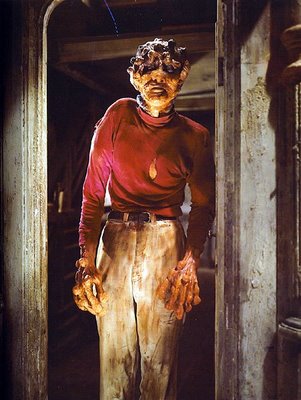
As the group slowly finds itself on edge due to the hopelessness of rescue and the encroaching pangs of hunger as their food runs out, in-fighting begins and some of the group turn to eating the untested mushrooms out of sheer desperation. It soon becomes apparent that the mushrooms are addictive and have a euphoric psychedelic effect, and as that is discovered the fate of the wrecked ship's crew is revealed when our protagonists encounter a hideously misshapen fusion of man and mushroom.

You guessed it: those who consume the mushrooms themselves end up as creepily-giggling, human-sized fungus monsters, eventually losing all traces of their former status as representatives of homo sapiens. For example:

Eventually, one of the castaways is rescued but what baleful effect has the experience had upon him? Let's just say that he likely would have been better off if he'd remained on the island...

Definitely low-key and all about atmosphere rather than straight-up "BOO!" scares — I swear you can practically smell and feel the thick mustiness of the fungus — this is perhaps Toho's most unique effort from that golden period and it deserves more exposure here in the West. Seriously, check it out.

Poster from the original Japanese theatrical release.