Having witnessed the PREDATOR franchise since its inception in 1987, I have to admit that I never quite cottoned to it the way most people did, mostly because the films following the initial installment did not live up to the potential of the concept. I wasn't all that keen on the first one either, despite its classic status, for reasons I've already outlined elsewhere, so when yet another PREDATOR flick was announced I didn't really care. That is, not until I heard Robert (PLANET TERROR) Rodriguez was involved. I really like what the guy brings to the table in all of his films, so when I heard he was producing the new one after seriously examining what worked in PREDATOR and what did not work in the execrable subsequent movies, I was filled with hope. Though Rodriguez did not direct, PREDATORS was well-helmed by American-born director of Hungarian films Nimrod Antal, and it looked and felt to me like a story from the classic era of Britain's 2000 A.D. sci-fi comics weekly. Before I go any further, though, it's only fair to state that HERE THERE BE SPOILERS.
The plot's pretty simple: a group of eight people, several of whom are heavily armed — a tough-as-nails seasoned mercenary (Adrian Brody), a Guatemalan sniper (Alice Braga), a huge Spetznatz operative (real-life bad motherfucker Oleg Taktarov), an African death squad member (Mahershalalhashbaz Ali), a serial rapist who's scheduled for execution (Walter Goggins), a silent Yakuza soldier (Louis Ozawa Changchien), a Mexican cartel enforcer (my man Danny Trejo) and a meek doctor (Topher Grace, shaking off the shame of SPIDER-MAN 3) — find themselves mysteriously transported to a dense jungle locale and soon come to realize they are on another planet (the three neighboring planets seen in the sky being the dead giveaway).
Bear Mountain it ain't.
In short order they figure out that they are in what amounts to an extra-terrestrial game preserve and that they are the game, there to be hunted by alien sportsmen who wield projectile and energy-based weapons, as well as tech that renders them pretty much invisible to human visual perception while allowing them to track their prey via their infra-red signatures. The aliens have also unleashed other vicious life forms, so the humans must do everything in their meager power to stay alive, and it sure as shit is not an easy task. And even if they did manage to survive, how the hell would they get back to the Earth?
The narrative is one long, briskly-paced hop from one insanely deadly situation to another, so here are the pertinent bits:
The title refers to not only the aliens, but also the chosen humans.
This time around there is less invisibility than previous, and that suits me just fine. The aliens already have a clear advantage with their size, strength, physical resilience and shitloads of very effective weaponry, so considering that they consider themselves sportsmen, the cloaking tech always seemed like cheating to me.
All of the characters are interesting, something unusual for a piece of "action figure cinema."
The events of the original PREDATOR are referenced, so this is less of a reboot than a continuation that wisely makes no mention of the sequels.
The majority of the decisions made and the actions taken by the stranded humans make recognizable sense.
As also mentioned in the original film, the aliens have been kidnapping Earthlings for sporting purposes for a long time. This is noted when the Yakuza soldier finds a katana that he states is very old.
Yakuza soldier Louis Ozawa Changchien engages one of the alien hunters in formal combat.
The fact that the humans are not necessarily good people is an intriguing angle, and we root for them mostly because they're the hopelessly outmatched unwilling home team.
PREDATORS gets my vote as the first summer blockbuster of the season to fully deliver on everything the viewer goes into it expecting to get, and it actually has a lot more intelligence than something like this has any right to possess, although after the ALIENS VS. PREDATORS films that may not be much of a shock. PREDATORS is very much a "guy" movie, but it's solidly entertaining and has nothing in it that I would not allow kids ten and older to see; it's got cussing and some gore, but it's nothing they couldn't handle (personally, I could have done with a LOT more gore, but that's just me). RECOMMENDED.
During the 1980’s I saw every Arnold Schwarzenegger movie as they came out, each one more overflowing with raw testosterone than the previous and offering heavily-accented, monosyllabic histrionics to be enjoyed by all comers, and nestled amid this rarefied niche in cinema is the action/sci-fi opus PREDATOR, which is considered by many to be one of the greatest action movies ever made. I even remember enjoying it very much when it was first released, but back in those days my perceptions were literally clouded by a perpetual haze of serious doobage so I gave many a lacking flick a pass if it amused me during my thoroughly baked state of existence. Well, I watched PREDATOR again for the first time in twenty-three years not too long ago and I have to say that I really don’t get what the big deal is.
The story, such as it is, deals with a bunch of commandos lead by an ambulatory slab of beef named Dutch (played, of course, by Ah-nuld) who are sent into some hellhole of a South American jungle to deal with some typical G.I. Joe shit but end up as the quarry of an invisible and heavily armed extraterrestrial hunter who collects human skulls as trophies. By the end of the film Ah-nuld is the only commando not skinned and de-skulled, and it’s a throw-down between him and his alien adversary. That setup would have been great if it didn’t take so goddamned long for the soldiers — a group virtually indistinguishable from a bunch of ‘70’s-era G.I. Joe dolls found in any suburban backyard battleground/sandbox — to catch the title monster’s attention and be drawn into ultra-violent set pieces, and much of what passes for character development between the soldiers, bits meant to communicate their combat-bonding, is weak even by the standards of eighties army-man movies. And don’t get me started on the scene where the soldiers blaze away with their weapons of full auto for what seems like five solid minutes while screaming “AAAAAAAAAAAAARRRRRRRRGGGGH!!!” and hitting nothing but innocent foliage.
The one thing that PREDATOR really has going for it is its laughable and unintentional (?) homoerotic content. This flick sets out to be the manliest flick that it can be, and it succeeds in ways that would have put it right at the top of Tom of Finland’s list of the greatest films ever crafted. The heroes are mostly a bunch of uber-ripped and musclebound supermen who look just like one of Tom’s famous leatherboy drawings, only sadly minus the fully visible, ginormous and veiny three-foot cocks that are as thick around as a can of Chock Full O’ Nuts coffee, and there even seems to be an attempt to cause the audience to take sides in a “who’s more manly” debate involving Ah-nuld and former Apollo Creed Carl Weathers. I swear to God, when Ah-nuld and Apollo greet each other at the beginning of the film they lock hands in the “soul shake” and immediately launch into a bicep clench-off that was only the first of several moments between them where I wondered how soon it would be until they finally admitted they were in love with each other and moved to the West Village.
Honestly, a homosexual love/adventure story between those two would have been a hundred times more interesting and entertaining that the actual movie, and the not-blatantly-stated-but-plain-as-the-nose-on-your-face love between Bill Duke and Jesse “the Body” Ventura’s characters would have offered another he-man interracial pairing with which to contrast the Ah-nuld/Apollo thing. No bullshit, watch PREDATOR again and try to tell me that Duke and Ventura aren’t more than just friends and comrades. (Any “Friends of Dorothy” out there who read this blog could do far worse than to spend an evening with PREDATOR, a box of tissues, and some Astroglide.)
Carl and Ah-nuld: the look of love.
The only other soldier to make any kind of impression is my man Sonny Landham, best known to most film fans as the Indian from 48 HOURS (1982). Here he plays Billy, the fighting unit’s Injun tracker and both his look and demeanor remind me a hell of a lot of famed comic book hero Wolverine.
Sonny Landham: fuck Hugh Jackman, this guy is Wolverine!
Sadly Landham has little to do other than portray a modernized version of the stoic and stereotypical native tracker found in eleventy-jillion Westerns, and even his mano a mano against the alien hunter is a total letdown because even though he strips off his shirt, draws some of his own blood and howls out a challenge, we do not see even two seconds of the battle. Instead we get Ah-nuld duking it out with his invisible enemy, and while that was fun in a Conan-reminiscent way, it was too little too late and concludes with a stunningly idiotic finale in which Ah-nuld, having mortally injured the alien, more or less outruns a nuclear blast caused by a self-destruct sequence built into the critter’s armor. When a rescue chopper arrives to pick him up, Dutch is standing there, looking not too much worse for wear, the mud covering his ‘roided-out physique apparently providing protection against inferno-like heat and hard radiation.
Never before has scientific realism been so starkly conveyed on the big screen.
As for the Predator itself, we are told that he shows up every few years whenever that particular patch of South America reaches a certain heat level and then begins his recreational hunting in earnest. That’s fine by me for a scary monster, but I’d find him a lot more frightening if he didn’t rely entirely on high-tech alien gizmos to get the job done; he’s got a cloaking device, a super-destructive laser whatchamawhoozit, knives and who knows what else, so he’s the extraterrestrial equivalent of one of those assholes who “hunts” animals who are trapped in an enclosure with zero chance of escape from death by automatic weapons fire. I find that neither impressive nor scary and for me the film only truly comes to life when the alien’s invisibility field is on the fritz and he must take on Conan, er, Ah-nuld on a somewhat more even playing field, but as previously stated it’s far too little coming far too late into the proceedings.
So what I want to know is how the fuck did PREDATOR garner such a lofty place in the cult of action figure cinema? It takes forever to get to what it promises, it’s pretty much lacking in suspense and it has dated horribly, so what was the big deal? If any of you out there can offer an explanation, please feel free to write in.
The cast of PREDATOR: surprisingly not a '70's-era G.I. Joe ad.
"A staggeringly powerful, magnificent film. Must be numbered among the most significant, brutal, liberating and honest American films ever made. It is a movie of great art and courage." -The New York Times
"Horse feathers!!!" -Cine-Miscreant
I finally got around to seeing Ralph Nelson's infamous SOLDIER BLUE, one of many Viet Nam-era flicks taking place in disparate genres that were thinly-veiled protests against the war, and I have to say that on all fronts — political allegory, western saga, romantic comedy — it's pretty much full of shit.
When Sam Peckinpah's superlative THE WILD BUNCH (1969) opened the door to outrageous displays of graphic cinematic ultra-violence, it did so with a talented (if whisky-marinated) hand guiding the camera and possessed a compelling story with characters who had actual depth, but in no time flat there were scores of imitators that fell far from the benchmark set by Peckinpah's epic, and SOLDIER BLUE definitely falls into that category.
SOLDIER BLEW, er, BLUE tells the story of foul-mouthed New Yorker Cresta Lee (Candice Bergen) a blonde proto-hippie chick who's been "rescued" from two years of "captivity" among the Cheyenne and is now being sent to a fort where she'll be reunited with the fiancée she only wants to marry for his money. Also on board the wagon she’s traveling in is a shipment of government gold, cash the Cheyenne need to buy guns with, so in short order the soldiers are wiped out and Cresta flees to the hills, accompanied by Honus Gant (Peter Strauss), the lone surviving cavalryman. Calling Gant by the snarky nickname “Soldier Blue,” Cresta demonstrates that her years among the “savages” was time well spent, outstripping Gant in survival skills, common sense and sheer balls, and over their journey toward the fort they must persevere against the elements, a band of hostile Kiowa, an unscrupulous trader — played by Donald Pleasance, here giving one of his most ridiculous performances — and, in the tradition of many previous western-set romantic comedies, each other.
Gant’s basically a decent sort, but his jingoism and naiveté constantly clash with Cresta’s views on the Indians and their treatment by the military; when Cresta attempts to enlighten Gant about massacres in which women and children are raped and tortured, Gant refuses to hear it and labels her a liar. He also considers her a traitor for her views and is shocked to discover that the only reason Cresta left the Cheyenne wasn't that she was unhappy or being mistreated, but because they just did things too differently for her to ever feel at home as one of them. Oh, and she was also married to the leader of the band that killed soldiers escorting the wagon, meaning that her sacred Whiteness has been tainted by intimacy with an Injun.
During the course of their misadventures the two opposites are inevitably — and predictably — attracted to each other and eventually end up getting it on — while Gant has a freshly-treated bullet wound that went clean through his leg, no less — in what was surely the only conveniently located cave for at least a twelve mile radius that wasn’t filled with rattlesnakes, mountain lions, or who knows what, plus to say nothing of the Cheyenne, who could have done something really spiffy with such a primo apartment (there I go, thinking in NYC real estate terms again).
Realizing that their love could never flourish outside of the cave, Cresta leaves Gant and makes it to the fort by herself only to discover that the dickhead in charge won’t spare a couple of men so they can rescue Gant; the regiment needs all available personnel to launch an attack on the nearby Cheyenne village and once Cresta gets wind of that she slips past her obnoxiously horny hubby-to-be and makes a beeline straight to the Cheyenne to warn them of what’s coming. The tribe’s leader for some reason has faith in the word of the Army — after all, they gave him a medal and promised no hostilities — and against the judgment of his advisers neither flees nor takes the fight to the cavalry.
What happens next is what gained the film its infamy; it turns out that all the wacky misadventures and squabbling were all just a lead-in to a hideous reenactment of the 1864 Sand Creek Massacre, an orgy of rape, torture and general sadistic evil perpetrated in the name of “keeping the country clean,” and forty years after its release this sequence still disturbs and nauseates for its sheer cruelty. Children are trampled beneath the hooves of charging horses or impaled on bayonets, unarmed people are beheaded — a nice effect, I have to admit — women are stripped and pawed by gangs of slavering brutes, then raped and mutilated — in one truly sickening instance a naked native woman puts up too much of a fight, so her rapist instead decides to cut off her breasts, which we thankfully only see the start of before the camera moves on to chronicle some other hideous act — and scores of innocent people are shot and dismembered, their component parts impaled on pikes and waved about in victorious celebration or kept as the most ghoulish of souvenirs. No bullshit, this scene would instantly garner an NC-17 rating if released today, to say nothing of possibly spurring Native American interest groups to riot in the streets over the incredibly exploitative manner in which the atrocities are depicted.
Gant manages to hobble to the action and witness for himself the horrors described by Cresta, and when he attempts to stop the inhumane mayhem he’s declared insane, a coward, and a traitor. When the smoke finally clears and the plains are literally strewn with bodies and severed limbs, Gant is led away in chains and Cresta, in full Cheyenne garb, joins the pitiful remnants of the village and begins a long march to either incarceration or a miserable existence on some reservation.
I’m all in favor of westerns that don’t shy away from honest portrayals of how the west was won (or stolen if truth be told), but this film has no idea of what kind of movie it wants to be. One minute it’s a heavy-handed pseudo-hippy lecture about how the treatment of the natives was totally fucked up (no shit, Sherlock), then it’s a light-hearted battle of the sexes farce wherein Cresta proves herself five times the man Gant is and manages to look hot in her tasty red calico poncho (with no undies), but that all goes out the window when Donald Pleasance shows up with an unintentionally (?) hilarious pair of buck-toothed dentures and our heroes must figure out how to escape from his murderous clutches in a sub-plot that goes nowhere, all of which culminates in the aforementioned apocalyptic climax. Any one of those tacks would have been okay for a coherent film, but the end result here is a slapdash mess that milked the horrors of its final ten minutes for all they were worth in the film’s promotion and poster imagery. Sadly, the only thing that works in the film is the violence, an unflinching display that tries to out-Peckinpah Peckinpah — which it doesn’t — and even rips off his famous slo-mo squib compositions to much diminished effect. Western auteurism as grindhouse exploitation movie, if you will.
But by trying to be all things to all audiences, SOLDIER BLUE ends up as an incoherent, preachy Mulligan stew of presumably well-intentioned political correctness, but if they were going to tell the story of the Sand Creek Massacre, wouldn’t it have been a good idea to have some Injun characters who were more than just walk-ons with Murphy Brown acting as their mouthpiece? We get to know absolutely nothing of the people who get wiped out solely for what appears to be a crass ploy to lure gorehound moviegoers into seeing “the most savage film in history.” If you, like me, were intrigued by the provocative ads and reviews that shower almost endless praise upon it for its “daring to tell it like it was,” take my word for it and let SOLDIER BLUE slowly fade into cinematic obscurity. A feel-good flick it ain’t and it’ll really kill all the joy in the room when you make it past the first forty-five minutes. The perfect companion piece for a double bill with the even more exploitative and offensive CUT-THROATS 9 (1973), which is a subject for another post and a much better film.
Oh, and did I mention that the characters reference the Battle of Little Bighorn, which did not occur until twelve years after the events of this story? Way to do your research, fuckstick!
If you're a lover of the martial arts and know the basics of Bruce Lee's history, you are no doubt aware of the aged grandmaster who taught him the style that formed the foundation for his legendary skills, namely Wing Chun kung fu. The figure in question was Yip Man (1893-1972) and by all accounts he was a highly proficient practitioner of his chosen art, so him being the fire that lit the fuse of Bruce Lee, who at the time was something of a delinquent asshole who respected few people, speaks volumes.
The real-life grandmaster Yip Man and his most famous student.
As much as I find Lee of considerable interest, I have always been much more interested in his teacher and his pursuit and promotion of Wing Chun, a form noted for its no-nonsense practicality and utterly devastating effect, something I can personally attest to after sparring with a few Wing Chun practitioners over the years and having my ass handed to me like a sack of sliders at the White Castle takeout counter. So with the undying popularity of Bruce Lee still very much in effect and the accompanying interest in the ancillary martial figures in his life, it was inevitable that someone would get around to making a bio-pic about his sifu. Fortunately, the resulting film, IP MAN (apparently the traditional Chinese spelling of his name rather than the Cantonese), is in every way better than the cloying, Hollywoodized date movie crap that was DRAGON: THE BRUCE LEE STORY (1993), although I do have my doubts as to the historical accuracy/truthfulness of this film since it adds up to a pretty much perfect HK-style inspirational heroic story. But who cares about veracity when you're being entertained so thoroughly?
Thoughtful Wing Chun master Ip man (Donnie Yen) works the Mook Jong.
The film opens in the Chinese town of Foshan in the pre-WWII 1930's, and we are immediately told that the place is known as "the town of martial arts" thanks to the high number schools teaching said skills. Among the many masters in the place is Ip Man (Donnie Yen), a kindly, quiet and thoughtful family man who is such a badass that people are constantly begging him to teach them his skills or let them test their own prowess against his. The first third of the flick shows us just what kind of a serious mistake it is to engage in a match with Master Ip, first as seen in the embarrassing private beatdown of a master who has an unduly over-inflated opinion of himself and his skill set (a defeat that Ip Man keeps mum about out of professional respect and consideration for his opponent's feelings and reputation), and Ip's complete and utter decimation of an arrogant would-be sifu who kicks the ass of every other master in town before showing up at Ip's house and rudely demanding to take him on. Both of these sequences are terrific and feature choreography by my man Sammo Hung — a real-life classmate of Jackie Chan and Yuen Biao who's a fatass whose nimbleness and overall kung fu talents will shock the living shit out of you just before you collapse to the dusty ground in a beaten and bloodied heap — and for the first time in years I found myself perched on the edge of my seat during a martial arts movie's fights.
After establishing both Ip's serene martial toughness and his sense of community-mindedness, things take a dour turn as the Sino-Japanese War gets underway and the people of Foshan feel the boot of Japanese occupation upon their collective neck. Ip's fortunes see a sad reversal as he, his wife and his son are turned out of their semi-palatial home and are forced to live as more or less peasants. As Ip's wife becomes ill due to the various deprivations of the situation, Ip takes a job digging coal — an immense step down for a cultured man such as himself, but he endures with a pleasant attitude and not one word of complaint — but soon takes up the challenge of the occupying Japanese general (Hiroyuki Ikeuchi), a stern bastard who enjoys seeing the karate skills of his troops tested against the downtrodden Chinese masters in exchange for a paltry bag of rice should the Chinese prove the victors. There's a bit of standard Hong Kong movie soap opera stuff throughout all of this, but not enough to detract from the ass-whuppin', and when an outraged Ip Man enters the general's improvised dojo and demands to fight ten men (as opposed to the usual one-on-one or three-on-one), it's a festival of foot-to-ass that will make fans of the genre feel glad to be alive.
The master against ten skilled opponents: worry about them, not him.
After the Japanese suffer a crushing defeat at the hands (and feet) of one very serene Chinese, tensions escalate to the point where Ip must teach the locals Wing Chun so they can defend themselves against the Japanese and a pack of opportunistic bandits led by the would-be martial arts instructor Ip thoroughly humiliated earlier in the film. And as if all that mishegoss were not enough, the Japanese general demands a personal and public one-on-one match against Ip in which he hopes to prove the superiority of Japanese martial arts, and unless he gets his way the innocent locals will be made to suffer, and suffer and suffer...
You get the idea, and all I have to say is put this one on the ol' Netflix queue immediately. After the disappointing, uninvolving and highly-overrated CHOCOLATE, I welcome IP MAN like a fondly-remembered and long-lost friend. Let's hope the two upcoming sequels are even half as good as this.
Thor the German Shepherd: this is the face of a true-blue hero.
As the TWILIGHT juggernaut rolls on and perpetuates the whole pussified vampires thing, I once more take solace in the werewolf movie genre and recently got my hands on a copy of BAD MOON, a flick I'd heard of but ignored for a number of reasons. One of those reasons was its rep as yet another of the many low-budget throwaways in the genre, and if there's one thing I should have learned by now it's that you cannot judge a horror movie's quality by its budget or relative lack thereof. The original NIGHT OF THE LIVING DEAD cost about fifteen bucks to make even almost forty years ago, and it's a classic. Same for the original THE TEXAS CHAIN SAW MASSACRE. Though not quite within the realm of those exalted landmarks, BAD MOON is a minor gem that does something different with the hoary conventions of the cinematic werewolf yarn.
The film is based on the 1992 novel THOR, by Wayne Smith, a story told from the point of view of the titular faithful German Shepherd who lives with a family of humans that he understandably considers his "pack." In the hierarchy of the pack Thor functions as the very capable protector, and his natural abilities are put to the test when a relative, Uncle Ted, comes to visit the family and only Thor, thanks to his animal senses and intuition, realizes that the guy is a werewolf. I have not yet read the book (I ordered it from Amazon and will review it once I've finished with it), but the movie apparently follows the book's plot basics, only losing the family's husband/dad and two of the kids, leaving Thor to look out for a single mother (Mariel Hemingway), and her young son (Mason Gamble, the kid from the horrid DENNIS THE MENACE movie). Thor proves his worth as a guardian early on, when a con man tries to fleece money out of the mother by provoking Thor to attack him, unaware that the woman is a lawyer who has prosecuted dozens of would-be hustlers just like him, and from that incident onward the audience knows to trust Thor's instincts.
After an expedition to a foreign land where his colleague/girlfriend is savagely killed by a werewolf and he himself is stricken with the curse of lycanthropy while trying to save her, Uncle Ted (Michael Paré ) returns to the States and embarks on a quest to find a cure for what has befallen him. Unfortunately, all avenues prove a dead end and Ted moves into a trailer somewhere in the deep backwoods of the Northwest, where his homicidal lunar activities will stand less of a chance of getting out of hand (a plan that doesn't work because his transformations are nightly and he's wracked up a body count of five before the plot even really gets rolling). When he invites his sister and nephew up to visit (with Thor along for the ride), Ted gets it into his head that the company of his family may be just the thing that will curb his rapacious supernatural urges. It is during this daytime visit that Thor is allowed to sniff about freely in the woods, where he picks up strange scents and the remains of a forest surveyor, a trail that leads right back to Uncle Ted. Thor may not be able to articulate what he senses, but he knows Uncle Ted is something very, very dangerous, and from that moment on he holds the man under very close scrutiny.
Creepy Uncle Ted, now a werewolf and safely ensconced within the bosom of his family...
...which puts him within Thor's territory of guardianship, and Thor knows EXACTLY what's up.And he doesn't like it one bit.
Following his latest murder and with the police investigating literally right outside his trailer door, Ted calls his sister and asks if he can stay with her for a while. Once he parks his trailer outside the family home, Thor immediately sets up a vigil to keep an eye on the lupine visitor. Ted, very much aware that Thor has his number, creepily tries to insinuate himself into a position of power within the pack while going out nightly to chain himself to a tree as his transformed self rages without causing harm to anyone.
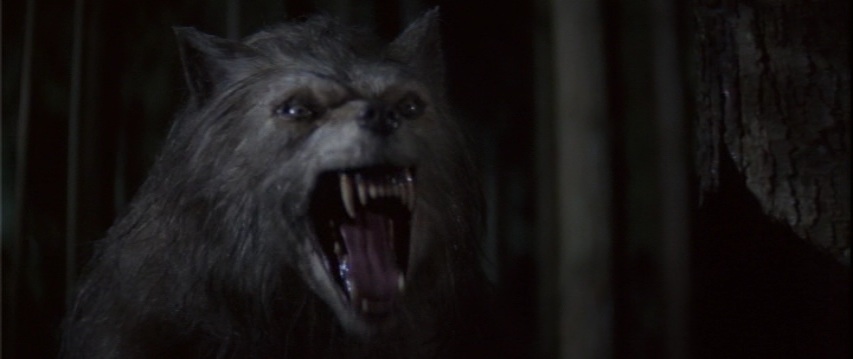
Uncle Ted, all wolfed-out.
Thor witnesses the chained werewolf and has his worst fears realized, returning to the house and pissing on Uncle Ted's camper as a territorial warning. From that moment, you had better believe it's on, and in no time Thor's seemingly vicious and totally mis-interpreted aggression toward Ted lands him in the pound, leaving his pack very much in harm's way. But never underestimate the power of a boy's love for his dog, or the dog's love of his humans...
The film's low budget is certainly evident, but the story more than makes up for any deficiencies in the department of production values. The movie even has a werewolf that's much better than expected, although the transformation sequence is somewhat-justly maligned. Though low on gore (at least by my standards), the film is a lot of fun thanks to its unusual protagonist and if you're a dog-lover like me, you will root for Thor like you haven't rooted for a hero since Indiana Jones went after the Ark of the Covenant. Played by a pooch named Primo, Thor is a canine hero to be reckoned with and he even takes on the werewolf — a goddamned WEREWOLF!!! — twice, in what can only be called savage, animalistic combat. When stacked up against Thor, Rin Tin Tin, Lassie and Benji are a bunch of pussies and they can each suck it.
If not for a wholly unnecessary sex scene at the film's very beginning, I would recommend this as suitable for all ages, provided the kiddies can take scares that are mild by adult standards. This really is the heroic dog story taken in a different direction and as such it has the potential for great cross-audience appeal. BAD MOON awaits re-discovery and I suggest that you give it a chance. RECOMMENDED.
Here's a review by my pal and recent high school graduate Olliver, which he kindly provided because I refuse to see this film, even though it has werewolves in it.Plus, let's face it: I'm not a tweener girl, the film's target audience. -Yer Bunche
This is a 30-minute movie review (I did everything in just 30 minutes).
After the success of Twilight 2: Electric Boogaloo, you would have to be extremely stupid if you didn't see this movie coming. The Twilight Saga: Eclipse provides more of the same from the last two movies, namely one-dimensional characters for tweener girls (and overage shut-ins with nothing better to do) to ogle over. Do you remember in high school how all the hot girls would only go out with the biggest tools they can find? Well, that's this movie. Twilight is THAT movie. We have "sensitive" vampire Edward Cullen (Robert Pattison), the amazingly bad actor with skills that bring to mind those of a dead fish, Bella (Kristen Stewart), who the movie obviously wants us to compare to a beaver since 60% of the movie is just a close up on her giant teeth, and Jacob (Taylor Lautner), the Indian werewolf hunk who is only there to sell tickets and can't seem to afford a shirt.
This is the best way I can think of to sum up this movie.
So Bella now has to decide who to go out with. If I was a girl, my choice would be obvious, but no... This is a Mary Sue story, so "everybody loves her and she has absolutely no real problems." (I wonder if the next movie is going to have an hour of Bella picking what shoes to wear for the day?) Have you ever heard some spoiled asshat complain about how their life is "soooo hard" and then they mention it's hard because they have to "take out the garbage" or something trivial like that? Well, say hello to the target demographic because that's Bella and those who fantasize about being her.
Meanwhile we are introduced to some real vampires. These guys kill for blood and are "real" to such to such a degree that they could have just walked off the set of Blade and make the Cullen family look like a bunch of whiny little bitches (though the Cullens actually do a good job of conveying that by themselves). So these vampires are ruling Seattle, eating all the people they can and there's nothing to stop them... until they decide to stop and, for no reason whatsoever, go after Bella. The whole world revolves around her. In the Twilight series she's more important then the Pope. Mary Sue literature at its best, folks.
"Forget about all that genocide and stuff, this single dull girl is more important than the horrible history of acts you committed against my family."
So the two clans decide, "Hey, let's not fight each other anymore. We need to work together to make sure that these new vampires don't kill this single teenage girl, even though the real vampires probably killed 40 girls by now in Seattle, but WHO CARES? Bella is more important, you know that!!! You can go killing all you want, but don't mess with this one girl." It's not like she has a secret or something so they have a reason to kill her. If Bella would die, nothing would be affected by her death. Both Edward and Jacob would go on living their lives like nothing happened and the world will still revolve with one less stuck up girl in it. So anyway, the two clans put aside all their differences and thousands of years of bloodshed for this one girl. BECAUSE SHE IS SOOOOO SPECIAL. This is the same as if the KKK and the Black Panthers teamed up... for a girl. Retardedness... Sheer retardedness...
One thing I hate is how we have Stephanie Meyer's (the shit-tastic author of this snooze fest) Mormon beliefs thrust upon us. It's hard to believe that these immortal monsters would care about the sanctity of marriage. Bela Lugosi wouldn't have made a purity pledge! Jacob talks about how it's fine to "love two people at the same time" and how he's "seen it before" and Edward... oh god, this one's gonna need it's own picture.
"Will you be my wife for the next 3 decades till you die and I find another?"
So Edward proposes to Bella for her hand in marriage (blegh) and she accepts even though she doesn't want to accept because she still has feelings for Jacob. Boo-freakin'-hoo. So we have a scene where Edward (keep in mind that he's a vampire) is sitting in the middle of a FIELD OF FLOWERS IN BROAD DAYLIGHT TALKING ABOUT WEDDING PLANS!!!! He tells her how important virginity is and how it.... Wait a second; a 200-year-old vampire is a virgin? What the fuck? So you're stuck as a 19-year-old for 200 years and can do all these flips and have super strength...and you can't get any poon? Either he is the most pathetic vampire ever or he's playing her for a dumbass. I hope it's the latter but wouldn't be surprised if it were the first. There you go, another example of Mary Sue literature; he waits 200 years 'til she comes along to have sex, BECAUSE SHE'S SOOO PERFECT. How can a vampire believe in virginity? Vampires are beings of pure sexuality. Then we have Edward. The sun doesn't hurt him, he doesn't turn into a bat, he doesn't drink blood, he's made out of crystals, he's a vegetarian and believes in virginity.... WHAT MAKES HIM A VAMPIRE?!?! He doesn't have a SINGLE vampire quality. My fish drawings are waaaaay more accurate than drawing him as a vampire. This, my friends, is why Mormon women should not be allowed to write books.
Of course, don't say that while watching the movie or you'll face a similar result (see above) from hardcore "Twilitards."
The movie consists 90% of just close-ups. Damned near everything is a close-up. The talking is zoomed all the way in, the makeout scene is zoomed all the way in... The only time to movie ever zooms out is to show the Indian kid's chest. I got that the vampires are pale, it's okay, but I didn't need to stare at his pale-as-a-corpse's-ass face for 2 solid hours. It jumped around more than Manos: Hands of Fate. I started getting motion sickness from it. It felt more like I was watching The Blair Witch Project than a vampire movie... Actually, it felt more like ANYTHING but a vampire movie.
When I look back over my four-and-a-half decades on this planet, I often ruminate on exactly what diverse and twisted influences served to create the Bunche that you know and love (?) and I can honestly state that a major portion of my world-view was determined by the movies my parents took me to or let me watch on the television before my seventh birthday.
My earliest memory of seeing a movie in a theater is of GULLIVER'S TRAVELS BEYOND THE MOON (1965) during what was surely a re-release, because I was about a year old when it was came out in the US.
I believe I was either three or four when my dad took me too see it and I will never forget how ominous the dark, empty theater seemed, a vast, foreboding space pregnant with possibility that my own experiences had not yet prepared me for. In later years I would accept that uncertainty as par for the course when going to the movies, the tension heralding either a glorious flight of escapist fare (like THE EMPIRE STRIKES BACK) or a total fucking dud, compared to which getting punished would have been preferable (FLESHBURN being a perfect example).
As the film exploded across the screen I had no idea that I was receiving my first exposure to the wild & woolly world of Japanese animation, but I did know that I loved the colorful images, solid story and the genuinely dark undertone that simmered during the second half. GULLIVER'S TRAVELS BEYOND THE MOON is the story of Ricky, a homeless street urchin in an unspecified European (?) city who sneaks into a theater showing a film adaptation of GULLIVER'S TRAVELS and, after hearing the hero's inspirational words about sustaining himself through impossible odds with hope, gets promptly thrown out on his ass by a surly usher. In short order Ricky is joined in his aimless wanderings by a talking dog and a living toy soldier, and this bizarre trio then falls in with Gulliver himself, now a misanthropic recluse who seeks to explore outer space in a homemade rocket ship. The heroes blast off into the void, running into Cupid — who grants them each one wish and is voiced by a grown-up Darla Hood of LITTLE RASCALS fame — and finding themselves embroiled in a conflict between two factions of sentient machines, one kindly and inquisitive, the other a warlike force of conquest-minded juggernauts who state their intentions in the song "Rise, Robots, Rise," a number so grim for a kiddie movie that I remembered certain images from it decades later like I'd just seen them yesterday. This truly dreamlike film ends with one of those "it was all a dream" scenarios but it doesn't disappoint because Ricky's adventures were simply too fantastic to have been anything else, especially considering that the whole adventure may have been induced by a concussion suffered during a hit-and-run car accident.
Even I felt like the memory of the movie may have been caused by me getting hit by a car and knocked for a loop when I was little — no bullshit — but I was relieved to find that I had not hallucinated its existence when I came across a copy of the soundtrack LP during my college years. And it wasn't until around three years ago that I was able to obtain a copy of the film on DVD and watch it again, and I was not in the least bit disappointed; if you can stomach the mostly-saccharine songs by Milton DeLugg (he of SANTA CLAUS CONQUERS THE MARTIANS infamy) this film is a unique fairy tale with a tone that feels like you're experiencing a waking dream. The only drawback is that thanks to the rarity of the flick, it's a bitch to find a decent print that hasn't been kicked around and dragged through a litterbox while the making the rounds on the kiddie matinee circuit, so the print available on DVD is washed out and looks like ass. Hopefully some company will tap into the current anime craze and unearth a crisp Japanese language print and release that, but I'm not holding my breath.
Not long after that, my parents took me along with them on a trip to Reno and left me in the casino's daycare while they gambled. The only thing I solidly remember from the experience was the daycare area's color TV running some movie featuring a cool giant robot that wandered around a countryside destroying all in its path with either energy blasts from its eyes or its implacable stride.
The mechanical giant in question.
The film also featured garishly-costumed alien invaders who abducted Earth women, but it was that robot that stuck with me. I did not know the name of the film but some years later, as my addiction to Japanese sci-fi/fantasy/monster movies forced me to delve deep, I found out that the movie was known as THE MYSTERIANS (1957) in the States, though initially released as EARTH DEFENSE FORCE in its native Land of the Rising Sun.
The American theatrical poster.
Though quite colorful and boasting superb effects by the legendary Eiji Tsuburaya, THE MYSTERIANS does not stack up too well against most of the other Toho Studios films imported to the States in the late 1950's and into the Sixties. It moves very slowly and it takes a long time for the robot, "Mogera," to show up, and when it does make the scene it's not around for long before being defeated. Still, a kickass robot remains a kickass robot, and the movie's worth seeing for it.
The next film to majorly impact my formative years was a steaming turdstorm called THE NAVY VS. THE NIGHT MONSTERS (1966), a zero-budget effort implausibly based on a novel by sci-fi legend Murray Leinster.
Bad on so many levels, the movie is a crap-film-lover's smorgasbord of heinous acting, obviously in-studio sets trying to pass for the outdoors, man-eating, acid-secreting plants that look like they were crafted by a bunch of third graders with some papier-mache and a couple of garden hoses (see below)
and the always welcome sight of Mamie Van Doren in a nurse's uniform that's about six sizes to small for her ample lungwarts.
Mamie Van Doren, second only to Jayne Mansfield as the greatest of the Marilyn Monroe clones.
The thing that stuck with me about this one is that it exposed my four-year-old eyes to their very first taste of cinematic gore in the form of a soldier getting his arm ripped off at the shoulder by a carnivorous squash; seen now the sequence is pretty tame, but it shocked the piss out me when I was little. Plus there are scenes of people getting splattered with acid, and we all know that's always good for vaporous histrionics and dripping, disfigured flesh.
The horrid results of "self-abuse."
Much more familiar to the rabid film fan is RODAN (1956), the first of Toho Studios' famed daikaiju ("giant monster") cycle to be filmed in color and one of the most balls-out fun.
Basically a sort-of love story between two rampaging, man-eating prehistoric birds, the segments within the mines where hero Shigeru works are still terrifying, especially the hideous tableau of hatching monsters and giant insects with deadly pincers that, once witnessed, drives him mad. Totally Lovecraftian in scope and horror, that scene spoke strongly to a small child of the utter helplessness that you realize when you grasp the concept of relative scale in the presence of hungry, malevolent beasts.
At age five, my lifelong love of werewolves began with I WAS A TEENAGE WEREWOLF (1957).
A couple of lapses into hokey, overage juvenile delinquent movie territory notwithstanding, I WAS A TEENAGE WEREWOLF offers up a fun and mildly creepy metaphor for the horrors and pains of adolescence, and wouldn't be the last lycanthropy flick to tackle that theme. Michael (BONANZA, LITTLE HOUSE ON THE PRAIRIE) Landon stars as a J.D. with an irrationally explosive temper who undergoes prescribed psychiatric treatment in an attempt to curb his hair-trigger aggression, only to end up in the “care” of a mad psychiatrist who uses hypnotic regression to send him down the evolutionary chain to become an actual werewolf whenever he hears bells (how a werewolf fits into mankind’s evolutionary tree I won’t even begin to theorize). The poor bastard goes on a killing spree before his doom, and the film contains one of the most effective werewolf-on-the-hunt moments in film: the werewolf prowls his high school after hours,
ending up in the gym and encountering a girl practicing moves on the uneven parallel bars. As she executes a move that inverts her visual perspective, she comes face-to-face, upside-down, with the slavering monster.
Terrified, she falls to the floor and attempts to escape, but no dice.
Not a masterpiece, but definitely worth at least a one-time viewing.
Hammer Films produced a shitload of colorful and luridly blood-drenched horror epics from the 1950's through the early 1970's, many of which also gave the viewer a plethora of lovely, buxom British actresses in increasingly scandalous states of undress. And while the cinematic correlation of sex and violence and the box office potential of the two may not have escaped Hammer, I was too little to truly understand what any of it meant when I saw THE KISS OF THE VAMPIRE (1963) on CREATURE FEATURES under its American television title, KISS OF EVIL.
Much like Toho's films, the Hammer output created a world that the viewer could totally buy into, fantastic elements and all, and the frilly Gothic settings lent a distinctly European flavor to the flicks. This was territory familiar to kids raised on the seamier versions of the Grimm fairy tales, and the straightforward manner with which the stories were handled was a refreshing change of pace from American horror's frequent ham-handedness. But the element of THE KISS OF THE VAMPIRE that set the mental gears turning within me was how the head vampire seemed a lot more interested in the virginal newlywed he'd lured into his cabal for nebulous activities that had little to do with feasting from her jugular...
Quaint in depiction by today's standards, I would later see that scenario played out dozens of times, with varying degrees of prurience, in other films, but none of them had the same nightmarish-yet-alluring appeal as it did for me here. Oh, and the bit at the very beginning, where a grief-stricken and drunk father plunges a shovel through the coffin of his vampire-victim daughter, only to have the soon-to-be-interred let out a hellacious scream and bright red blood flow gorily out of the wood is still a killer.
And speaking of killer, how could I not mention THE KILLER SHREWS (1959)?
A notorious piece of sci-fi shit, this film introduced me to the concept of a film with a budget so low that they couldn't afford to create a decent fake monster, so the filmmakers simply threw cheesy costumes onto some dogs and let them run around the set.
Lassie had seen better days.
I've since seen that move pulled in countless flicks where dinosaurs are merely iguanas with big, fake fins glued to their spines, but the impact of THE KILLER SHREWS will never fade from my memories of childhood because it convinced me that at any minute my goofy, hyperactive Collie, Corky, could turn into a flesh-eating scientific abomination.
THE GIANT GILA MONSTER (1959) is an abomination of a whole different sort, namely the abomination that is boredom. Coming late in the 1950's cycle of atomic mutation/nature run amok pictures — so memorably kicked off by THEM! (1954) and subsequently run into the ground by legions of vastly inferior knockoffs — THE GIANT GILA MONSTER doesn't even have the common decency of having a cool title, such as GI-LA THE FUCKING AMAZING or HOLY SHIT, THAT'S A BIG-ASS LIZARD!, and the title creature is just a plain old Gila Monster on oversized sets, an effect similar to putting your pet lizard into the middle of a town you just constructed out of Lincoln Logs (see below).
Sucking out loud in just about every way imaginable, THE GIANT GILA MONSTER is the first film where I realized I was willing to sit through anything once just as long as it may have even the slightest grain of entertainment. In this case there was no grain present, even for a rabid giant monster addict.
Then came SON OF GODZILLA (1967), a film my mom sat me down in front of because she figured I'd dig the cute little monster. Well, as any Godzilla movie fan worth his salt will tell you, that plan backfired;Minya , the title character, is a nauseatingly cutesy creation who looks half-formed and fails utterly at enthralling children. I think I speak for all other Godzilla junkies when I say that we watch these films for Big G and whatever other monster/monsters/army of humans in toy tanks and airplanes he's gonna kick the living shit out of, and whenever Minya appeared the action ground to a complete halt. Fortunately, SON OF GODZILLA does have plenty of big critter mayhem going on in between "heartwarming" scenes of Big G nurturing his (her?) offspring. The tropical island setting may have eliminated costly miniatures getting destroyed, but the battles with giant mantises and the horrifying (to little ones, anyway)Spiga — the biggest, meanest motherfucker of a tarantula I've ever seen — are kaiju eiga ("monster movie") gold. After this, I was a slave to Godzilla for life, even willingly enduring GODZILLA ON MONSTER ISLAND (1972), in which Godzilla and giant hedgehog Anguirus actually talk. No, seriously.
One of the things my dad instilled in me was a fervent love of "space opera" and all its corny trappings, and I still hold the original FLASH GORDON serial (1936) in high esteem. The plot could have been written by a six-year-old: Flash Gordon (studly, Aryan adventurer and Yale graduate; not a poof, despite flamboyant appearance)
Dr. Zarkov (egghead scientist/inventor, possibly Jewish)
and Dale Arden (eye candy)
fly to the planet Mongo to prevent it from crashing into the Earth. Once there they must contend with the evil emperor Ming the Merciless (a space-Chink, played by a white guy, who wants to defile Dale's sacred whiteness)
and his daughter, Princess Aura (the Asian nymphomaniac stereotype transplanted to deep space)
along with an endless supply of monsters, hostile aliens, beast-men, and noisy aerial battles in the loudest spaceships on record, dime store vehicles that shower the sky with sparks and smoke.
When spaceships sound like Taco Bell flatulence, it makes me smile.
Sheer fun and possessing not a single brain cell in its head, this set the template for all space adventure flicks to come; watch a few chapters of this followed by the original STAR WARS and tell me I'm not right.
This one instilled the take-no-shit-from-anybody attitude in me, inspired by Flash taking it to whoever earned his wrath. My battles have mostly been in the verbal arena, but you get my point. Oh, and I also learned that it's okay for grown men to run around in flamboyant capes and questionable shorts that show off their scrawny legs.
THE MONSTER THAT CHALLENGED THE WORLD (1957) featured giant gastropods kicking mankind's ass, and sent me under the living room coffee table in abject terror. The life-size monster props were first rate and the scene where one of them gets a gaffing hook through the eye still knocks me out.
The lesson learned in this film is that anything, and I do mean ANYTHING, can mutate and seek to eat the nearest tasty thing around, namely you.
Admittedly, several of these films may be a bit obscure to the layman, but how many of you out there haven't seen the 1958 version of THE FLY?
This tale of what can go seriously wrong with a matter-transporter experiment still resonates, thanks to a compelling story and decent acting, but what every person who's ever seen it will never forget is the famous ending... But first, the story: after the guy experimenting with the transporter tries the device out on himself and ends up getting his molecules blended with those of a common housefly, the poor bastard finds that his human head and left arm have been traded to said fly for a gigantic fly head and claw. Figuring he might be able to fix things if he found the tiny fly and went through the transporter again, this time sorting out the spliced genes, the now grotesque scientist enlists his wife's aid in tracking down the insect, but the tiny fly escapes from the house through a hole in a window screen. As the insect side begins to take over, the scientist convinces his wife to help him commit suicide by placing his head and arm into a multi-ton vertical press. When the wife confesses to the murder to the local police inspector and the scientist's brother, everyone thinks she's crazy, but as she's about to be carted off to the rubber room her young son — who has no idea of the sci-fi tragedy that has occurred — casually mentions that he's seen that odd fly with the white head in the garden, trapped in a spider's web. The kid shows the web to his uncle, and when the uncle takes a close look at the fly he sends the boy away and calls for the inspector.
The two adults peer closely at the fly struggling in the web as a hungry spider looms, and what they see is an unthinkable horror:
There, before their very eyes, is a miniscule part-man, part-fly, firmly ensnared in the web's strands, cowering and pitifully shrieking, "HELP ME! HELP ME!" in a high-pitched whine. Too stunned for words, the inspector picks up a rock and crushes the spider and fly, thereby rendering himself just as guilty of murder as the allegedly-mad wife, so there's no choice but to let her walk.
The scene that has warped innumerable young minds for three generations.
I've seen this film many times over the years, and even though I know it's coming that ending still sends me into a very dark corner of the mind, one that hovers dangerously close to madness. No joke, that scene is strong — if ludicrous — stuff, and the image of that tiny head raises the question of exactly why the human head is now bald and apparently toothless. A fly's life must be pretty fucking bad if it causes you to lose your teeth and hair in no time flat...
So what films ruined you for life, dear reader? Write in and tell me all about it!
 Having witnessed the PREDATOR franchise since its inception in 1987, I have to admit that I never quite cottoned to it the way most people did, mostly because the films following the initial installment did not live up to the potential of the concept. I wasn't all that keen on the first one either, despite its classic status, for reasons I've already outlined elsewhere, so when yet another PREDATOR flick was announced I didn't really care. That is, not until I heard Robert (PLANET TERROR) Rodriguez was involved. I really like what the guy brings to the table in all of his films, so when I heard he was producing the new one after seriously examining what worked in PREDATOR and what did not work in the execrable subsequent movies, I was filled with hope. Though Rodriguez did not direct, PREDATORS was well-helmed by American-born director of Hungarian films Nimrod Antal, and it looked and felt to me like a story from the classic era of Britain's 2000 A.D. sci-fi comics weekly. Before I go any further, though, it's only fair to state that HERE THERE BE SPOILERS.
 Bear Mountain it ain't.
 Yakuza soldier Louis Ozawa Changchien engages one of the alien hunters in formal combat.