Search This Blog

Friday, October 1, 2021

31 DAYS OF HORROR 2021-Day 1: DOCTOR WHO "THE BRAIN OF MORBIUS" (1976)

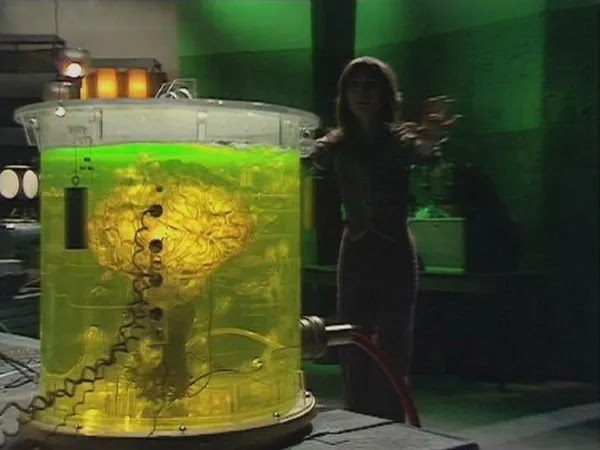
A blinded Sarah Jane Smith (Elizabeth Sladen) stumbles upon the brain of criminal Timelord Morbius, a baleful entity awaiting a new body with which to continue his campaign of evil.

At an unspecified time, The Doctor (Tom Baker) and staunch companion Sarah Jane Smith (Elizabeth Sladen) unexpectedly find themselves in the planet Karn, diverted there for an unstated purpose by the Timelords, but the Doctor is certain that he has been brought there to do some "dirty work" for his overlords, a hunch that proves right. The landscape it littered with crashed spaceships from dozens of worlds, but no survivors are evident. It turns out that the lack of survivors is due to them being killed and their body parts harvested by Condo (Colin Fay), the hulking dimwitted slave/assistant to Dr. Solon (Philip Madoc), a madman who was once considered the galaxy's greatest surgeon. He is obsessed with crafting a viable body for the evil Timelord Morbius, of whom all that remains is his sentient brain in a life-sustaining tank, ands all he needs is a suitable head. The Doctor's curly-topped noggin happens to be both a perfect match in terms of species and also convenient, but while fending off the machinations of Solon, the Doctor must put a stop to the threat of Morbius before he is resurrected. He must also prevent the Sisterhood of Karn — basically a cabal of science-fictional witches — from sentencing him to death, as they are convinced that he has been sent by the Timelords to steal the sacred flame that grants them near-immortality. 


The Sisterhood of Karn gets its chant on.

During this era of DOCTOR WHO'S classic 1970's run, the program, which had initially been conceived as a means by which to educate children about history, truly found its groove (and immense popularity and relevance within its native British culture) once it began exploring its conceit of being able to have its protagonist and his companions freely travel throughout the boundless reaches of time and space, where they often ran afoul of assorted evil life forms that could be categorized as "monsters," though always with a scientific/biological explanation for their existence.  

By the mid-1970's, the children that had watched DOCTOR WHO since its debut in 1963 had grown up with the program, and it's more kiddie-oriented aspects began to wane as the show hit its adolescence at the same time as its audience. The stories became darker and were front-loaded with elements that kept its fans terrified, with a common experiential marker of British youth of the era being "watching DOCTOR WHO from behind the setee." Though still often quite shonky thanks to the BBC's notoriously tight-fisted budgets, the series more than compensated for its lack of funds with scary scripts and solid performances from the cast. 

Once under the control of producer Philip Hinchcliffe and with actor Tom Baker taking over as the Fourth Doctor, becoming arguably the most iconic actor to essay the role as of this writing, the stories embarked on a two-year (1975-1977) streak of serials that went as far as possible in providing scares allowable under the auspices of the BBC's censors, material that would set DOCTOR WHO firmly in the sights of hardline Christian conservative Mary Whitehouse, an opponent to what she considered changes to "traditional" British values, and self-appointed arbiter of good taste and decency in media.

Mary Whitehouse (1910-2001), arch-enemy of fun.

While wielding no officially appointed position for weighing in on such matters, damned near any aspect of change that began during the 1960's, be it the sexual revolution and feminism, hit records like Alice Cooper's "School's Out" and Chuck Berry's cover of Dave Bartholomew's "My Ding-a-Ling," sitcom TILL DEATH US DO PART (upon which ALL IN THE FAMILY was based), and THE BENNY HILL SHOW (for obvious reasons),  were vehemently opposed by Whitehouse, so it was only a matter of time before the BBC would pussy-out and cave to Whitehouse's criticisms, toning down the material to an insulting degree in the name of children, but in actuality to serve her own ultra-conservative agenda. Fortunately, "The Brain of Morbius" went out before Whitehouse's baleful influence would neuter DOCTOR WHO for the remainder of its original run.

"The Brain of Morbius" is of interest to horror buffs because it is unabashedly meant to evoke the look and feel of Hammer films, the flavor that dominated U.K. horror for almost two decades at the time of its airing. It has all of the elements of a Hammer Frankenstein entry, including mad scientist, hulking lab assistant of questionable intelligence, an atmospheric landscape, a moody lab stocked with all manner of bubbling vials and sparking electrical ephemera, and, of course, a creature crudely assembled from whatever body parts were available, in this case items savagely stolen from murdered survivors of crash-landings on Karn.

  Dr. Solon (Philip Madoc) contends with the impatient Morbius, whose brain resides in a makeshift bubble atop a hideous patchwork body. The stuff of nightmares.

The Morbius creature is a piecemeal horror of mismatched biological elements — a hulking, hairy body, one arm a massive crustacean claw while the other is the flesh and bone of a human, surmounted with a bubble sporting artificial eye stalks — and it must have been terrifying to younger viewers at the time. Hell, it's still unnerving, with its threadbare look actually adding to its effectiveness. 

In short, "The Brain of Morbius" is simply an old school family-friendly creature feature of the type made for saving an otherwise boring Saturday afternoon, and it's also probably the closest that classic DOCTOR WHO got to crafting a straight-up horror yarn (science-fictional aspects notwithstanding).

 Packaging for the DVD release.

31 DAYS OF HORROR 2021-Introduction

Sooooo...

Here we are, with the United States about to enter Year 2 of the COVID-19 pandemic,  a run that shows no sign of slowing down, thanks to the utter willful stupidity of the North American public. With such a real-life Reaper upping its score every day, how can mere works of entertainment even serve to scare us anymore? I can't answer that one, but at least I can provide looks at horror confections that will remove us from the threat of a real-world microscopic monster and instead place us firmly within the imagination's landscape of strange creatures, legendary beasts, unkillable slashers, malevolent aliens, you name it. Anything with which to escape from the real thing, even if only for a little while. 

Enjoy, fellow Cine-Miscreants. Enjoy.

-Yer Bunche


Monday, September 20, 2021

SHANG-CHI AND THE LEGEND OF THE TEN RINGS (2021)

Ah, the joys of public transit.

Born from Marvel Comics' merry willingness to attempt glomming onto whatever trend is currently popular, no matter how ill-advised (witness US-1), Shang-Chi, Master of Kung-Fu was the imprint's answer to the martial arts movie boom of the mid-1970's. 


The inauspicious first appearance of Shang-Chi. (art by Jim Starlin, who was also busy creating Thanos right around that time)

Taking many cues from ENTER THE DRAGON (1973), artist Paul Gulacy's - not the first artist on the series, but absolutely the who visually defined it and far and away the most beloved and well-remembered - take on SHANG CHI: MASTER OF KUNG-FU gave us "Bruce Lee as James Bond," which was quite a departure from Marvel fare at the time (though it did take place within the Marvel Universe). Shang-Chi, raised from birth to be a living weapon for his father, pulp era mastermind super-criminal Fu Manchu (for whom Marvel had obtained the rights for use), was at first a wanderer but was swiftly conscripted by MI6 as an agent. Shang-Chi. along with an assortment of secret agent supporting characters, traveled the world on an odyssey of world-class ass-kicking directed against Fu Manchu. 

Classic-era Shang-Chi. (art by Paul Gulacy)

Shang-Chi as a character was intriguing because he was a mortal with martial arts skills of such a high caliber, he could go up against fighters whose abilities bordered on and often straight-up crossed into superhuman territory and beat the living shit out of them six ways to Sunday. The bottom line was simple: Do NOT fuck with Shang-Chi, no matter how quiet, serene, and philosophical he was when not handing someone their ass.

This was the kind of stuff that you just did not get anywhere else in Marvel Comics of the 1970's. (art by Paul Gulacy)

Though mildly popular as a cult series, SHANG-CHI: MASTER OF KUNG-FU ended in the early 1980's, as the chopsocky boom faded from the zeitgeist somewhere around 1978, but Shang-Chi still occasionally popped up in guest spots in titles across the Marvel Universe. Which brings us to the present.

Now that the heavy hitters of the Marvel Cinematic Universe's first three phases have mostly moved on, the studio now hopes to successfully mine Marvel's vast IP for other characters to make movies with, and Shang-Chi is the first of that roster to get a shot.

What's important to know here is that if you are going to this film with knowledge and love of the Shang-Chi of the classic '70's comics, you will likely hate this film, as it has pretty much nothing to do with the version of the comics. Shang-Chi, even in his heyday, was a rather problematic character and series, replete as it was with damned near every Asian stereotype you can name, including the presence of Fu Manchu himself in full-on "yellow peril" mode, plus to say nothing of the fact that all of the series' Asian characters' skin tones were colored varying shades of yellow or orange. Much like the classic Iron Man villain the Mandarin, adjustments and reimaginings had to be made in order for Shang-Chi to fly in the 2000's.

In short, forget everything you know about the original Shang-Chi and just strap yourself in for a total reboot.

Shang-Chi (Simu Liu) is a parking valet at a hotel, and he spends most of his time having fun with his platonic best friend and co-worker, Katy  (Awkwafina). 

Katy (Awkwafina) and Shang-Chi (Simu Liu), enjoying some fun before their lives are forever changed.

That is until his past catches up with him in the form of a group of skilled thugs, sent by his father, who want a pendant that he possesses. They approach him on a bus and attack with lethal ferocity, but this is when Shang-Chi lets his nice guy persona slip as he reveals himself to be possessed of shocking hand-to-hand combat skills. Despite Shang-Chi putting up one hell of a fight — seriously, it's spectacular, especially for an American-made film of this nature — the baddies manage to snatch the pendant, so from there Shang-Chi, with Katy along for the ride, journeys to find out why the pendant is so important. Along the way we meet Shang-chi's estranged sister, and we also meet their father, Wenwu (Tony Leung), an apparently immortal master of a criminal empire who seeks to free his once thought to be dead wife from an extra-dimensional barrier by using the Ten Rings, weapons of great power. But in doing so, Wenwu could release a threat that will spell doom for all involved and beyond...

Shang-Chi in superhero mode.

I had fun with the film, but I did feel it was a a tad overlong for the story it chose to tell, and it did not dazzle me the way it did most westerners who have seen it. I have been enjoying this sort of material for the past four decades, so I've seen many, many movies of this ilk, featuring all of the same elements and story beats, including the story's fantasy aspects, so to me it was a very light Marvel-branded confection. A true popcorn flick.

The film is structured in two halves, the first being set in San Francisco and introducing our hero and his sidekick, and the second set in an other-dimensional fantasy world straight out of your garden variety wuxia movie. (For example, Tsui Hark's 1983 GREEN SNAKE.) The abrupt tonal shift between the two settings is jarring, and in my opinion things slow down considerably once in the realm of fantasy. In fact, it got so slow and dreamlike, I fought not to doze off, but I eventually succumbed to a slumber that lasted less than a minute. (I was awakened by my own snoring.)

Pluses in this film include the always-welcome presence of my girl Michelle Yeoh (who kicks tons of ass, as per usual), Tong Leung's Wenwu, one of the MCU's best villains, and the sorcerer Wong (Benedict Wong) from DOCTOR STRANGE, which at first seems like a weird inclusion, but him being there does figure into the overall shebang, and a truckload of well-choreographed martial arts ass-whuppin'. I could have done without the magical creatures, most of which appear to have been included solely in hope that they will work as marketable merchandise. I'm also not a fan of introducing superpowers and magic/mysticism into the Shang-Chi mix, but this film was made for the Joe Sixpacks and not this aging comics fan.

It's a serviceable movie and it's good to see a lot of Asian faces in a Marvel film — or even in any major Hollywood film, for that matter — but be advised that the individual viewer's mileage may vary. Oh, and as always with Marvel films, stay all the way through to the end of the credits. We get two intriguing stingers... 


Poster for the theatrical release.

Sunday, August 22, 2021

THE STREET FIGHTER'S LAST REVENGE (1974)

Sonny Chiba as Takuma Tsurugi returns for one final bout of karate mayhem.

I first saw THE STREET FIGHTER'S LAST REVENGE with the American dub, which involves intrigue surrounding factions warring over two tapes containing a valuable formula for synthetic heroin. What I did not know at the time was that the U.S. dub had been edited to remove some of the gore — in the Japanese version, Chiba rips a guy's heart out, which could have garnered an X — the order of some scenes had been rearranged, and that the plot about heroin was added by the American distributors, completely altering the Japanese version's story. The fuckery with the American version forced the film to make little or no sense, and I hated it when I saw that version in the '90's.

Then, a few years ago, one of my favorite "grey market" online video stores began selling a set of all three Street Fighter movies, uncut and with the option of watching them with English dubs or in Japanese with subtitles. I snagged the set and watched all of the films in Japanese for the first time, and the native language made a big difference in re-experiencing them. In the case of THE STREET FIGHTER'S LAST REVENGE, seeing the original version completely reversed my opinion on the film, and watching it again yesterday cemented its place in my head as my favorite of the sequels, as the liveliness of the first film returns somewhat. It's not as savage as the first installment, but it's a solid chopsocky actioner. So, for my one-man Sonny Chiba memorial wake, I  re-watched all of the Street Fighter movies, and this time I've finally made peace with RETURN OF THE STREET FIGHTER. It's mediocre, yes, but overall it has its moments, is entertaining enough to sit through, and Chiba is excellent while in what he must have known was just a "meh" sequel. THE STREET FIGHTER'S LAST REVENGE, however...

The story is solid, with Chiba's character staying more or less his usual asshole self, only having upped his game into the realms of a 1960's spy boom hero for this third outing. He's still a mercenary jobber for assorted underworld interests, but now he utilizes MISSION: IMPOSSIBLE-style masks as disguises and has a slick, James Bondian apartment.

Tsurugi fights for the film's Mcguffin,  a tape containing a confession worth killing for.

This time around, Tsurugi is hired to break out a criminal who's about to be interrogated by the police. That daring and clever breakout places an unwitting Tsurugi in the middle of two factions who seek to obtain a tape containing a damaging political confession. (The heroin plot found in the American dub has absolutely nothing to do with what was going on in the Japanese original.) Though Tsurugi delivers on the jobs he is paid for, he is double-crossed by his employers over and over again, and as we have previously seen, he is not a man to take being fucked-over lightly...

There's more mayhem in this one than in RETURN OF THE STREET FIGHTER, and the film moves at a lively pace. It's replete with karate fights, and the legendary Etsuko Shihomi (SISTER STREET FIGHTER, DRAGON PRINCESS, THE YOUNG ARISTOCRATS: MAKI'S 13 STEPS) pops up as a young but skilled Chinese karate fighter for hire. 

Tsurugi cops a cheap feel off of Etsuko Shihomi.

There's also Reiko Ike as an underworld seductress, and she is by far the most memorable and well-developed female character in the entire trilogy. A Flemingesque avaricious viper with a hot pussy who will shift alliances in a nano-second, as long as her shenanigans will make her rich.

Tsurugi cozies up to Reiko Ike during a romantic ride though a carwash.

THE STREET FIGHTER'S LAST REVENGE would almost be on par with the original if it had more blood and overall viciousness. What nastiness it does have is fun, though, and there's Mister Black, a ludicrous American character who's another of the seemingly endless legion of martial arts thugs for hire, only this guy runs around in full-on Mexican attire, complete with huge sombrero. 

  Mister Black: the Frito Bandito with laser fingers.

He claims to possess psychic superpowers that allow him to cut through wood and metal, so our anti-hero must somehow contend with a man with laser fingers. Tsurugi has a couple of encounters with sombrero man and susses out the source of his alleged superpower, with their final set-to occurring in a crematorium, where Tsurugi lures the guy into a coffin-style box that sends him straight into the crematorium's incinerator while the guy was very much alive. His screams as he's dispatched into the incinerator and realizes what's about to happen to him are horrifying.

Anyway, none of the several bad guys who fuck Tsurugi over during the course of the story make it out alive, and all meet terrible fates. In short, THE STREET FIGHTER'S LAST REVENGE does not disappoint, is flat-out the best of the sequels, and is a good installment with which to end the series. Personally, I would have loved to see more of Takuma Tsurugi adventures, perhaps even one where he meets his inevitable and nasty fate, but Sonny Chiba chose to move on and play other types of characters. Good on him, but his Takuma Tsurugi is indelible, and he is among my Top 5 martial arts movie protagonists.

Bottom line: THE STREET FIGHTER'S LAST REVENGE in its Japanese version is simply terrific and absolutely worth your time.

R.I.P, Sonny Chiba, dead at age 82, felled by the global scourge that is COVID-19. Thank you for entertaining us for so many years, and for being an all-around badass and sweet human being. You will not be forgotten.

Poster for the Japanese theatrical release.

RETURN OF THE STREET FIGHTER (1974)

The legendary Sonny Chiba returns as Takuma Tsurugi, once more facing off against rat bastard mafia scumbags. (Not that Tsurugi is himself any kind of a nice guy, but whatever...)

The international plague of COVID-19 continues its inexorable march, and just the other day it took one of the legends of martial arts cinema. Yes, COVID-19 felled the mighty Sonny Chiba at age 82, and now the legendary Street Fighter fights no more. Upon hearing the news, I was devastated, so, in Chiba's honor, I watched a triple-feature of the Street Fighter series as an impromptu wake for the martial artist/actor who had so thoroughly entertained me for nearly forty years. My thoughts on THE STREET FIGHTER, the landmark 1974 Japanese answer to ENTER THE DRAGON that was reportedly the first film to be award an X-rating for violence rather than sexual content when released in the United States, can be found here, so let's go over the first of its sequels.

Released a swift three months after its predecessor, RETURN OF THE STREET FIGHTER, though better than I usually give it credit for, is a tepid confection indeed when stacked against the masterpiece that preceded it. The plots beats are virtually the same as those in the first film — Takuma Tsurugi engages in assorted violent mayhem before being hired for a Mafia job his code of honor will not let him accept, so he fucks over those who hired him and spends the rest of the movie decimating those they send against him in retaliation for his betrayal. We also get a montage of Tsurugi's rigorous training, and he's stuck with a goofy Okinawan sidekick (Yoko Ichiji), only this time the sidekick is a young woman, with the proceedings padded out with reuse of the flashback about his father's execution during WWII (along with his father's memorable advice to him as a child) and bits of business from the previous film's Seikubon dojo sequence and fight against Grandmaster Masaoka (Masafumi Suzuki). And though he was quite decisively killed by having his throat manually and gorily ripped out by Tsurugi at the end of THE STREET FIGHTER, vengeance-seeking Masashi Ishibashi as Shikenbaru ("Junjo" in the U.s. dub of both THE STREET FIGHTER and this sequel) returns (complete with flashback footage of their last encounter at the previous film's climax, further padding things out), seemingly from the dead, to once more engage with Tsurugi, only this time somehow equipped with bionic vocal chords. Oooookaaaay... (Shikenbaru notably ends up suffering the same electrified fate as Oddjob in the 1964 James Bond classic, GOLDFINGER.)

Having seen the classic original, watching RETURN OF THE STREET FIGHTER is a textbook case of the filmmakers playing it safe and just more or less giving the audience the same film again, only this time with the gore and flagrant brutality considerably neutered. Though there are plenty of fun karate fights throughout, they are neither as lively nor as creative as those found in the first film, and the climax is very much a rehash of the first film's, with Tsurugi making mulch of dozens of opponets, though this time in a building instead of on a rain-swept oil tanker. That said, there is a memorable bit where Tsurugi inexplicably finds himself atop a snowy ski slope where he is attacked by two weapons-wielding assailants that he makes short work of, with the coup de grace being him slugging a guy so hard in the back of the head that he knocks the bastard's eyeballs out of their sockets. 

                                                             An eye-popping encounter.

That moment lives up to the glory of the initial installment, but it's a diamond found in one's truck stop sushi. Nonetheless, an acceptable and entertaining way to spend 85 minutes.

Extra points for the superb foley work. The numerous slaps, crunches, and squish noises greatly enhance the fight scenes.

Poster for the Japanese theatrical release.

Poster for the U.S. theatrical release.

Thursday, August 19, 2021

THE STREET FIGHTER FIGHTS NO MORE

Requiescat en pace to the martial arts cinema icon Sonny Chiba, taken from us by the scourge of COVID-19 at age 82. His THE STREET FIGHTER (1974) was reportedly the first film to earn an MPAA rating of X for violence rather than sexual content, and it remains my favorite karate/martial arts film that takes place in the then-present day. If you have never seen it, I cannot recommend it enough.

From 2015, here's the raw footage of yours truly expounding on THE STREET FIGHTER and its meaning for and impact upon me personally, minus script and on the floor at a now-defunct Park Slope comics shop. (special thanks to Bill Scurry)


Friday, July 9, 2021

BLACK WIDOW (2021)

                        Natasha (Scarlett Johansson) and Yelena (Florence Pugh): Total badasses.

So, BLACK WIDOW is good enough to have held my attention, but it’s definitely a lesser Marvel flick. Not bad, per se, just lesser.

The plot finally gives us an origin for Natasha, and it's a tragic one, revealing more secrets of the Red Room. It opens with a look at barely-pubescent Natasha and her six-year-old sister, Yelena, living an idyllic life with their mother and father in Ohio. But, this being an espionage story, nothing is as it seems, and soon enough the girls are turned over by their father and drugged, subsequently spirited away for Red Room indoctrination. If you were paying attention to details dropped by Natasha in the AVENGERS films, you have a pretty good idea of what she and Yelena endured while being molded into elite professional killers. The story then skips ahead by 21 years, and we see Natasha still on the run after the events of CAPTAIN AMERICA: CIVIL WAR. After that, I will spoil nothing, other than to state that the now-grown Yelena is still under the mind-control of the Red Room, but not for long...

Scarlett Johansson as the Black Widow has only really shined in a handful of the MCU movies, and while I'm sure the scriptwriters and directors instructed her to mostly play Natasha as something of a personality-void badass — with the exception of her turns in CAPTAIN AMERICA: THE WINTER SOLDIER and AVENGERS: ENDGAME — the blandness of her standard performance as Natasha makes me sad because I love the character as portrayed on the page, and little or none of what endeared me to her in the first place — 50 (!!!) years ago — has been present onscreen. Instead, this film is utterly stolen by Florence Pugh as Yelena Bolova. Once freed from the stranglehold of the Red Room, she displays personality to burn, which is good because she's clearly being set up to replace Natasha after the events of AVENGERS: ENDGAME. David Harbour and Rachel Weisz are also quite good as Nat and Yelena's parents, and that's all I'll say on that.

The film does not need to be 133 minutes long, and at times it has serious issues with pacing, a state of affairs familiar to anyone who's seen a Bond or Bourne movie over the past 25 years, and it’s needlessly over-long at 133 minutes, nearly ten of which are credits. Other than it being set in the MCU, it’s just another big-budget espionage flick. It takes place immediately after Captain America: Civil War, and it should have been released in sequence. Releasing it now comes as a case of too little too late. The time to strike would have been during the height of Avengers-Mania, when everyone and their parakeet would have shelled out the movie theater ticket price to see it. I was fortunate to have access to a friend's Plex account, and thanks to that I can honestly say that the film is in no way worth the thirty bucks Disney+ wants for it.

Lastly, by now you all know the drill, but I'm saying it anyway: If you do allow yourself to be rooked for thirty bucks, make sure to stay for the stinger at the end. I am intrigued...

Poster for the theatrical release.