Search This Blog

Wednesday, October 11, 2017

31 DAYS OF HORROR-Day 11: JIGOKU (1960)

"Once drawn by that merciless wind, the fair youth of morning is at dusk naught but bones. In the end, all must die. Numberless are the sins committed on the way to death. For those sins, there may be punishment in the law. Some may slip through its net, but the awareness of sin cannot be escaped. Religion imagines a world after death, dealing punishment in place of the law. That world is Hell."
— opening narration

Theology student Shiro Shimizu (Shigeru Amachi) is engaged to Yukiko (Utako Mitsuya), the daughter of his respected teacher, Professor Yajima. He also maintains a strange relationship with the uber-creepy Tamura (Yoichi Numada), who seems to know the intimate and sometimes shameful secrets of all and sundry. Showing up uninvited to the professor's house as Shiro announces his intention to marry Yukiko, Tamura makes it clear to the professor that he knows of an atrocity that the man committed during WWII and leaves with Shiro. As Tamura drives Shiro home, Tamura lets on that he knows Shiro has been sleeping with Yukiko and asks him to consider the possibility that she may be pregnant. (The guy's a total buzzkill from the word "go.") 
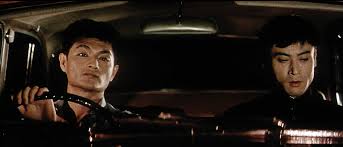
Tamura (Yoichi Numada) and Shiro (Shigeru Amachi), on a road trip to a dire destiny.

Seconds later, Tamura runs over a drunk named Tiger Kyoichi, a leader of the Gondo yakuza syndicate, and drives away. Shiro demands that Tamura stop the car so they can see if the victim is alright, but Tamura stoically refuses and blames the accident on Shrio, citing that it would not have happened if he had not asked Shimura to deviate from his planned route of travel. While Shiro silently contemplates his culpability for murder if the man dies, the gangster's mother (Kyoko Tsuji), alongside his floozy girlfriend, Yoko (Akiko Ono), grieves over her son's corpse and vows vengeance should she ever find the hit-and-run perps. Upon reading of the hit-and-run in the paper the next day, Tamura could not give less of a shit if he tried, while Shiro tries to convince him to go with him to the police and turn themselves in. Tamura notes that Kyoichi was only some piece of yakuza scum and not worth the best years of their lives, but the guilt-ridden Shiro confesses the accident to Yukiko, who suggests that her father might know what to do. While on their way to see the professor, the cab the pair are riding in crashes into a telephone pole and Yukiko is tragically killed. After Yukiko's funeral, Shiro frets over whether he or Tamura will "win" their battle of conscience (or lack thereof) and finds himself hanging out in a sleazy nightclub, where he meets, picks up, and puts the bone to the yakuza's bereaved girlfriend (who is also revealed to be a heroin addict, in a narrative bid to up the vileness quotient). Yoko twigs to the fact that Shiro is one of her lover's murderers, so she reports back to the gangster's mother and, with the target now identified, the plot for revenge escalates.

As if Shiro were not already fucked up enough by his fiancee's untimely demise, he heads to a rustic retirement community upon being notified that his mother if terminally ill, and while his mother lays there slowly expiring, her husband cavorts in the very next room with some kimonoed hoo-er. (Yeah, this movie's a roller coaster ride of sunshine...) Suddenly, a cutie named Sachiko shows up and she happens to look exactly like the dead Yukiko (which only makes sense, as she's played by the same actress). Sachiko sent the letter that alerted Shiro to his mother's illness, and she is his mom's nurse, as well as the daughter of Ensai (Jun Otomo) an alcoholic painter who lives nearby and drinks heavily while painting a depiction of Hell. We also meet other assorted residents of the community, all of whom are quite sleazy and/or pathetic, and are each responsible for murders and other acts of awfulness in the past. Tamura, the professor, his wife, the yakuza guy's mom, and the yakuza guy's lover all converge on the retirement community and in short order all are killed, via natural death, suicide, a fall from a great height, hanging, consumption of rancid fish and poisoned wine at a party, gunshot wounds, or strangulation. Thus, every fucking character in the story is consigned to Jigoku, which is the Japanese word for Hell. Well most of them go to Hell, but I'm getting to that...

When I first sat through JIGOKU — aka SINNERS OF HELL — I was disappointed to discover that it's basically a slice-of-life drama focusing on the sleazy doings of some Japanese folks in 1960 whose climax features an infamous depiction of the culture's concepts of Hell and what becomes of those whose vileness during life earns them a one-way ticket to eternal damnation. Loaded with enough sleazy characters and situations to fuel several schlocky soap operas, the melodrama just keeps on coming, piling on atrocious behavior after atrocious behavior with the kind of glorious excess for which Japanese cinema is renowned. In fact, things get so over-wrought that it all verges on self-parody. But the most bizarre aspect of this flick is its dual nature as a two-way mind-fuck of a film. If one approached this movie knowing absolutely nothing about it, it at first reads as a straight drama picture, which is totally understandable, but then it turns into a balls-out gruesome and gory festival of the torments of the damned brought to life. It's like someone swapped out the last reel for the ultra-nasty and surreal final twenty-plus minutes of an unabashed horror movie.

Just one of the creepy images seen once the film quite abruptly turns into a straight-up horror movie.

Upon his death, Shiro ends up in Limbo, where he again sees Yukiko, who tells him she was pregnant with his daughter, whose soul has been sent along the river into the underworld, so Shiro must brave the horrors of Hell itself to save her. What follows is a journey through hideous punishments, tortures, and other such wholesome sights, coupled with a few shocking revelations along the way. Packed with creepy and gore-filled imagery, the Hell sequence features a cornucopia of folks being graphically beheaded, sawn in twain, flayed, disemboweled, tormented by naked temptresses,  being boiled in oil, impalement, tongues torn out, walking barefoot through a landscape of three-foot-tall glass shards, and the general hopelessness of existence. 

Not even Hammer films went there like this back in 1960, so once again Japan delivers.

Even by today's standards, some of this stuff is very extreme and disturbing, and it's worth making one's way through all of the soap opera mishegoss just to get to it. That said, the ending is simultaneously disappointing and corny, but the film overall packs serious balls and must have been quite a shock to Japanese audiences in 1960. And if you're wondering why you've never heard of this movie, despite there having been a ton of Japanese horror and sci-fi flicks released in the States during the 1960's, trust me when I tell you that this film's content did not have a hope in, well, Hell of ever getting past American censors. Even without its visceral diabolical slaughterhouse segments, the film's adult content would have been tough for watchdogs of media decency to let by, and an edited version would have ended up as a very short and incomprehensible mess.

Though its 100-minute running time may occasionally seem to drag a bit, which has a lot to do with the film's utterly joyless/hopeless tone, JIGOKU is never boring and the final reel makes it worth a look for all horror completists.

Poster from the theatrical release.

Tuesday, October 10, 2017

31 DAYS OF HORROR 2017-Day 10: SILENT NIGHT, DEADLY NIGHT (1984)

Santa Claus is coming to town...WITH A FUCKING AXE!!!

Yeah, yeah, I know this a Christmas movie, but while considering '80's slasher flicks to talk about for 31 DAYS OF HORROR, this one kept coming back to mind. Thus I haul it out as that rarest of the rare: a combination cookie-cutter seasonally-themed slasher flick and a movie that you can run for the family at Christmas that is guaranteed to offend all and sundry.

Everybody has their favorite Christmas movie. IT'S A WONDERFUL LIFE, MIRACLE ON 34th STREET, WHITE CHRISTMAS, THE NIGHTMARE BEFORE CHRISTMAS (which, in my opinion, is more of a Halloween flick), and THE SANTA CLAUSE all vie for time on the airwaves each December, and in the case of the downright hilarious A CHRISTMAS STORY the bloody thing gets put into heavy rotation as of Thanksgiving, in some cases airing repeatedly for twenty-four hours on one station. It's Christmas spirit overkill and I'm saddened to see the Christmas flicks that suit the needs of myself and others of like mind — curmudgeons who find the annual overkill both nauseating and oppressive — get no respect and are given pretty short shrift by the general public. I'm talking about recent cult favorite BAD SANTA, and the far more offensive SILENT NIGHT, DEADLY NIGHT.

Both flicks kicked up a certain amount of controversy for having the nerve to be anti-everything the season stands for and filling the screen with lurid tastelessness, but that was the raison d'etre for both movies and BAD SANTA was definitely the more high class effort. It had competence behind the camera, actors you'd actually heard of, and a funny though admittedly vile script, so it definitely counts as a legitimate piece of well-crafted cinema. The same cannot necessarily be said of SILENT NIGHT, DEADLY NIGHT.

Arriving at the ass end of the first wave of the infamous "slasher movie" cycle of the 1980's, this flick tells the tragic story of Billy, a sweet little boy whose life turns into a gigantic habanero turd on the night his family visits Grandpa, an old geezer who's been catatonic for years. When the rest of the family is out of earshot, Grandpa — strongly resembling Bill Murray in a cheesy wig and beard —

speaks for the first time in years, eerily warning Billy, "Ya know what happens on Christmas? Santy Claus visits all the little boys and girls, and if they bin bad...he punishes 'em! So if you see Santy Claus a-comin', you better run, boy! RUN FOR YOUR LIFE!!!" immediately after which Grandpa returns to his drooling catatonia. Needless to say, Billy's parents end up viciously murdered on the roadside by a crook in Santa drag, an event that he witnesses, thus dooming him to a lifetime of scarring yuletide memories.

The lesson here: do NOT stop for random roadside Santas. 

Poor Billy, along with his infant brother, is relegated to a Catholic orphanage, complete with a Mother Superior who could have taught Torquemada a thing or two, where he endures years of physical and psychological abuse, permanently warping his mind against the tripartite horrors of sex, the Christmas season and all its trappings, and, of course, nuns.

Sister Bertrille she ain't.

As the years pass, Billy grows into a handsome, hulking young hunk and gets a job at a local toy store. He's a bit twitchy but basically okay as a person and a worker, but when the Christmas season rolls around Billy is forced to don a Santa suit for the store's Christmas party. Spurred on by liquor and witnessing the almost-rape of a co-worker by the odious stock boy, Billy snaps and wanders about the neighborhood indulging in a rampage of castigation, bellowing "PUNISH!!!" as he nails people in their heads with an axe, a hammer, or what have you.

"PUNISH!!!"

The film is strictly bargain basement, and its low-budget only adds to it's lurid charm. I mean, what's not to love about a crazed lunatic in a Santa suit killing off an assortment of stock slasher movie non-characters? Hey, they were drinking, and fucking and stuff, so they had it coming! And among this cannon fodder can be counted the lone thespian that I've actually heard of, namely Linnea Quigley, the preeminent "scream queen" of eighties horror best known for her memorable butt-nekkid cemetery dance in THE RETURN OF THE LIVING DEAD (1985).

'80'S topless horror mainstay Linnea Quigley.

If your movie needed gratuitous nudity or bared boobs Linnea was the gal to call, and she doesn't disappoint here (the one drawback being that her lovely jubblies end up with a pair of wall-mounted deer antlers protruding from them after Billy impales her for messing around with her boyfriend while she was supposed to be babysitting).

SILENT NIGHT, DEADLY NIGHT certainly isn't the film to put on for grandma during her Christmas visit, but it's fun for us sick-of-the-season types and even has moments of pitch black humor: after wiping out the babysitter and her boyfriend, Billy is confronted by the adorable little babysitee, a wee girl who thinks he's the real Santa Claus (despite Billy's beard hanging off and him being rather blood-drenched). When he sees her he asks if she's been good, to which she vigorously nods in the affirmative. As he draws ominously closer, Billy asks, "Are you SURE you've been good?" The little darling emphatically assures "Santa" that she's been a good girl, so Billy hands her a present: a bloody box-cutter that'd he'd earlier used to slash a victim's throat. As he dazedly wanders out into the night the camera returns to the sweet little kid who now has a look on her face that fairly screams, "What the fuck kind of present is this shit?" Get used to it, sweetheart, this is just the first of many disappointing Christmases to come.

When all is said and done, SILENT NIGHT, DEADLY NIGHT is just the ticket for a drunken Christmas Eve get-together of friends you haven't seen since last year, all of you eager to ditch your dysfunctional families for a few hours and be the reprobate that you can't get away with being while staying with the folks. It's a colossal "fuck you" to all the sentimental tripe that's been shoved down your throat for at least the past month, so slip on your K-Mart Santa suit — make sure the beard is in no way properly aligned — crack a few cold ones, and let the film take you along on a fantasy in which it could be you planting a fireman's axe into the treacle-addled pate of the Christmas season. And whatever you do, avoid the sequels like the plague; they may just be the very worst franchise in the entire horror genre, even edging out the wretched HOWLING followups. Seriously, they fucking suuuuuuck...

The classic theatrical release poster, which reportedly caused great consternation for parents when it was displayed at shopping mall movie theaters.

Monday, October 9, 2017

31 DAYS OF HORROR 2017-Day 9: SWEENEY TODD: THE DEMON BARBER OF FLEET STREET (2007)

One would think Tim Burton to be the perfect filmmaker to adapt the Broadway classic to the screen. Guess again, bucko...

Something that may come as a bit of a shock to regular readers of my ramblings, rantings and drivel is that Yer Bunche was weaned on musicals. There was plenty of pop music to be had on the radio and a little bit in my parents’ record collection along with smatterings of jazz and soul, but my mother had a fair collection of musical soundtracks, both movie versions and original Broadway casts. Among the first music I remember absorbing were the albums for SOUTH PACIFIC, WEST SIDE STORY, MY FAIR LADY, and my favorite by a landslide out of that lot, HAIR; that one rocked, plus it was fun to wander about the house singing loudly about psychedelic drugs, “colored spades,”  the comparative joys of interracial sex, sodomy, fellatio, and “sixteen-year-old virgins” while having no idea what any of it meant (I was five).

Then I was exposed to movie musicals and swiftly discovered they were a seriously mixed bag. Genre entries created for the screen like THE WIZARD OF OZ and SINGIN’ IN THE RAIN fused the Broadway structure with the non-stagebound freedom allowed by the camera and worked to spectacular effect, using thespians who could actually sing and dance as well as act, an element that ensured those films cinema immortality for good reason. But there were many adaptations of Broadway hits that fizzled rather than sizzled when they hit the screen; for every ON THE TOWN or WEST SIDE STORY (possibly the greatest B’way to H’wood translation) there was a L’IL ABNER or a SOUTH PACIFIC to offset the excellence. Mediocrity or outright awfulness were the defining characteristics of far too many big screen musical translations, such as PAINT YOUR WAGON (Lee Marvin’s rendition of “I Was Born Under A Wanderin’ Star” must be experienced to be believed), A CHORUS LINE (a turgid mess that made it to the screen nearly two decades after its impact had groundbreaking relevance on stage), CAMELOT, MAN OF LA MANCHA (which featured some of the worst miscasting in film history), HAIR, and many others, each peopled with talented casts whose lack of musical theater training sank each film (Okay, the cast of A CHORUS LINE could at least dance).

Which brings me to Tim Burton’s SWEENEY TODD: THE DEMON BARBER OF FLEET STREET.

I saw SWEENEY TODD during its original Broadway run and was immediately won over by its successful attempt at chucking the nauseating feel-good pablum that mired the majority of shows, and its embracing of dark, gory, and offensive material as fodder for live entertainment. The story of a wronged barber in Victorian-era London and his quest for vengeance, aided by a meat pie shop-proprietor and their side business that turns many of the London populace into unwitting cannibals, was operatic, loaded with pitch black humor, bombastic tunes, gore fountaining from the razor-slashed necks of the title character’s victims, one of two choreographed rape scenes that I can recall in a musical (MAN OF LA MANCHA featuring the other one), and stunning performances from all involved, especially George Hearn and Angela Lansbury (during her pre-MURDER SHE WROTE days). It was smart, evil, bloody, over-the-top, and a truly tragic story, so how could I not have adored it? It remains to this day my favorite musical that I saw during its prime.

From the original Broadway production. it may look poovy, but I'm telling ya, this was the shit.

Nearly thirty years after it debuted on the Great White Way, the Tony-winning penny dreadful brought to life hit the screen, helmed by cult director Tim Burton, a creator who gave us such classics as PEE-WEE’S BIG ADVENTURE, BEETLEJUICE, EDWARD SCISSORHANDS, and the superlative ED WOOD (and for those of you who are ready to write and tell me I forgot to mention THE NIGHTMARE BEFORE CHRISTMAS, it’s not here because Burton didn’t direct it). But while Burton has certainly shown a visual flair and signature look in his films’ art direction, he has crafted several films that look pretty but are soulless works of pure artifice that boringly meander until the credits finally, mercifully arrive. I felt deeply ripped off by such dead-in-the-water Burton efforts as BATMAN (once eloquently described by a critic as “the greatest act of mass hypnosis in human history”), MARS ATTACKS, SLEEPY HOLLOW, BIG FISH, CHARLIE AND THE CHOCOLATE FACTORY, and the execrable “reimagining” of PLANET OF THE APES, so it was with mixed feelings that I approached his SWEENEY TODD. While I loathed about half of the films he’s made, I figured he’d be perfect for the overwrought sturm und drang of TODD because its dour flavor and gloomy Victorian setting seemed to mesh perfectly with his sensibilities, so I went in with a fairly open mind.

But then I discovered that while Burton had chosen a dream cast for the film adaptation, he chose actors without a lick of musical theater experience and had them gamely attempt to sing parts that would have been daunting even to those with serious training. His actors all try very hard, but SWEENEY TODD is a musical that is every bit as lively and frenetic as it is gruesome and morbid, and Burton has directed his entire cast to perform as though on Prozac, thus completely neutering the material. I love Johnny Depp, Helena Bonham Carter, and Alan Rickman, but all of them are wasted here, delivering listless performances that bring to mind “Charles Dickens Night” at Madame Tussaud’s, and no amount of atmospheric visuals or SHOGUN ASSASSIN-level gore (of which there was enough to keep me watching) can disguise what could waggishly be renamed SWEENEY TURD.

And don’t get me started on how they ripped off Johnny Depp’s look in the movie from my man Dave Vanian — lead singer of my second-favorite band, the Damned — during his mid-1980’s proto-Goth days…

Dave Vanian, c. 1985.

Johnny Depp, 2007.

All I can say in summation is that you should give the Tim Burton version a solid miss, especially since the completely excellent Hearn/Lansbury version, shot live in 1982, is available on DVD , thank whatever dark and vengeful gods there may be. TRUST YER BUNCHE and tell Tim Burton to shove this somnolent floater back up his wannabe Edward Gorey ass.

Poster from the theatrical release.

Sunday, October 8, 2017

31 DAYS OF HORROR 2017-Day 8: FRANKENSTEIN: THE TRUE STORY (1973)


In November of 1973, I was eight years old and already an addicted "monster kid" who feasted on the horror movies that were in heavy rotation on local TV, and by that point my understanding of the genre had not yet graduated from the kid-friendly realm of what was deemed universally appropriate. That state of innocence was forever shattered when NBC aired the two-part made-for-television FRANKENSTEIN: THE TRUE STORY. 

When I was eight, I knew of all things Frankenstein via cultural osmosis. I'd seen the doctor and his creation referenced in countless cartoons, comic books, TV shows, toys and models, pictures in monster magazines and books on horror movies, and the only Frankenstein movie I had seen was FRANKENSTEIN CONQUERS THE WORLD (1965), a distinctly post-Godzilla, very Japanese take on the monster that rendered him a giant that fought other critters of the variety commonly found in the films of Toho Studios. I loved it and could not understand why most Frankenstein fans wrote it off as an outright turd that was a blasphemous bastardization of the concept. Significantly, I also had not read the source novel, which I freely admit I would have been too young to make my way through or fully comprehend. So, when FRANKENSTEIN: THE TRUE STORY was announced as an upcoming TV special event, I obtained my parents' permission and sat down to watch it, expecting another mild spook show that would have been right at home on a Saturday afternoon. What I got instead was an eye-opening exercise that changed my life and stepped me up out of the little league.

If you've ever seen even a halfway decent Frankenstein flick, you know what to expect. Dank and cluttered laboratories filled with sparking electrical equipment and bubbling beakers, the pilfering of recently-dead corpses, gratuitous displays of severed limbs and assorted surgical procedures (sometimes quite gory for the time), the doctor shunning his creature for being either too grotesque or homicidal or both, the monster inevitably going on a murderous rampage, and sometimes even the stitching together of sundry body parts to craft a beautiful (if eerie) female monster. All of those tropes are found in FRANKENSTEIN: THE TRUE STORY, with every effort made to replicate the look and feel of the Frankenstein films previously released by Hammer Studios (minus the cleavage and heaving bosoms, alas), so if you are already familiar with the basics, there's really little need to go into detail on this film's plot, but I'm gonna do it anyway. It's well-written, acted, and directed, but it's basically a fun and vivid catalog of all the expected goodies, plus a few signature moments of horror that keep the film alive in the memories of those who saw it at an impressionable age. All one really needs to know is that it's about an atypically sane Victor Frankenstein (Leonoard Whiting) having Regency-era medical misadventures while working on curing death, motivated by the untimely death of his younger brother. The abridged version:
  • Victor encountering and becoming the apprentice to brilliant alcoholic surgeon Dr. Henry Clerval (David McCallum), who introduces him to techniques for revivifying dead tissue and animating it. Clerval has successfully restored life to a severed arm, which disturbingly grabs Victor and eventually reveals a flaw in the process that leads the flesh to become aggressive and decay.

Victor's first encounter with reanimated flesh.
  • Upon discovering that the arm is visibly degrading, Victor graphically disposes of it with acid, a sight common to Hammer's output but definitely something new to kids raised on more genteel fare.

Proof that almost anything could be gotten away with on 1970's TV. Good luck showing this during primetime today!

  • Armed with the knowledge gleaned from Clerval (who has died from a heart attack), Victor assembles and animates a male creature (Michael Sarrazin),


The monster in his handsome early phase.

who is at first quite handsome, pleasant, and friendly, so Victor parades him around through high society.  But once the physical corruption sets in, the creature becomes aware of his ugliness and unintentionally causes assorted mayhem. Embittered, the monster flings himself from a cliff and is presumed dead, but instead survives.

State of decay.
  • After accidentally causing the death — via a truly horrible horse & carriage accident — of the granddaughter of a blind peasant whom he has fallen in love with from afar, the monster takes her body to Victor's lab and in hope of getting him to restore the girl to life. He instead finds the brilliant-but-evil and handless surgeon/chemist/hypnotist Dr. Polidori (James Mason), who has solved the problem of decay, and Polidori uses his knowledge of the monster's (unintentional) murders to blackmail the newlywed Victor to use his miraculous surgical skills to help him create the perfect, non-decaying revenant using some random female body and the head of the peasant girl.

Some assembly required.
  • The project is a success and yields Prima (Jane Seymour), a beautiful creature whom Polidori passes off as his ward and brings to live with Victor and his new bride, tasking Prima to model her actions on Mrs. Frankenstein. Charming to all, Prima displays a gift for mimicking expected womanly behavior, while constantly wearing a choker to disguise the seam where her head was sewn onto her toothsome body.

The homemade hotness of Prima.
  • Prima's charm and beauty are soon found to mask a streak of evil that leads her to attempt seducing Victor and strangling a house cat.

"And if I don't hurt him, he'll do me no harm..."

But Prima is nonetheless a scientific/medical breakthrough and is afforded every advantage that will mold her into the perfect lady. 
  • To ensure Frankenstein's cooperation, Polidori keeps the monster locked up in his lab, but once the experiment with Prima seems a success, Polidori opts to release Victor from his blackmailing clutches and destroy the monster with an acid caustic enough to dissolve stone in no time. The monster, however, escapes and eventually makes his way to the society event where Prima is being presented to rich potential suitors as an eligible bachelorette. Polidori plans to use her married and wealthy status to gain power and prestige, but his plans rocket straight down the shitter when the monster puts in a timely appearance that completely blew my mind when I was eight...

"Think I'll hit the bar!"

"Hey, baby! Wanna dance? No?"

"Well then, 'scuse me while I..."

"...RIP YOUR FUCKING HEAD OFF!!!"

After that, it's just a matter of the clock winding down and the monster and his creator facing off for a final time in an apocalyptic and rather ridiculous climax.

Though labeled as "the true story," the film instead bears a lot of the novel's spirit while eschewing nearly everything else about it. The book is a very cerebral piece in which the monster is an articulate tortured soul whom we get to know and care for greatly, despite the atrocities that he commits, while this film's iteration of the creature is basically a put-upon dufus whose crimes are mostly accidental,  with his truly awful shenanigans not really getting underway until the final fifth of the movie. Victor is clearly neither mad nor obsessed, and his pursuit of forbidden knowledge comes off as more of a committed hobby than anything else. When all said and done, FRANKENSTEIN: THE TRUE STORY is by no means perfect, but it served as a fun and engrossing entryway into more grown-up horror entertainment and has more than enough memorable bits to make it worth sitting through. It's a tad over-long, clocking in at just over three hours (minus commercials), but it's still one of the better entries in the legion of Frankenstein flicks. 

Packaging art for the DVD release.

Saturday, October 7, 2017

31 DAYS OF HORROR 2017-Day 7: SOUND OF HORROR (1964)

The unseen terror stalks.

When I was but a budding "monster kid," I religiously watched all of the Tri-State area's pre-cable sci-fi/horror movie showcases, and one of the pitfalls of that area of gaining knowledge was the acceptance of the unavoidable fact that for every classic/good/worthwhile film that one saw, there were was a disproportionate amount of flicks that ranged from the mediocre down to the rancid. But then there was the very special breed of bad  sci-fi/horror movies, films that were so boring, conceptually feeble, and all-around terrible that they are worth seeing simply because you can't believe that the filmmakers had the whale-sized balls to release such a work and expect innocent people to pay money to see it. Such was the case with SOUND OF HORROR, a Spanish would-be shocker that fails on every level and features a "gimmick" monster so bad that it's actually kind of endearing.

Ancient horror hatches in the 20th century, and promptly vanishes...

I've already made it clear that this movie sucks a high hard one, so I won't bother to go into thorough details on its plot particulars. All you need to know is that a bunch of archaeologists in Greece unearth a cave where a treasure is purportedly hidden, while also unwittingly unleashing a slavering dinosaur-like creature with homicidal tendencies. It's the humans versus the monster in a dull and drawn-out battle for survival, but what makes the movie worth sitting through once is that fact that the dinosaur is completely invisible, its presence betrayed only by its footprints, the ghastly murders it commits, and its distinctive wail (hence the title). Yes, you read that right: The dinosaur is fucking invisible, which was likely a new low in cheapjack filmmaking at the time.  All we get are some murky quasi-looks at it through some smoke and shots of its footprints. 

Mauled to death. She sure didn't see it coming... 

Even by the standards of the most frugal of low-budget filmmakers, releasing a monster movie where we simply do not see the monster is shameless, an insulting ripoff, and unintentionally hilarious. It's impossible not to crack up as a cast of no names — with the notable exception of Hammer stalwart Ingrid Pitt, who is given nothing to do here — react to, flee from, and be torn up by a whole lot of screaming nothing. And for me the highlight of the movie is when two of the character-free heroes throw hatchets it where they think the monster is, and we see the hatchets stick in mid-air, with each landed hit being punctuated by the invisible dinosaur's cries of pain and indignation.

Not since Ray Harryhausen has the silver screen been graced with such amazing monster effects!

And during the moments in the narrative when the monster's not invisibly causing mayhem, we get loads of footage of the humans hanging around gabbing, discussing the aforementioned lost treasure in ways that make you just not care about it, and we also get the women shaking it to Spanish-accented surf music and a traditional Greek dance number where the observers clap along to the music while actually being completely off-rhythm.

Can you stand the sheer terror???

Like I said, SOUND OF HORROR is a turgid piece of shit, but how can you not give it points for the idiocy of its invisible dinosaur? If you find yourself with insomnia some night, put this film on and I guarantee you a night of deep and blissful slumber.

Poster from the original Spanish theatrical release. At least this film has an excuse for its monster not being depicted in its promotional imagery!

Friday, October 6, 2017

31 DAYS OF HORROR 2017-Day 6: THE BLACK SCORPION (1957)

 A big pot of boiling water and some drawn garlic butter should take care of this.

In a nutshell: Earthquakes in Mexico open up a subterranean realm full of all manner of gigantic stop-motion animated nasties, chief among which are huge shrieking scorpions that rampage around the countryside, destroying property and chowing down on "Ay-yi-yi" stereotypes. A pair of heroic geologists and a hot ranch-owner serve as protagonists, along with the most annoying kid character this side of a 1960's Gamera movie, and they inevitably have to deal with the titular horror, an ebony nightmare that dwarfs its brethren.

The very definition of "treading familiar territory," THE BLACK SCORPION is, plainly and simply, a shameless remake/ripoff of the vastly superior THEM! (1954), which was released by the same studio a mere three years prior. It's aping of its template is downright embarrassing and it's inferior to THEM! in every way, save for the special effects that bring its monsters to life. 

The special effects artistry of the legendary Willis O'Brien, the movie's lone saving grace.

The stop-motion animated creatures are the work of the legendary Willis O'Brien, animator of the original King Kong and mentor to Ray Harryhausen (who basically became the god of stop-motion). THE BLACK SCORPION, replete as it is with bland and pretty much interchangeable heroes and long stretches of utter narrative boredom, only comes to life when O'Brien's monsters show up to cause havoc. Seriously, there's really no other reason to sit through it.

 The ultimate bad day at work.

Dull, derivative, and not scary in the least (unless you happen to be under nine years old), THE BLACK SCORPION is recommended solely for animation fans and 1950's giant monster completists, and also as an entry-level giant monster flick for kids. I first saw it when I was five and I loved it, but then again I was too little to realize just how dull it was when the monsters weren't on the rampage. Little kids will sit through just about anything, as long as it has occasional parts where something of fantastical interest occurs — the cowboys-versus-dinosaur western THE BEAST OF HOLLOW MOUNTAIN (1956) being a case in point — and this film certainly has enough of that sort of thing going for it. And while I did not find it scary when I was little (I thought the idea of giant, man-eating scorpions was pretty fucking cool), the mileage of other little kids may vary, so take that into consideration. The monsters here are rather eerie in presentation and some kids have trouble dealing with the "unreal" look and movement of stop-motion puppets. My niece, Aurora, was scared shitless after seeing just one minute of the scorpions in action when she was seven, so keep that possibility in mind before running this for the wee ones.
Poster from the British theatrical release. You know you're in trouble when the poster opts to explain why you should scream during what's meant to be a scary movie.

Thursday, October 5, 2017

31 DAYS OF HORROR 2017-Day 5: I MARRIED A MONSTER FROM OUTER SPACE (1958)

It started with a kiss...

Marge Farrell (Gloria Talbott) has been married to her husband, Bill (Tom Tryon), for a year, during which time she notices that he's no longer the man he was before their wedding day. Though not unkind to her, Bill treats Marge with a cold, emotionless lack of affection, and now dogs react defensively in his presence (which is odd because Bill is a self-admitted "dog person"). Something's clearly amiss and Marge is no idiot, so it was only a matter of time until she discovered that what appears to be her husband is in actuality an alien life form, one of a number of invaders who have infiltrated her town with a creepy agenda on their minds: marrying, mating with Earth females and fathering children. 

The abduction of Bill (Tom Tryon).

Their species' world and all of its females have died out and with space apparently not being as populated as one would hope, our world is their best shot when it comes to breeding options. Upon uncovering the alien charade — and surprisingly not seeming all that perturbed at having been giving her body sexually to an extra-terrestrial life form for a year — Marge sets about trying to alert the local authorities to the secret, silent invasion, but she soon finds that alien doppelgangers have replaced key members of the community's power structure and that she has no hope of contacting outside help. So, what's a girl to do?

Despite being stuck with an idiotic, WEEKLY WORLD NEWS-style title, I MARRIED A MONSTER FROM OUTER SPACE takes its concept seriously and handles it with a surprisingly "adult" approach. It's a well-crafted picture that boasts quality camerawork, an eerie atmosphere that brings to mind the small-town isolation of INVASION OF THE BODY SNATCHERS (1956), a believable script, and solid performances from all involved, so it's much better than it has any right to be. It's an interesting reflection of the ultra-macho/patriarchal American 1950's and the era's considerable disconnect between male and female, an aspect examined in a few other sci-fi/horror flicks of its time and easily the most interesting told from a woman's perspective.

Marge's  (Gloria Talbott) sense of marital unease grows.

Front and center in this inversion of Fifties suburban bliss is Gloria Talbott, one of my favorite actresses of her generation, who turned in memorable performances in movies and on television in works including GIRLS TOWN (1959, as a judo-expert delinquent), THE LEECH WOMAN (1960), and episodes of THE ADVENTURES OF SUPERMAN, THE CISCO KID, and BONANZA. In this film she conveys a palpable sense of the nervous bride, which, when pitted against an invasion of reproduction-minded space-creeps, is quite effective and instantly relatable.

The alien and his Bill simulacrum.

Tom Tryon's also quite good and believable as the emotionless husbandly simulacrum, and he would later write the 1971 source novel for the classic horror movie THE OTHER (1972), but we'll be getting to that later this month. Tryon's Bill is at first typical of the standard 1950's alien tropes, but the interesting twist here is that he is slowly coming to understand love, though he's not in any way demonstrative with such. He does, however, treat his human would-be broodmare kindly and it's clear by the end that he has indeed come to care for her (for all the good that does him, which is none). And it's the alien's handling of the situation and Marge's reaction to all of this that leads one to ask the obvious question: Would this breeding strategy be considered rape? By human standards, since consent was not knowingly given to the aliens, but rather men assumed to be the women's intended husbands, that would be a massive "Yes, it's rape." That said, it's clear that the aliens were acting out of sheer desperation at the possible end of their species, plus their lack of emotion/empathy may preclude such moral concepts as consent when no violent physical coercion is perpetrated, but how will they think of their own actions as they slowly come to understand and perhaps experience human emotion? It's a much heavier topic for discussion than can be properly addressed in a film of its time that was intended for general audiences, and it warrants further serious consideration. And am I alone in  finding Marge's relative nonchalance upon finding out that she's unwittingly been servicing a space alien rather odd? Is it a case of simply resigning herself to "Well, that happened, so I might as well move past it?" Any way you cut it, it's just fucking weird.

Some invaders on the move.

The film boasts quite good special effects for its era and among the highlights are:

 What happens to the aliens' human forms when they are found out and stopped...

...and a barfly on the make putting the moves on an invader, only to end up on the business end of a disintegrator weapon.

Another effort that's ostensibly sci-fi, I MARRIED A MONSTER FROM OUTER SPACE works well as a part of the "marital horror"sub-genre, wielding a solid and squirm-inducing creep factor when one really thinks about what's going on. When Marge asks "Bill" what kind of children his people would have with human females such as herself, he emotionlessly, ominously answers, "Our kind," which speaks Lovecraftian volumes. Yet despite the highly questionable way in which they implement their plan, one almost feels sorrow and compassion for the aliens. The key word here being "almost."


Poster from the original theatrical release.