Search This Blog

Thursday, May 20, 2010

WICKED PRIEST (1968)

I finally got around to checking out the first in the GOKUAKU BOZU (“Wicked Priest”) series of chambara (“swordfighting”) flicks and was not disappointed in the least, thanks in no small part to the performance of my man Tomisaburo Wakayama in the title role. For those not in the know, Wakayama was the intensely stoic actor who played Itto Ogami in the LONE WOLF AND CUB films, and if you’ve seen those you know that the guy was one hell of an actor and absolutely the very last guy you would ever think about engaging in sword combat.

Portrait of a complete and utter badass: the late, great Tomisaburo Wakayama in his signature role of Itto Ogami in the LONE WOLF AND CUB series (1972-1974).

Wakayama’s swordsmanship is a thing of beauty to behold, on the level of Baryshnikov or Bruce Lee in terms of physical wonder, as is that of his equally talented younger brother, Shintaro Katsu, aka Zatoichi, but I’m veering quite a bit off topic. The LONE WOLF AND CUB and Zatoichi films are more than worthy of their own discussions, so I’ll just leave you with a recommendation to see them and get back to the Wicked Priest.

The GOKUAKU BOZU films preceded Wakayama’s work as Lone Wolf and will come as a bit of a surprise to those who know him only from his later, ultra-gory Itto Ogami movies because, although quite the capable badass, the protagonist of the GOKUAKU BOZU series is an all-around fun guy who thoroughly enjoys life, in other words the polar opposite of Ogami. Here Wakayama portrays Shinkai, a Buddhist monk in the Japan of the 1920’s who ends up getting booted from his order on a bullshit charge and is relegated to a one-year probationary exile to some backwater town’s temple. Cut to five years later and Shinkai is seen having a blast engaging in all the stuff an observant Buddhist monk is not supposed to be doing, namely gambling, drinking, merrily frequenting whorehouses, getting into karate/jiu jitsu fights in which he is clearly the baddest motherfucker in the room (even when faced with firearms), and seducing married female temple-goers.

Pussy and saké: two great things that go great together!

He’s a lovable and fun guy who performs his duties as the town’s monk (always for an expected fee, er, “donation”), but his lust for life only earns him the bitter hatred and disgust of the rather corrupt priests in his former order, a pack of total assholes who get up to all kinds of shit while putting out a public front of piety and respectability. Their abbot, however, is a decent guy who raised our hero and has a tolerant and avuncular relationship with Shinkai, and as a result looks the other way at the so-called wicked priest’s transgressions, an attitude that fosters plots for the abbot’s ousting in the face of disgrace under threat of blackmail for past indiscretions.

The main plot follows Shinkai’s bitchin’ and utterly shameless lifestyle and brings him into the path of young Kentaro, a rather ineffectual would-be yakuza tough guy who makes his questionable living by luring innocent young girls to his slimy boss’ whorehouse, where they are either forced into prostitution or sold into sex slavery in Shanghai. Kentaro cares nothing for the innocents whose lives he destroys, but his heart belongs to Kogiku, a sweet girl who is nearing the end of her three-year prostitution contract at the whorehouse, and the two intend to get married when her time is up. Kentaro meets Shinkai when the monk prevents him from luring yet another innocent, and the lad has his attitude seriously adjusted after Shinkai kicks his ass (twice) and those of his goofy accomplices. You see, although he’s a rampant womanizer who enjoys the pleasures of women, Shinkai genuinely likes women as people — a breath of fresh air in this misogyny-laden genre — and will brook no mistreatment of the fair sex, so he seeks to stop Kentaro’s foul ways before the boy is beyond redemption (too late if you ask me, but I didn’t write the script). Learning from Shinkai’s example — to say nothing of the aforementioned pair of back-to-back bitch-slapped beatdowns — Kentaro tries to get his act together for when he and Kogiku get married, but his refusal to further deceive innocent women for purposes of exploiting them does not sit well with his scumbag boss, so what follows is a tragic tale of escalating cruelties that sees the abuse and death of assorted innocent people that finally galvanizes Shinkai to hand down some much-deserved death to bad guys who seriously need to be removed from the face of the earth. (NOTE: unlike what is depicted on the film’s poster/DVD box art, at no point does Shinkai personally engage in any swordfighting, so Lone Wolf fans, caveat emptor.)

While this synopsis may make the film sound action-packed, the truth of the matter is that it’s more of a study of the fun-loving Shinkai and the peripheral characters than the swords-a-slashin’ bloodbath one usually expects (and gets) from this kind of flick, and the film is all the better for that. Chambara cinema is rife with drama and tragedy and could be fairly described as soap operas for men, and to a certain extent that’s exactly what this first GOKUAKU BOZU film is. There are highly emotional subplots involving single-parenthood and the stigma that falls upon the women who selflessly raise their bastard kids in the face of social ostracism, bitter daddy issues from the perspective of now-grown abandoned children, political intrigue within the monastic order, sympathy for the plight of whores, and a whole bunch of other stuff, so if you decide to check this out, be prepared for more plot than action, but also keep in mind that you will not be bored. It’s not a classic or anything, but it is solidly entertaining from start to finish.

From what I could determine in my admittedly brief research on it, there are apparently five films in the GOKUAKU BOZU series and I am eager to sit through the rest of them. I picked up four of them when I came across them a while back, but the one I’m missing is the second one in the sequence, so I’m going to hold off until I can find it and then continue, While not all chambara series continue directly from one film to another, there are many that do, so I’ll err on the side of patience and wait to experience some more cinema of Wakayama that I have not yet seen. He’s one of my all-time favorite actors and ass-kickers, so I’m perfectly happy to endure the wait.

LADY SNOWBLOOD AT THE JAPAN SOCIETY

A study in lethal elegance: Meiko Kaji as the vengeful Yuki.

Last night I went to Manhattan's Japan Society to see a rare screening of LADY SNOWBLOOD (1973), and while the movie was excellent and remains one of my favorite chambara films, I was once more reminded of why I fucking hate seeing just about any Asian film in a festival setting with a New York audience.


A page from the original manga, illustrated by Kazuo Kimamura.

Based on an early-1970's manga series written by LONE WOLF AND CUB scribe Kazuo Koike and illustrator Kazuo Kimamura, LADY SNOWBLOOD is the grim tale of Yuki (the haunting Meiko Kaji), a woman literally born to avenge the heinous murders of her father and older brother, as well as the serial rape of her mother by one of the killers. Upon stabbing her rapist to death, Yuki's mother is sentenced to life in prison, where the woman proceeds to indiscriminately have sex with every available male guard in the place, earning her the hatred of the other female prisoners and a reputation as "a bitch in heat," in hope of giving birth to a strong son who can carry out her wished-for vengeance. Instead of a son, she gives birth to Yuki and dies shortly thereafter, and the baby is entrusted to another prisoner who, upon the completion of her sentence, raises the girl with a retired master swordsman who is now a monk. From early childhood, poor Yuki is forged into a stoic engine of her dead mother's vendetta, trained without mercy in various skills, but most importantly as a swift and utterly deadly swordswoman who conceals her blade in her parasol. Upon turning twenty, Yuki — now operating under the nom de revenge "Lady Snowblood" — embarks on a bloody trail of retribution as she seeks out the three remaining villains who have gone unpunished for the past two decades, slashing her way through all comers in the process.

As is typical of chambara films of the period, LADY SNOWBLOOD is drenched in spewing arterial spray that looks a lot like thinned-out red paint and is over-the-top along the lines of the Black Knight sequence in MONTY PYTHON AND THE HOLY GRAIL (1975), but while the Python flick played its graphic violence to stunning and hilarious comedic effect, the gore in LADY SNOWBLOOD has the exact opposite intention and its excesses serve to punctuate a story that's already as serious and depressing as a heart attack. Which brings me to the point where I start bitching and moaning.

One of the things that drives fans of Asian cinema in general and Japanese film in particular crazy is seeing screenings of Eastern movies among festival audiences composed of curiosity seekers who are unfamiliar with styles of filmmaking other than what they run into every week at their local multiplex. These moviegoers may have read or heard about Asian movies in some article extolling the perceived hipster virtues of getting into such stuff, and so off they go to an Asian film festival and collide head-on with another culture's style of film craft, often with zero grounding in how that culture tells stories, or what those storytelling tropes mean within that rich cultural context. While filmmakers like Kurosawa strove toward and achieved stunning results with a realistic approach, many of the makers of Japanese film sought to appeal to an audience raised on centuries-old traditions of unabashed melodrama, stories marked with sometimes broad and over-wrought emoting and lashings of sanguinary displays that straddle the line between intentionally excessive narrative punctuation and seemingly pointless gratuitousness. When it comes to their storytelling, the Japanese tend to milk a narrative for all that it's worth, bringing audiences heroes who are practically superhuman in terms of their skills, focus and virtues, villains who are vile in ways that make you want to leap onto the screen and kill them yourself, and sequences of action that take things to completely insane levels of carnage, all in the name of keeping the paying theater-goers entertained. In that respect, Japanese cinema has a hell of a lot in common with our own home-grown efforts, but the difference lies in cultural aesthetics, and that's where the problems can start.

While watching LADY SNOWBLOOD, in an audience containing a large percentage of Japanese attendees, the majority of the Westerners in the theater laughed heartily at the melodrama of the piece, despite the fact that the movie contains not one shred of anything that could be considered comedy. As you can gather from my brief synopsis, the story is one very dark motherfucker, yet many in the audience cracked up repeatedly, offering up interjections of "Sweet!" or "Nice!" during moments of raw emotion and terrible violence. The one gory image that did not elicit would-be-ironic comment from the hipster Peanut Gallery was a stark flashback shot of Yuki's perhaps eight-year-old brother laying dead by the side of a river after the killers bashed his brains in, immediately after which we are treated to the (thankfully) non-explicit rape of Yuki's mother as the criminals turn the violation into drunken entertainment (one of their number is even a woman who takes obvious enjoyment in watching the proceedings).

While I'm a big fan of LADY SNOWBLOOD, I'm the first to note that, though compelling, it's a very depressing affair for a number of reasons, and even given the cross-cultural disconnect of Eastern versus Western sensibilities, I was appalled at anyone finding the tragedy that played out onscreen as funny. LADY SNOWBLOOD's melodrama was roundly mocked by an amused audience that could most likely watch American soap operas and not crack jokes about the over-the-top emotional torments endured by the characters, and it just brought me down. Would they have found the very same elements laughable if they had been presented in the context of a Clint Eastwood western? I kinda doubt it. Then again, I've heard reliable reports from people who were in the audience when the infamous and ultra-graphic to the point of being nigh-unwatchable gang-rape landmark I SPIT ON YOUR GRAVE played theatrically, and they said that several members of that audience cat-called and guffawed as actress Camille Keaton (Buster Keaton's grand-niece, by the way) was put through abuses that would have offended the most hardened of regular grindhouse patrons, so I guess such inappropriate and disheartening reactions are nothing new.

Poster from the original Japanese theatrical release.

Anyway, my experience last night was very much off-putting and on several occasions I wanted to stand up and scream "What the fuck are you people finding so goddamned funny? Does human suffering amuse you?" I had not attended an Asian film festival since the mid-1990's and after last night I plan on resuming that stance, unless there's a decent marathon of Toho's giant monster flicks or a run of the LONE WOLF AND CUB films. I just wish those shit-for-brains sunsabitches would stick to their multiplexes and showings of TRANSFORMERS: REVENGE OF THE FALLEN and suchlike...

Oh, and for a more clinical overview of exactly what LADY SNOWBLOOD is all about, check out the excellent review found here.

THE VAMPIRE LOVERS (1970)

This first in Hammer Films’ “Karnstein trilogy” — comprised of THE VAMPIRE LOVERS, LUST FOR A VAMPIRE (1971) and TWINS OF EVIL (1972) — is far and away the best of the lot and deservedly made a horror star out of Polish-born Ingrid Pitt. Though rather tame by current standards, THE VAMPIRE LOVERS was just the hit that the ailing Hammer studio needed, fueled by a letter perfect combination of the usual Hammer tone and the then-new explicit rather than implicit lesbian angle allowable thanks to British censors shifting the “X” certificate from age sixteen and over for admission to eighteen and over (essentially equivalent to the MPAA’s “R” rating and allowing for nudity, simulated sex and gore, but not gynecologically detailed or pornographic content).

The haunting Ingrid Pitt as Mircalla/Marcilla/Carmilla Karnstein.

Based on Joseph Sheridan Le Fanu’s novella CARMILLA (1875), THE VAMPIRE LOVERS lays out the eerie events set in motion in the early 1800’s (I think) when a beautiful and mysterious woman (Ingrid Pitt) arrives in the Duchy of Stiri and works her way through the populace, killing off members of the local populace with her vampiric feeding. Her M.O. is to insinuate herself into the house of an aristocratic family and feed on that family’s virginal young daughter (who is invariably cute as hell) until the girl wastes away, presumably because of anemia, and then the sultry vampiress moves on to her next victim. The vampire in question is Mircalla Karnstein, the last of a line of undead suckfaces who were believed wiped out years earlier, and she operates under the anagrammatically rearranged monikers of “Marcilla” and “Carmilla,” as the possibly unwilling thrall of a mysterious horseback-mounted man in black (John Forbes-Robertson) who’s obviously a master vampire. First working her baleful magic upon the niece of General Spielsdorf (Hammer mainstay Peter Cushing, in a role that amounts to slightly more than a cameo), the vampiress soon moves on to the doll-like and smokin’ hot Emma Morton (the adorable ginger-tressed Madeline Smith, who sports a pair of alabaster Brit-breasts that you just want to latch onto with eager lips and tongue), and it’s that literally unnatural relationship that drives the movie.

Carmilla and Emma share a tender moment.

As the vampiress slowly drains away the poor girl’s life, members of the household gradually twig to what’s up, so it’s only a matter of time until Emma lies dead or Mircalla is thwarted. Let us not forget that Peter Cushing, cinema’s most notable and formidable Van Helsing, is in this flick, so it’s a no-brainer as to how things simply must turn out; following the miserable demise of his niece, Cushing’s General seeks the aid and advice of Baron Hartog (Douglas Wilmer), who some years earlier avenged the death of his own daughter by taking out what was presumed to be the last of the vile Karnstein clan, and from there it’s time to kick some fanged ass.

Though set in various identifiable European locales and sometimes foreign lands such as Egypt, the Hammer horror world may as well all take place in the same stylized realm, so instantly recognizable is their atmospheric style. Replete with isolated country back-roads, misty graveyards, busty peasant women in dairy-showcasing bodices — one of the things that got me into these films during my formative years — and lavish period sets and costumes that drive home the fantasy and bring to mind MASTERPIECE THEATER as filtered through a Dan Curtis sensibility, the Hammer efforts are as unique and fun as the Universal Studios that preceded them. The Universal influence comes as zero surprise since Hammer’s horror films launched from a template established by their Yank antecedents, starting in the 1950’s with gored-up re-interpretations of Dracula, Frankenstein and the Mummy, followed later by their take on the Wolf Man, and those films were always worth a look. Filled with terrific eerie visuals, including a great bit with an earlier Karnstein lady searching the graveyard for her burial shroud (without which she cannot return to her tomb) and two shocking beheadings by sword. THE VAMPIRE LOVERS has much to savor from both the visual and narrative standpoints, and its interest has only increased with each passing year.

Perhaps most renowned for its lesbian content, the film is nowhere near as shocking in that respect as it was some forty years ago, and when looked at today it reveals layers far more rich than its initial prurient value. Mircalla does not appear to enjoy her state as one of the undead and seems to commit her evil acts either as a result of being compelled to do so by the mysterious (and unexplained) man in black, the occasional basic need for sanguinary sustenance or simply out of a need to defend herself against those who have figured out what she is. When it comes to her relationship with Emma, what at first may seem predatory or a symbolic mission to destroy innocence in the face of the girl’s obvious and untried womanhood is revealed to be a genuine affection, and Mircalla prolongs the inevitable by feeding on a couple of unfortunate locals so she can enjoy as much time with her inamorata as possible. The scenes of sexual intimacy between “Carmilla” and Emma are tastefully handled and have an almost childlike innocence in their emotional content, at least until the vampiress kisses her way south — if you know what I mean and I think you do — as the camera remains focused on the wide-eyed and ecstatic face of Emma.

Which brings me to Ingrid Pitt. One of the short list of indelible female figures in pre-1980’s horror cinema, Pitt simply owns THE VAMPIRE LOVERS in much the same way as THE EMPIRE STRIKES BACK was Darth Vader’s movie and I simply cannot picture anyone else in the role of Mircalla (unless the film was remade with Monica Bellucci). Pitt’s vampire is graceful, somewhat terse unless interacting with the object of her desire, and wears an expression that’s a curious mix of indifference and resignation to her lot in un-life. Mircalla is definitely creepy, but there is some indefinable something about her that evokes sadness to such a degree that one almost cannot help but pity her despite the trail of carnage she leaves in her wake. Pitt is also extremely easy on the eyes and has an air of commanding elegance that is evident even when she’s sponging her nekkid self in a bathtub or frolicking topless with Emma during a preamble to their first Sapphic encounter.

As I stated previously, the film’s naughty content is tame by modern standards, and I sat there for roughly the first half hour wondering why the film received an “R” rating form its U.S. release after witnessing only the most minor display of blood and one bare tit from the general’s niece during a brief post-mortem medical going-over, but then the bathtub scene where “Carmilla” engages in initially innocent girl time with Emma came on and all was right in the world…

THE VAMPIRE LOVERS is one of the last times when the horror engine that was Hammer fired on all cylinders, and it is very much recommended to horror fans and followers of the whole lesbian vampire sub-genre. Available on one of those reasonably priced MGM-released Midnite Movies DVDs in a double feature with the vastly inferior COUNTESS DRACULA, THE VAMPIRE LOVERS is a very welcome must-have for aficionados and those looking to remember the days before vampires were ruined by Anne Rice’s pussification and that fucking TWILIGHT bullshit.

The marvelously cheesy poster from the American release. None of the stuff seen on this poster happens in the movie.

THE VIRGIN WITCH (1972)

The lovely packaging art found on the DVD. Needless to say, nothing like this occurs at any point during the actual film.

Shot in 1970 but released two years later after running the gamut of ludicrous British censorship hassles, THE VIRGIN WITCH is less of a horror movie than it is a softcore Euro-sexploitation flick featuring supernatural elements. It tells the story of a pair of sisters (real-life sibs Ann and Vicki Michelle) who end up falling into the clutches of a "white" magic coven, headed by a horny Charles Gray-like high priest and a stereotypical predatory lesbian high priestess who has designs on the older girl, and that setup serves as an excuse for acres of naked female flesh to be put on display. (It's interesting to note that European softcore and porn actresses of the time did not seem to suffer from the Chewbacca-esque and unruly "'70's bush" syndrome that their American counterparts often sported.) Anyway, there's really nothing to the story other than the two coven leaders both wanting to get into the older sister's knickers (which they both succeed at), the older sister getting into the idea of gaining power within the coven and suddenly learning black magic in order to achieve her from-out-of-nowhere evil ends, and the younger sister displaying minor psychic abilities that do zero to advance the thin shred of a plot. The copious amounts of nudity during all of this are the film's sole redeeming feature, but that aspect grows old very fast, especially when one considers how much actual porn is so readily available.

In short, THE VIRGIN WITCH is a curiosity at best, but if you choose to skip it you will miss absolutely nothing.

Poster from the theatrical release.

THE SAVAGE GIRL (1932)

A prime example of pre-Hays Code schlock that appears to be a hastily made cash-in on the Johnny Weissmuller TARZAN THE APE MAN (which was released to rousing success some eight months previous), Monarch Film Corporation's (who?) THE SAVAGE GIRL is just about as slapdash as a film can be, but it's a mercifully short 66 minutes in running time and features some major league eye-candy in the toothsome form of actress Rochelle Hudson (who, according to the stats available on the IMDB, was sixteen at the time of the film's release, so I'm now officially a dirty old man).

What does it say when a film opens, as this one does, with a text crawl that pleads its case by imploring the audience to pretty much think, "Aah, we all know this movie is a stupid piece of crap, so who gives a fuck?" Giving not one good goddamn about such things as logic or even basic story structure, the filmmakers take us along for an African expedition funded by eccentric comedic alcoholic millionaire Amos P. Stitch (Harry C. Myers), who, along with generic semi-British-accented great white hunter Jim Franklin (Walter Byron) and drunken German guide Alec Bernouth (Adolph Millar), set off to procure animals for Stitch's personal zoo. Upon arriving in "Africa" — aka an obvious Poverty Row jungle backlot somewhere in California — the cast find themselves among an array of incongruously-situated animals that seem to have been dropped from random points all over the continent into one convenient location, some actually on-set, the rest seen in tons of over-exposed stock footage.

Rochelle Hudson as the unnamed jungle girl.

After about twenty minutes of our intrepid heroes traipsing around the jungle capturing assorted beasts and indulging in hoary comedy, the title character finally — thankfully! — shows up, and she is one stunning animal print-clad critter. A dark-haired beauty with bright eyes and striking features, Rochelle Hudson is certainly easy on the eyes and definitely serves as a possible inspiration for fantasies far less wholesome than those found in the script (well, most of the script, but more on that later). Cribbing liberally from Weissmuller's template for a feral character, the unnamed jungle girl is silent and lives in perfect harmony with her animal companions, although her behavior is just about as sweet and girly as one would expect from a jungle heroine conceived in the Shirley Temple era (Maureen O'Sullivan's cultured but utterly capable Jane Parker being the much more interesting alternative). She engages in no knife or spear-armed throwdowns with wild animals or papier-mâché crocodiles (which the budget could have in no way allowed), instead spending her time merrily swinging on vines or sitting around cuddling with adorable little leopard cubs, and she comes into contact with the expedition when she spies upon them as they capture some of her animal neighbors.

Our nature girl: so sweet and wholesome that her handling of leopard cubs does not arouse their mother's fanged and clawed ire.

When she frees the animals in the middle of the night, the drunken German immediately twigs to the culprit being the local "jungle goddess," but his warnings are laughed off by Franklin and Stitch. Nonetheless, a pit is dug in which to trap the jungle goddess, and when she is caught all are surprised to find a hot white girl in Tarzan-knockoff drag in the middle of the jungle. Oh, and at no point in the story is any explanation given as to exactly who this girl is or how she got there, nor how and why the local requisite "ooga booga" natives came to worship and fear her (the latter aspect of which is especially confusing since she's such a sweetie).

Our heroine, captured by white folks!

Once in the hands of the white folks, the jungle girl puts up a futile fight as the white men imprison her in a crude shack. She quickly figures out that Stitch and Franklin have no intention of harming her — especially not Franklin, whom she realizes is kind after seeing him remove a thorn from a monkey's paw and then gently petting the beast, who does not mind in the least — but the drunken German makes no bones about his intent to rape our nature girl.

Our heroine, about to fall prey to a drunk and lustful Kraut.

Bernouth attempts to violate our heroine in no uncertain terms (in a scene that shocked me, especially considering when the film was made) but her screams attract the attention of Franklin, who arrives just in time to prevent the foul crime and hand the Teutonic turd a thrashing before kicking him out of the expedition and letting the jungle girl go free. Our heroine does not stay gone for long though, because Franklin's act of gallantry ignites the jungle girl's spark of interest into full-on and surprisingly aggressive lust that, thanks to his 1930's-style Britishness, our bland hero stupidly does his (rather ineffectual) best to dissuade.

Portrait of one seriously dumb Brit.

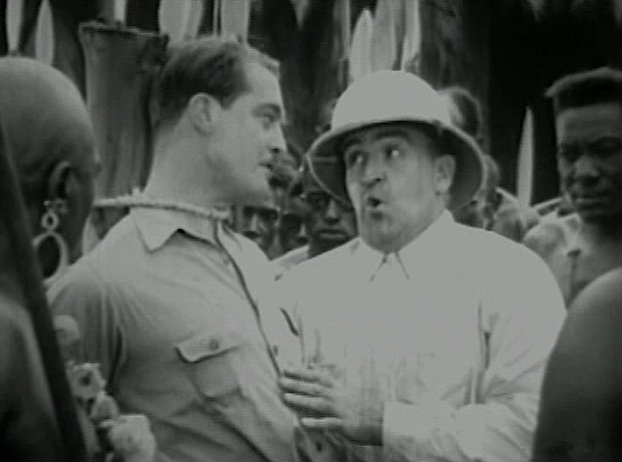
Meanwhile, the pissed-off and rape-denied German fucks off to the local "ooga booga" natives and tells them (via a translator) that the other white guys have captured their white goddess, so he suggests that they not only attack the expedition but also make Franklin into a sacrifice to their voodoo god. (How they'd know which white guy was Franklin is anyone's guess, but I'll let it slide.) The natives attack while Stitch and his servant are off testing the boozy tycoon's theories regarding elephants and their fear response to common pet shop mice (don't ask) and Franklin is captured and promptly tied to a stake in preparation for the religious festivities, and once Franklin's securely trussed up, Bernouth has the unmitigated nerve to gloat to our bland hero's face and admonish him for "not wanting to share her" with him, as well as smugly announcing that he now intends to go back to the camp and finish what he started with the jungle girl.

"Oh, vot I em goink to do to her..."

Leaving Franklin to his fate, the merry would-be sexual assaulter arrives at the camp, claims the other white guys are dead, thus obviously meaning he's now the boss, after which he enters the hut where our heroine is hanging out and once more attempts to get his rape on.

Attempted sexual assault, round 2.

Not that she was any kind of tough in the first place, but our heroine is quite clearly overmatched as the laughing Kraut mauls her and throws her around the room (you will get as irate as I did when you witness this atrocity), but our bland hero is rescued by the tipsy tycoon and immediately runs to the rescue since the millionaire's cab has inconveniently run out of gas (don't ask). Upon returning to the camp, our bland hero gets into a lackluster fight to the finish with the German asshole, and when shit gets too thick the vile villain readies himself to draw a gun. That underhanded plan of action is quite decisively thwarted when, alerted by our heroine's chimp pal, a hulking guy in a tatty gorilla suit rips the bars off the window behind the German and drags him to a well-deserved end (which I hope included him getting ass-fucked by the bargain basement Kong).

A noble gorilla takes a stand against "that sort of thing."

At last all is well and our lovers prepare to make the beast with two backs, but the film abruptly comes to screeching halt before we get to the good stuff.

The lovers prepare to get it on...

...and then the movie just comes to a screeching halt. What the fuck? TARZAN AND HIS MATE this ain't!

In fact, the movie ends so fast that you hardly have time to process that it's over, an aspect that prompted me to say aloud, "That's it? Seriously, movie? You're gonna go with that ending? Ooookaaaay..." There's no denouement, no attempt at wrapping things up or possibly explaining what's next for our characters. It just stops as if someone pulled the plug. TARZAN AND HIS MATE (1934) this ain't, that much I can tell you. Nonetheless, THE SAVAGE GIRL is not without its merits and its brief running time doesn't really give viewers the chance to grow bored. The chief attraction here is obviously Hudson's gorgeous unnamed jungle ingenue, and when all is said and done that's all that really matters. I would have appreciated it if they'd bothered to give her some copper wrist adornments or a spear, though...

Rochelle Hudson: the #1 reason to sit through this time-waster.

BLONDE SAVAGE (1947)

Ah, the ludicrous pleasures of the jungle adventure, a genre more or less wrestled to extinction by the two-pronged assault of political correctness and the existence of reality. With the Tarzan movies leading the pack in terms of entertainment, budget and basic concept — white person/people run around Africa kicking the shit out of “bad” Negroes and any wildlife that has the balls to attempt protecting itself, and occasionally taking the time to loot indigenous cultures of their ancient treasures or murder their gods — the genre flourished on the big screen from roughly the early 1920’s through the late 1950’s/early 1960’s, thereafter settling into an almost thirty-year rotation on syndicated television as weekend afternoon matinees. More often than not silly as hell, even the most cheapjack of jungle flicks can be a boatload of fun, which brings me to the idiotic charms of BLONDE SAVAGE.

I first encountered footage from BLONDE SAVAGE while stoned out of my mind and watching late night cable in 1987 in a documentary best described as the THAT’S ENTERTAINMENT of bad movies, namely IT CAME FROM HOLLYWOOD (1982), during a segment entitled “Musical Memories." In that segment, highlights from atrocious cinematic musical numbers unspooled to hilariously awful effect, eventually hitting a cross section of offensive blackface and faux African material, smack dab in the middle of which was grainy footage featuring some incongruous blonde bombshell in Tarzan-style drag leading a horde of war-painted “Africans” in a non-rousing pre-battle pep chant.

To quote Richard Pryor, "Sing that song, you bitch!"

As the natives rolled their eyes and furiously pounded drums, the blonde yowled forth in the most White-a-tized voice one could imagine when compared to the earthier charms of the tribe’s “race” music, shouting “Vah-Gah! Vah-Gah! Dah-Koom Vah-Gah! Dah-Koom Vah-Gah!” which apparently means “Kill” or some such thing.

The bruthas get down.

As the bug-eyed Hottentots boogie down, they gaze upon the blonde with obvious reverence of her stilted attempt at being funky, until she lets out a delighted squeal, picks up a spear, leaps off her throne and joins the throng in the Dark Continent Soul Train road company. The documentary's footage then abruptly cut to even more outrageous pickanninny shenanigans, but I was laughing my ass off since I find few things funnier than old movies depicting the melanin-challenged doing black people shit better than black people do while my dusky brethren stand around admiringly as if to say, “Gaw-DAMN, dat li’l white gal sho’ can dance/eat fried chicken/kill colonials! Yowza!!!” Thus intrigued, I embarked upon a twenty-year quest to find BLONDE SAVAGE, and thanks to the New York Comicon I have successfully obtained my quarry. The DVD release of the film is transferred from a beaten-to-shit print that jumps about thanks to individual seconds missing here and there and sports scratches all over the place, both elements that only add to its squalid glory.

The film opens with a title card that evokes the most piss poor of matinee serials, yet somehow instills the viewer with confidence that massive goofiness is about to follow, and trust yer Bunche, it does so in spades.

Gale Sherwood as Meelah.

In a nutshell: two doofy White guys, one a handsome bohunk (Leif Erickson) and the other a standard-issue lunkhead (Frank Jenks), are paid by a rich asshole (Douglass Dumbrille) who owns a diamond mine to locate the hidden village of a tribe who keep giving him shit, allegedly motivated solely by their innate savagery, and when our bargain basement heroes conveniently crash land right next door to the village, they discover a hot blonde named Meelah (Gale Sherwood) —speaking fluent Hollywood “oogah-boogah” gibberish — who’s sort of a goddess to the tribe, and pretty handy with a poisoned blowgun and spear.

There's always fun when you've got a blowgun!

After convincing the tribe that they aren’t the rich asshole, the heroes take a couple of weeks to fix their prop plane and teach the heathens English, thereby discovering the details of how what would otherwise be a tasty surfer babe came to be situated among a bunch of boogies.

Unlike several other jungle girl movies that are content simply to give us a hot chick in an animal skin, this one also gives our girl a spear and a shield. Sort of the jungle equivalent to Barbie's Camaro.

From that point the story gets even dumber as the hunky hero gets the Tarzan chick’s nethers into a froth (after shooting an anaconda with a pistol, despite the anaconda not being indigenous to the continent) and has to contend with the adulterous intentions of his employer’s horny and miserable wife (Veda Ann Borg) who happens to be one of his innumerable old flames, and…

Aw, you get the idea, and for a flick that’s less than seventy minutes long, it’s got loony to spare; it gets in there, does its stupid business, entertains, and then it’s over. A perfect B-movie confection. RECOMMENDED (and it's dirt-cheap!)

The most important lesson learned from this film is this: never piss off a jungle chick...

...especially when her knife-throwing skills are on par with those of Willie Garvin.

BAD LIEUTENANT-PORT OF CALL: NEW ORLEANS (2009)

Abel Ferrara’s infamously gonzo BAD LIEUTENANT (1992) is a classic of extreme bad taste and offensive behavior, as well as being one of the unexpected classics of the 1990’s, so damned near everyone was quite skeptical when German director Werner (NOSFERATU, THE VAMPYRE) Herzog announced that he would be coming up with a film to continue what would be a potentially dubious franchise. But what no one expected was what ended up unleashed onscreen when BAD LIEUTENANT-PORT OF CALL: NEW ORLEANS opened and proved to be a festival of outrage with its own singular flavor, well crafted across the board, and containing one of the best performances in Nicholas Cage’s checkered career.

Cage plays Terence McDonagh, an already somewhat bent workaholic detective in post-Katrina New Orleans whose questionable aspects escalate to the Nth degree once he becomes addicted to painkillers prescribed in the wake of a back injury. Having access to the evidence room, McDonagh regularly supplements his drug intake with whatever illegal pharmaceuticals are available, plus whatever goodies he finds during the course of his daily investigations, plunging himself into depths of altered lunacy that would have turned Hunter S. Thompson green with envy. At its heart the most pitch black of black comedies, the film is an over-the-top and thoroughly compelling narrative of one man’s odyssey of incredibly fucked-up behavior, fueled by copious amounts of coke-snorting, petty theft, compulsive high-stakes gambling, sexual coercion of shaken-down clubgoers, harassment of senior citizens, blunt-smoking and hallucinations guest-starring iguanas.

Just another stakeout with Lieutenant McDonagh.

While this maelstrom of out-of-control madness swirls insanely, our hero investigates the execution-style murder of an African drug dealer’s family while simultaneously dealing with the issues of his loving and equally coked-up hooker girlfriend (Eva Mendes). It’s a complete and utter shitstorm that resolves itself in several moments that had me loudly exclaiming, “This has got to be a dream!” and at no point was I bored. In fact, about the only way I could have been more entertained by this film is if it had been directed by British madman Ken Russell — he of LISZTOMANIA (1975) and THE FALL OF THE LOUSE OF USHER (2002) infamy — as opposed to Werner Herzog.

BAD LIEUTENANT-PORT OF CALL: NEW ORLEANS can’t really be discussed at length without giving away an intricate web of seemingly disparate plot elements that do turn out to go somewhere, so I’ll simply offer a few things to note:
  • If Nicholas Cage has turned in a better performance, I would like to know about it. Cage is an actor who is widely despised for reasons that continue to elude me; I like the guy a lot (perhaps because of my natural affinity for Italians?) despite many of his movies being clunkers, but an actor should not be held accountable for a film’s script deficiencies, so I hope people will give this movie a chance.
  • Eva Mendes somehow manages to be appealing, despite her character, Frankie, being a majorly drug-addicted whore.
Ah, romance...
  • Val Kilmer, though underused to an extent, is fun as McDonagh‘s partner.
  • My girl Fairuza Balk turns in a brief appearance as Heidi, a corrupt and kinky highway cop pal of the protagonist, and her look while wearing naught but black undies and her highway-fuzz boots is quite memorable. More prominent roles for her, please!

Ah, the all-natural wonder that is Fairuza Balk. Leave the boots on, baby...

  • My favorite actress who serially performs roles of skanky hags, Jennifer Coolidge (best known as the “M.I.L.F.” in AMERICAN PIE), is seen here in fine anti-glamorous form as the protagonist’s father’s beer-swilling girlfriend. I’ve been an avid Coolidge fan since BEST IN SHOW (2000) and welcome any opportunity I get to see her work her singular sleazy magic. This is her most interesting turn since Eugenie the ‘ho in POOTIE TANG (2001).
White trash goddess Jennifer Coolidge gets her drink on.
  • Contrary to its packaging’s description, the film is in no way an action movie. It’s a character study. Other than one brief firefight, there is no gunplay whatsoever to be had.
So, long story short, put this very bad boy at the top of your Netflix queue. TRUST YER BUNCHE!!!