Search This Blog

Wednesday, October 31, 2018

31 DAYS OF HORROR 2018-Day 31: BEING HUMAN "ADAM'S FAMILY" (2011)

An unusual way of putting food on the table for one's child.

Meet Adam Jacobs (Craig Roberts), a 46-year-old British vampire with the physical/social/emotional development of an obnoxious, hormonal teenager. His poorly-controlled feeding habits force him and his parents to periodically move residence to places where they are not known, only for the cycle to once again repeat itself, but this time Adam opts to feed on an old man in the Bristol hospital where George Sands (Russell Tovey) works as an orderly. That's a fortunate development for him because George is a reluctant werewolf with a kind heart who lives as a seemingly mundane guy in normal human society. George brings the (relatively) young suckface home with him, intent on giving the "kid" someplace to live while his father lays in a hospital bed, slowly dying after decades of allowing his son to feed on his blood. (An example of which we see in the episode's opening flashback, set in the 1980's.)  Once the old man expires (in a truly tragic scene that makes clear that he loved his son very much, vampire or not), Adam officially moves in with George and George's housemates, Mitchell (Aidan Turner), who is himself a vampire of over a century in age, and Annie (Lenora Crichlow), the ghost of a young woman who was murdered in the house. The three supernaturals strive to live as normally as possible but it's not an easy task — as Annie is adjusting to just having been rescued from purgatory, and Mitchell is attempting to stay "clean" after savagely slaughtering twenty people on a train — so they seek a stable family of vampires with whom to place Adam. 

BEING HUMAN'S protagonists: housemates George (a werewolf), Mitchell (a vampire), and Annie (a ghost).

The perfect foster home seems to be found when Adam is introduced to the kindly and well-off Richard (Mark Lewis Jones) and Emma (Melanie Walters), who live in a posh country estate and get around the grotty business of killing humans by maintaining a dungeon in which they have kept a succession of all-too-willing humans as a straight-from-the-tap blood source. That arrangement strikes George as weird, especially after meeting and chatting with Number 7 (Morgan Jones), the latest "big, bouncy food supply" who happily resides chained up in the dungeon and perpetually clad in a full-body rubber S&M outfit. His interactions with Richard reveal that he is treated like a beloved (if rather stupid) puppy, and that his drained-out predecessors have been given the "dignity" of a burial in the family garden, as if they were simply expired house pets. Richard and Emma also display a solid streak of upper-class snobbery and racism, considering humans and the other members of the non-human community to be "trash from housing estates, the dole scum, the layabouts, mongrels...and werewolves," but George and his girlfriend, Nina (Sinead Keenan), figure Adam would be better off in a vampire environment that eschews straight-up murder of innocent prey. However, once back home, George and Nina realize they've left an immature and impressionable killing machine to be raised and influenced by foster parents whose attitudes are elitist and racist, so they head back to get the lad the hell out of there. But what George and Nina did not figure on was the fact that Adam's new foster parents are a pair of hardcore, kinky-as-hell hedonistic S&M swingers who seek to initiate the already hormonal Adam into their lifestyle during a full-blown orgy, complete with guests openly engaging in sex acts, sporting leather fetish wear, and indulging in clearly expert flagellation. But the parents' true and most horrifying party piece is leading Adam into an upstairs room where he will be "made a man" in the presence of — and with the accompanying kinky sexual participation — of Richard and Emma, plus assorted guests, as a delighted Number 7 is laid down upon a pool table covered with plastic sheets, so Adam can literally drink him dry. A nervous Adam is encouraged to feast, as he will' need all his strength" for when his attention is turned to Emma — who, remember, is now his mother figure — and when George and Nina arrive just as the main event is about to go down, Adam must face a choice between going with the good guys and enduring an eternal life of considerable hardship, or giving himself completely to evil and indulging every forbidden whim and fantasy as his heart desires.

Adam's "coming out" party, interrupted.

BEING HUMAN was a five-season comedy-drama series that ran on the BBC from 2008 through 2013, and while I only saw the first three seasons, I loved what I saw. It took the kind of horror-as-serialized TV thing pioneered by DARK SHADOWS (1966-1971, 1991) and later codified with the likes of BUFFY THE VAMPIRE SLAYER and TRUE BLOOD and gave it a distinctly British reworking that rendered its fantastical elements utterly believable. Though rooted in a recognizable reality, the series perfectly blended the real and supernatural worlds, and the main focus of the show was on how the un-human housemates made their way through the world in as normal a way as fate would permit. Nothing was ever easy for any of them and the audience gets quite invested in their individual and combined struggles and arcs, such as Annie slowly recovering suppressed memories of how she really died and the circumstances leading up to her death, or Mitchel losing control over his vampiric nature and becoming a wanted man by both the human authorities and the vampire community's elders for his role in the "Box Tunnel 20 Massacre." Very good stuff and I intend to someday watch the final two seasons, but the main plotlines sometimes take a back seat to standout episodes like "Adam's Family," which do something new and fun with the tropes one expects from a genre as well-trod as horror.

The correlation between the vampire and the sexual has been explored innumerable times since the dawn of the genre, but "Adam's Family's" depiction of Richard and Emma as jaded, posh, upper-class hedonistic assholes was a stroke of genius, and their portrayal by Mark Lewis Jones and Melanie Walters is nothing short of darkly hilarious as they perfectly convey the oblivious obnoxiousness of the super-entitled. It's made quite clear that there is no perversion that they would not indulge in, and that makes them of far more interest than your run-of-the-mill undead suckfaces, and I was kind of sad that they didn't get their own six-episode side story that allowed us even more of an intimate look into their home (un)life.

Emma and Richard: a refreshing change of pace for the depiction of the modern-day vampire.

In short, if you have not already checked out BEING HUMAN, it is well worth your time, or at least the first three seasons are. You will not be disappointed.

And with this year's final entry, I bid you a HAPPY HALLOWEEN!!! Let's meet again next year! Same blog, same time! AWOOOOOOOOOOOOOOOO!!!

Tuesday, October 30, 2018

31 DAYS OF HORROR 2018-Day 30: THE PLAGUE OF THE ZOMBIES (1966)

Cornwall, 1860: a village suffers from mysterious lethargy and numerous odd deaths, so resident doctor Peter Tompson (Brook Williams) sends for the aid of his old friend and former teacher, Sir James Forbes (Andre Morell). Accompanied by his daughter, Sylvia (Diane Clare), Sir James arrives in the afflicted village and immediately runs afoul of a band of fox-hunting blue-blood assholes who, in their zeal to run down their prey, accidentally knock over a coffin being borne by two men. Upon crashing to the ground, the casket opens and exposes the body of the recently-deceased son of one of the bearers, and the bearer is none too pleased at the disruption and takes it out on the new arrivals. Since setting up practice in town twelve months previous, one local has died per each month of Dr. Tompson's presence, and he is at a loss to explain what the cause could be. As the locals' mistrust of Tompson percolates, Sir James find lodgings with Dr. Tompson and his wife, Alice (Jacqueline Pearce), and during an after-dinner conversation with the doctor, it is stated that Tompson has not been allowed to perform autopsies on any of the dead, both due to the villagers' reluctance at the perceived desecration of their loved ones' corpses, and also by the decree of Squire Clive Hamilton (John Carson), whose word amounts to local law in the eyes of the villagers. Since they cannot legally obtain a corpse for their investigation, Sir James and Dr. Tompson take it upon themselves to illegally exhume the body that was so rudely exposed by the fox-hunters, but upon opening the grave, the coffin is found to be empty...

Meanwhile, Alice has been looking haggard and behaving strangely, as she has been targeted by Hamilton for diabolical, voodoo-fueled purposes. Following Alice as she leaves in the middle of the night, a crying and terrified Sylvia is abducted by the returning fox-hunters and subjected to the preamble of what is clearly about to become a gang rape, which is thwarted just in time by an irate Squire Hamilton. Though allowed to depart unharmed and with a (seemingly) sincere apology from the Squire, Sylvia threatens to report the assault to legitimate authorities, but Hamilton persuades her not to do so, citing his appreciation and promising that the would-be rapists will be punished. On her way back to the doctor's house, Sylvia encounters Alice, now quite dead, in the arms of the undead brother who was missing from his coffin. 

The deceased Alice, carried by the undead.

Horrified and in shock, Sylvia makes it home and informs her father of what she has seen. Alice's body is retrieved and an autopsy finally takes place, which yields the discovery that a sample of blood taken from Alice is not human. The investigation leads Sir James and Dr. Tompson to a forgotten mine on the moors, and from there the true horror of what's been transpiring beings to become clear.

Oh, what the young lads bring back after studying abroad...

Unbeknownst to the general public, Hamilton is the head of a clandestine voodoo cabal comprised of himself and the fox-hunting rape gang, and the Squire has been utilizing his voodoo powers (which he learned during his studies abroad during previous years) to steal and revive the bodies of the dead to serve as slaves in the abandoned mine, which now yields tin that the Squire and his followers will maintain their wealth with. Thus, it's only a matter of time until the forces of goodness and medical science engage in final conflict with black arts cribbed from black people.

 Tompson encounters the living dead.

I'm a big fan of the Hammer cycle of shockers, a roster that cut a bloody and colorful swath across screens worldwide and which redefined the horror genre after the iconic run of Universal's monochrome celluloid nightmares, and despite being an avid seeker of their films, THE PLAGUE OF THE ZOMBIES was one that eluded me until just a few days ago. It never seemed to run on any of the local TV showcases for horror movies during my growing up years and I never saw it listed for cable airings. I finally had to shell out ten bucks for a DVD copy at the Chiller Theatre Convention over the weekend, and I am saddened to say that it was not worth the wait nor the ten bucks. I've certainly seen worse horror films, but I hold Hammer's works to a certain general standard and it's painful to encounter one of their films that's a solid dud, which is a kind way to describe THE PLAGUE OF THE ZOMBIES. First of all, the title is an outright lie. There is no "plague" of revenants. Prior to the film's ending, we get brief glimpses of exactly two zombies who do nothing but lurch around a bit, and a bit where Dr. Tompson is confronted by four newly-risen undead, only to wake up and have the encounter revealed to have been a nightmare. Then, during the climax, we see a bunch of zombies slaving away while being whipped in the tin mine. That's it. And bear in mind that these are pre-Romero, classical-style zombies, so they are simply undead slaves as opposed to being the ravenous flesh-eaters that now define the creatures in question. That lack of flesh-munching leaves little room for much in the way of gore, and the one bit of signature Hammer-style gruesomeness that we do get is a weak and unconvincing beheading of the zombie Alice via shovel. 

To be fair, the cast does their best with what the script gave them to work with, but one cannot make a gourmet meal from a can of Spam and a box of saltines. It is with a heavy heart that I rate THE PLAGUE OF ZOMBIES near the bottom of my estimation of Hammer's horror catalog. Perhaps not the worst they had to offer, but definitely a dull, tepid disappointment that does not warrant subsequent viewings. 

Poster from the U.K. release.

Poster from the American release.

Monday, October 29, 2018

31 DAYS OF HORROR 2018-Day 29: THE BLOOD ON SATAN'S CLAW (1971)

The unearthing of sheer evil.

In 17th -century England, plowman Ralph Gower (Barry Andrews) unearths a portion of some strange creature's skull, complete with an intact eye, and promptly runs to alert the authorities, represented by the local circuit court judge (Patrick Wymark). The judge is an educated man, the antithesis of the sort of magistrates seen in stories of this stripe, so he at first dismissses Gower's claims as mere peasant superstition, but nonetheless allows Gower to take him to the location of the mysterious remains. Upon arriving at the scene, Gower and the judge find the remains are gone, so Gower is disbelieved. From that moment on, the town is afflicted with a rash of insanity among its residents, with the local youth getting up to assorted improper "games," a nasty self-inflicted severing of a hand, and many developing odd and random patches of coarse, dark fur upon their bodies, all while some weird creature lives in the infrastructure of the house where the judge is staying while visiting an old friend. The hairy patches are believed by the still-superstitious peasants to be a sign that those thus afflicted are marked as the Devil's own, and soon many of the local youth are in the thrall of the witchy and seductively beautiful adolescent Angel Blake (Linda Hayden), whose unsavory actions influence the village's teens. Matters escalate as the teens follow Angel and set up a base in some ruins in the nearby woods, from where they launch a campaign of ritualistic murder and mutilation as they harvest patches of hair skin and organs for their unseen "master," who is apparently the aforementioned thing inside the house. It was incomplete, but it comes closer to being fully intact with ever human part stolen and every atrocity committed in its name. Needless to say the judge must get his shit together and go all WITCHFINDER GENERAL on the diabolical evildoers before that weird devil thing is fully incarnate.

Angel (Linda Hayden) introduces innocent Cathy (Wendy Padbury) to a new game. If you can call her ritualized rape and murder a game, that is...

Falling neatly into the niche that some term "folk horror," THE BLOOD ON SATAN'S CLAW was part of the wave of witch-hysteria films popular in Europe during the late-1960's and early-1970's, with items like WITCHFINDER GENERAL (1968), THE DEVILS (1971), and MARK OF THE DEVIL (1972) being the best-known examples of the form, and it were up to me, it would take the place of the appalling and sleazy MARK OF THE DEVIL on that roster. THE BLOOD ON SATAN'S CLAW is a well-crafted take on the genre's tropes and it surprises in that it's not the festival of over-the-top badly-acted peasants with bad teeth that one expects. The characters are largely rational and relatable, and when things turn diabolical none of the un-influenced behave in ways that do not make sense. Also interesting is how it takes place  just as the witch-paranoia of old is giving way to more level-headed enlightenment, only to have the old fears and superstitions turn out to be wholly justified.

Ralph Gower (Barry Andrews) prepares to offer his skin while enthralled in an unholy ritual.

The story's events unfold slowly and logically, and Linda Hayden's Angel Blake proves an enticing and sinister young witchling indeed. Hayden was born to play sexy roles and she's perfect here as Angel leads a pack of sweet-faced former-innocents into all manner of evil and murderous shenanigans, including luring sweet local girl Cathy into what is pitched as a "new game," but is in actuality the young lass' ritualized rape and savage murder. The tension that builds during that sequence is truly squirm-inducing, and it's made that much more unpalatable by Cathy being portrayed by Wendy Padbury, aka Zoe Heriot from the Patrick Troughton era of classic DOCTOR WHO. Seeing her so brutalized is not something anyone would want to witness, and it's especially hard to see it happen to the much-loved actress who played Zoe.

Angel goes in for the ritualistic kill.

Though rather tame by today's standards, and even for its era, especially when stacked against the excesses of its more infamous brethren, THE BLOOD ON SATAN'S CLAW is a solid little piece from Britain's short-lived Tigon studios, and the only element that would earn it an R-rating now would be the full-frontal nudity of Linda Hayden as Angel attempts to seduce the village's religious leader (NOTE: she was seventeen or so when the film was shot and she physically looks it, so exercise discretion when viewing) and the rape of Cathy, which is more disturbing than graphic. Definitely worth your time if you're into films about ye olde schoole witchcraft from the POV when witches were all presumed to be followers of the Devil.
Poster from the American theatrical release.

Sunday, October 28, 2018

31 DAYS OF HORROR 2018-Day 28: DR. TERRIBLE'S HOUSE OF HORRIBLE "Lesbian Vampire Lovers of Lust" (2001)

Our host, Dr. Terrible (Steve Coogan).

"Sapphical vampiricism, the love which dare not spell its name. 'But surely,' you say, 'there's no such thing as vampires or lesbians. But what's that under the bed? And who's that in the closet?"
-Dr. Terrible

Upper Carpathia, 1877. As a newlywed couple rides to their honeymoon through the dark woods, a pair of hot women in diaphanous gowns eagerly swap spit, but one of the espied lovelies is...a vampire!!! Anyway, upon arriving at the Hammerstein Inn (I see what they did there), dashing young Captain Hans Brocken (Steve Coogan) of the 23rd light rapier dragoons and his bride, Carmina (Sally Bretton), are at first turned away by Grebenor (Ben Miller), the creepy (and rather fey) caretaker, but he relents when he realizes that Carmina is a virgin of the purest order. 

Our virtuous protagonists.

Grebenor suggests that the lovebirds stay at the ominous and ludicrously fog-enshrouded  Castle Kronsteen instead, and at once there they are surprisingly greeted again by Grebenor before meeting Countess Kronsteen (Ronni Ancona), whose every aspect simply screams "I may not be Ingrid Pitt, but I'm sure as hell a sapphic undead suckface," and Ingrid (Anouska Bolton-Lee), her, um..."companion." 

Vampires and — even more diabolical — lesbians.

During dinner, Hans attempts to regale the Countess and her minions with tales of how he injured his arm in war against cossacks — accounts that bear distinct overtones of implied buggery and suchlike — while the Countess targets the virginal Carmina as her next immortal inamorata. But before the Countess can put the bite on Carmina, she avails herself to a snack consisting of pious and nubile twins (Hayley and Sarah Henderson), whom she joins as they frolic naked in an a stream in the nearby woods (at night, no less). Oh, and upon witnessing the shenanigans in the stream, the twins' Monsignor uncle dies "of fright...From fear!!!" Meanwhile, Hans' plans for a long-awaited wedding night romp with Carmina are thwarted when she is drugged by Grebenor and as a result lays unconscious all night, an ingenious bit of cock-blocking by the Countess to ensure that Carmina remains unsullied until the time is ripe for the Countess to pounce. 

The arrival of Transeet Van Eyre (Honor Blackman).

Then, as if things were not already convoluted enough, into all of this strides Transeet Van Eyre (Honor Blackman), an elderly, leather-clad woman who seeks to rescue the twins, if she can, and whose every aspect fairly screams, "I may not be Peter Cushing, but I'll kick a vampire's motherfucking ass!!!" and from there matters escalate as the Countess makes her move while Hans faces lingerie-clad vampiric temptation and Van Eyre gets down to the serious business of vampire-slaying.

Trotting out damned near every trope established by Hammer Studios' Karnstein trilogy of the 1970's — THE VAMPIRE LOVERS, LUST FOR A VAMPIRE, and TWINS OF EVIL — (with only slightly less nudity), "Lesbian Vampire Lovers of Lust" works in the vein of YOUNG FRANKENSTEIN-style satire of a beloved horror flavor, this time with the sights set on Hammer films rather than those of the classic Universal horror cycle. Episode Five in the six-episode British horror-comedy anthology television series DR. TERRIBLE'S HOUSE OF HORRIBLE (2001), this installment is a very funny half-hour-long avalanche of knowingly-deployed cliches and innuendo, and it's especially effective if one has recently seen all of Hammer's Karnstein trilogy of sexy vampire movies. Coming late in the run for the legendary studio, the Karnstein films were replete with the kind of skin-baring "sauce" that the British have long been masters of, and when coupled with Hammer's signature art direction, atmosphere, and then-shocking gore, the formula swiftly veered into the territory of unintentional self-parody and left Hammer's works with the inaccurate image that all of their films wallowed in lurid content. In other words, it became ripe for parody by creators who knew the films inside and out and could humorously take long-overdue jabs at them from a place of genuine affection. The episodes of the DR. TERRIBLE'S series applied that approach to having fun with the flavors, tropes, and signature stylistic touches of assorted U.K. horror studios with mixed results, and this episode is definitely one of the best of the lot. It's a letter-perfect lampoon and features memorable bits throughout, with highlights including:
  • When Carmina notes that the Countess does not cast a reflection in a mirror, the Countess brushes off the observation with the excuse that "it is not a very good mirror"
  • Grebenor's zealous interest in women's clothes (he swipes Carmina's luggage and comments on how its perceived loss is receiving his utmost attention)
  • An hilarious intentionally poorly-acted sex scene between Hans and Ingrid.
  • The over-wrought music when Carmina and the Countess start making out.
  • Comedian Steve Coogan embodying every vapid, handsome hero in any given Hammer vampire shocker.
And of course, the always-welcome presence of Honor Blackman as self-described "undead-hunter" Transeet Van Eyre. She's a treasure in damned near every role she essays, but she gained screen immortality and eternal film-junkie favor as Hera in the Ray Harryhausen Greek mythology masterpiece JASON AND THE ARGONAUTS (1963), and of course as Pussy Galore in GOLDFINGER (1964), the film that truly set the template for what we think of when we think of pretty much all of the carved-in-stone elements to be found on a 007 film.

Unfortunately DR. TERRIBLE'S HOUSE OF HORRIBLE has not, to the best of my knowledge, been aired in the United States, so if you want to see it, you'll have to invest in an all-regions DVD player and the U.K.-issued Region 2 DVD of the six episodes. Definitely recommended for fans who know their way through pre-1980 British horror and who appreciate played-straight ridiculousness.

Saturday, October 27, 2018

31 DAYS OF HORROR 2018-Day 27: ALMOST HUMAN (2013)

Mark (Josh Ethier) was not quite the same after his return.

On October 13th, 1987, in the small town of Patten, Maine, a desperate Seth Hampton (Graham Skipper), makes his way to the home of his friend Mark (Josh Ethier), claiming to have been driving with a friend who was taken into the sky by a beam of blue light. Mark's fiancee, Jen (Vanessa Leigh), is also present, and both are understandably skeptical at Seth's story...until the area is suffused with the aforementioned blue light, this time accompanied by ear-splitting, other-worldly sounds. As Seth and Jen shield their ears and begin to bleed from their noses, Mark stiffens, stands up, and marches outside, where vanishes after being consumed in a shaft of light. Nearly two years pass and the events of that evening remain unexplained, with Seth now suffering from nightmares and nosebleeds and having been at one point under suspicion for the disappearance of Mark and the friend that he spoke of driving with. Jen has moved on and is now engaged to a new guy, but both she and Seth have an eerie feeling of something once more not being right, as the strange lights and sounds of two years previous once again manifest.


Mark is back... Or is he?

Coinciding with the strange phenomena, a nude and crud-festooned Mark is found in the woods by a pair of hunters. The men attempt to rouse Mark, only to have him jolt awake, let out an ear-splitting, non-human howl, and brutally slaughter them. Adorning himself in the clothes of one of his victims, Mark launches on an implacable spree of gory murder as he makes his way home in search of Jen. Mark also harvests the bodies of his victims — those that aren't too damaged, that is — for sinister purposes, and it soon becomes clear that what has returned is not exactly Mark. Unseen aliens abducted Mark on that night two years ago, and subjected him to a series of unexplained but apparently agonizing experiments/alterations before dropping him back to Earth, and once he's back his agenda is single-mindedly focused on alien invasion via insemination and assimilation, and his mind is set on reuniting with Jen. The paths of the seemingly unstable Seth, the unstoppable Mark, and a horrified Jen collide  at Mark's former residence, and the results are far from genteel.

A welcome stylistic throwback to the sci-fi/horror blends of the '80's, like John Carpenter's THE THING, and with INVASION OF THE BODY SNATCHERS (1956) and NIGHT OF THE LIVING DEAD (1968) serving as templates, coupled with generous helpings of very nasty and visceral murder, ALMOST HUMAN is an independent low-budget gem that seems to have somehow flown under the radar of most horror fans, and I only heard of it because a buddy of mine, Chuck Doherty, is in the cast (as Clancy the hardware store owner). Chuck invited me to the Fangoria screening of the film at Manhattan's IFC Center back in February of 2014 and I enjoyed the film very much, but somehow never got around to reviewing it and spreading the word of its quality. Hopefully this review will go a ways toward redressing that wrong.

The performances are all good, in fact I dare say that they are way better than expected for what at first looks like it could be just another run-of-the-mill low-budget shocker, with the three principals all being utterly convincing in their roles. I was especially impressed with how Josh Ethier's simultaneously subdued and savage portrayal of Mark perfectly communicated how the character had returned as a focused, alien-influenced engine of murder, and he's a truly unsettling presence. The film's gore and violence is as brutal and shocking as it should be, with plenty of lovingly-depicted splattery practical effects. And there's a particularly invasive attempted alien insemination involving Jen on the receiving end that will make every female in the audience squirm for all she's worth.

Absolutely worthy of rediscovery, ALMOST HUMAN stacks up impressively when weighed against other contemporary horror entries, scoring extra points from me for being a sincere effort made by and for people who give a shit about horror cinema with teeth. None of that wimping-out for the almighty lucrative PG-13 box office here, and for that I am quite grateful.

Poster as seen in the lobby on the evening of the Fangoria screeing back in 2014.

Friday, October 26, 2018

31 DAYS OF HORROR 2018-Day 26: MOM AND DAD (2017)


They brought you into this world...and they can damned sure take you out.

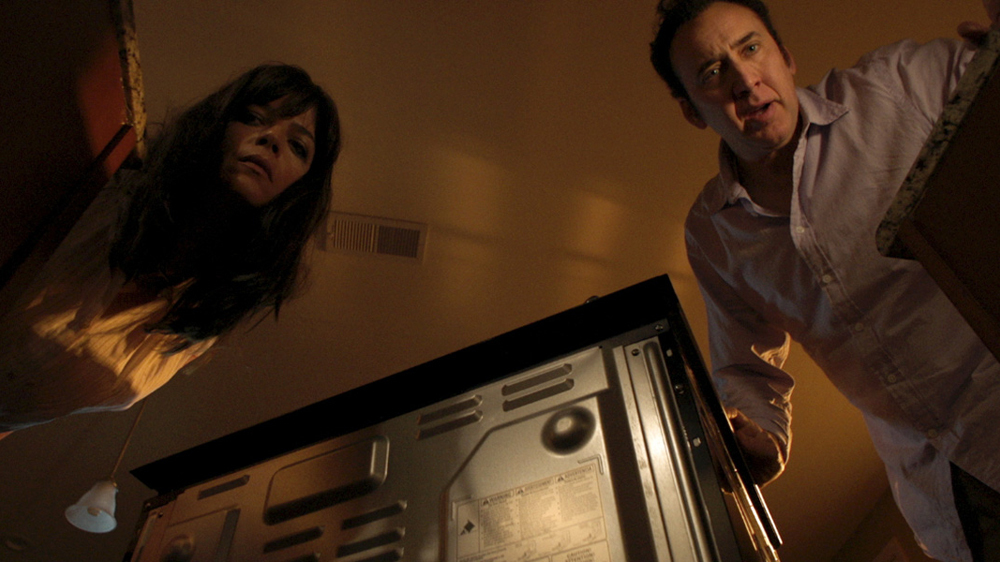
Setting: A typical day in suburban America. The Ryans are a normal family whose father, Brent (Nicolas Cage), is in the midst of a full-blown mid-life crisis, while mother Kendall (Selma Blair) feels generally unfulfilled in her role of mom and wife. High school-aged daughter Carly (Anne Winters) displays open contempt for her mother, from whom she steals money, and has a contentious relationship with her younger brother, Josh (Zackary Arthur). Brent does not approve of Carly's boyfriend, Damon (Robert T. Cunningham), due to remembering how horny he himself was during his adolescence, which only adds further fuel to the fire of Carly's distancing from her family. And on top of all of the other usual family mishegoss, Brent's parents are coming over for dinner that evening, but Carly would much rather spend time with her friend Riley (Olivia Crocicchia). But the utter mundanity of their world veers off the rails as the entire community, and perhaps the world, falls under the apparent influence of an unexplained signal transmitted by television that influences all parents to murder their children. To be specific, only  the direct offspring of the affected parents are marked for slaughter, while all others are ignored. The murderous influence kicks off during the school day as hordes of parents show up at Carly's school's gates, which they swiftly storm in homicidal pursuit of their kids. A full-on apocalypse of filicide breaks out and Carly, Damon, Riley, and Josh must fight for their lives against parents that have for no explained reason turned brutally, remorselessly savage. As the film reaches its final act, it's just the siblings and Damon trapped in the Ryan household as mom and dad become the most determined of predators. 

MOM AND DAD walks a fine line between outright TWILIGHT ZONE-style shocker and the blackest of black comedy, and as such it works quite well. All the performances are spot-on, with Selma Blair yet again proving she's one of the most believable actors around when it comes to playing people like someone we would know in real life. But the real gold here is spun by my man Nicolas Cage, who is given every possible opportunity to go as over-the-top as only he can, and this time he delivers what may be the most unhinged and literally animalistic performance in a career defined by complete and utter lack of thespic restraint. Seeing him literally howling like a rabid dog while attempting to murder his kids with power tools, a pickaxe, and a re-purposed gas oven is a delight, and he looks for all the world like he's having the time of his life while unleashed.

Nicolas Cage at perhaps his most unhinged, which is REALLY saying something.

The film's thrill factor is high and the goings-on get very visceral and nasty, especially a sequence involving Kendall's sister giving birth in a hospital and her immediate homicidal turn once the newborn is in her arms. And along with presenting the horror of the most trusted people in a child's life completely turning against them to a lethal degree, the movie also comments on the release of the pent-up frustration of the promise of one's young life being deferred by the responsibilities and commitments entered into when settling down to start a family, and over time discovering that one's family is not the hoped-for perfect nuclear unit of our dreams. It's crazy as a soup sandwich but all the more relatable for it.

My only complaint about MOM AND DAD is its abrupt ending that leaves everything unexplained, which I did not necessarily have a problem with, but also leaves the scenario unresolved. If you approach it with the knowledge that the story simply comes to a screeching halt and you're fine with that, then I say give it a look. Otherwise, you may find yourself pissed off and disappointed when all is said and done.

Poster for the theatrical release.

Thursday, October 25, 2018

31 DAYS OF HORROR 2018-Day 25: FREAKS (1932)

Aerialist Cleopatra (Olga Baclanova) reacts to Half Boy (Johnny Eck) with poorly-contained revulsion.

"We didn't lie to you, folks. We told you we had living, breathing monstrosities. You laughed at them, shuddered at them. And yet, but for the accident of birth, you might be one as they are. They did not ask to be brought into the world, but into the world they came. Their code is a law unto themselves: Offend one, and you offend them all." 
— the sideshow barker

The circus or midway sideshow has long been a surreal place of fascination and has many times been the backdrop against which scenarios of unabashed horror have played out. Director Tod Browning's FREAKS is perhaps the ur-example of the sub-genre, even some 86 years after its first screenings, but when looked at for what it actually is, calling it a "horror" film is something of a misnomer. It certainly contains plot points and imagery that are indeed horrific, but when it comes right down to it, the real meat of the story is about how families look out for one another, and woe betide them who fuck with said family. Justice is a stone-cold bitch, and few films get that point across more pointedly than this one.

The audience is taken along with a group of curiosity-seekers at a sideshow, where the sight of one of the living attractions elicits screams of abject horror from one of the onlookers. With the revulsion-inducing creature hidden from our view, the barker informs us that the horror before us now was once Cleopatra (Olga Baclanova), a beautiful trapeze artist known as "the queen of the air." The story of how Cleopatra ended up in her present sorry state is recounted in a feature-length flashback:

Cleopatra uses her womanly charms to beguile and marry Hans (Harry Earles), a dwarf who works in the same circus, and Hans is well-off thanks to a sizable inheritance. Though already engaged to the equally-diminutive Frieda (Daisy Earles), Hans is smitten by the big blonde, so he thoughtlessly casts aside the visibly heartbroken Frieda, while blinding himself to Cleopatra's interest in him being solely due to his money, plus the obvious fact that she's sexually involved with circus strong man Hercules (Henry Victor). Though she initially manages to hide her contempt for Hans and the rest of the members of the "freak" community at the circus, once the ring is on her finger, Cleopatra stands revealed as a loathsome cunt of the lowest order, completely dropping all pretense of love and openly mocking Hans and the other performers as she and Hercules continue their cavorting while simultaneously slowly poisoning Hans. The plan is to bump off Hans so Cleopatra will be the legal heir to his fortune and the illicit lovers can go their merry way with a cushion of sweet, sweet cash, but their contempt for the freaks does not allow them to account for the fact that the wronged family of freaks are not stupid — they are wise to the poisoning plot — nor are they to be trifled with, as the barker told us in no uncertain terms at the beginning of the narrative. It all comes to a head on a stormy night, with Cleopatra and Hercules squarely marked for hideous and ultra-personal retribution that they absolutely had coming...

There is no stronger force on this earth than a tight family.

Though the vengeance wreaked upon the evil lovers is certainly (and deservedly) horrible, especially for the cinema of its era, and the undeniable fact that one of the film's draws back in the days was the "thrill" of seeing "living, breathing monstrosities," to me FREAKS will always be a strong statement that no matter how bizarre it may seem to outsiders, one's family is the most important thing in the world, be they biological relatives or chosen, and they will always have your back, no matter what. I come from a highly-dysfunctional biological family, so I began piecing together a chosen family of fellow oddballs, outsiders, and outcasts, a group that has grown quite large and very tightly-enmeshed  over the decades, and I would step in front of a bullet or happily serve a prison sentence in order to protect them, so dear are they to me. That sort of love and fraternity is what FREAKS communicated to me when I needed it most, and even when I saw it for the first time, I found nothing "freakish" about the sideshow performers in its story. What I saw in them was an embodiment of a loving and involved family, and they were easily the most "normal" people on display throughout. It's Cleopatra and Hercules who are the film's monsters, shamelessly personifying so-called humanity at its ugliest, most vile, and most offensively repellent. 

For the unforgivable wrongs done, there can be no mercy nor escape...

The shames surrounding FREAKS are many, but let me cut to the most significant ones. Director Tod Browning was a talented filmmaker who had himself been a sideshow performer in various capacities during his youth, so when making FREAKS he brought a genuine understanding of and compassion for his subjects to the film, and that sympathy is quite evident. Browning made the film hot on the heels of his critical and box office success with DRACULA (1931), starring Bela Lugosi and one of the most important horror films (or films of any kind, for that matter) ever made, so when he made FREAKS, MGM was expecting a hit to rival DRACULA. What they did not expect was the very vocal public outcry over how allegedly repugnant and offensive the film was, and its upsetting of the tender sensibilities of the American moviegoing public proved to be one of the key factors pointed to when it came time for Hollywood to police itself with the instituting of the infamous Hays Code. As a result of the film's failure and immediate status as a celluloid pariah, Browning's career effectively came to a premature end, and more's the pity as the man was definitely a visionary. The other great tragedy of FREAKS is that in order to placate the torch-wielding public and hopefully see some sort of profit from its original release, the film was shorn of several scenes that reduced its running time from ninety minutes to a mere sixty-four, and that shortened re-release lost money anyway and the original full-length version is now considered lost forever. And, adding insult to injury, FREAKS was banned in the United Kingdom for over three decades, due to it being perceived as exploitative.

Now rightly hailed as a classic, FREAKS should be seen by all with an interest in film as an art form, and not just by those keen on horror cinema and its history. Even in its neutered version, FREAKS wields considerable power, and it boggles the mind that anyone at any time would ever deem it offensive or exploitative. There are few films that extol the bond that is family as effectively and as viscerally as Tod Browning's misunderstood, under-appreciated bastard child of a movie.

Poster from the original theatrical release.